
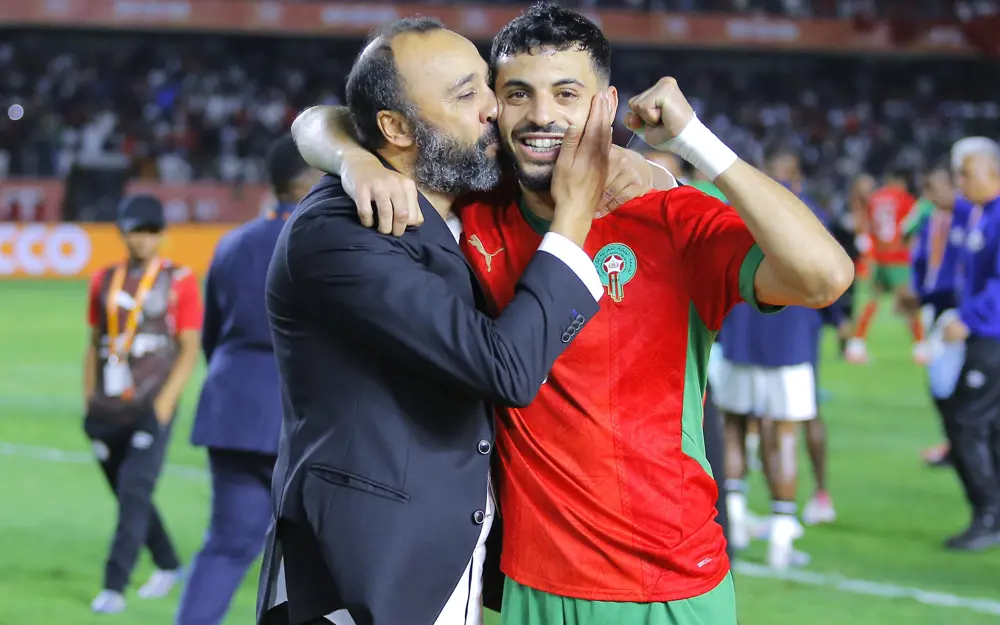
The Morocco national team’s impressive rise, highlighted by their historic 2022 FIFA World Cup semi-final run, reflects a carefully developed strategy and clear playing philosophy. Their tactics combine defensive resilience, midfield tenacity, and dynamic counterattacking.
Under head coach Walid Regragui, the Atlas Lions have developed a disciplined and effective system built on teamwork and determination. This article examines Morocco’s playing style, including formations, defensive strategies, midfield dynamics, offensive transitions, and key player roles.
Morocco’s compact defense and rapid counterattacks are designed to maximize strengths and exploit opponents’ weaknesses. This analysis will detail the strategic decisions and tactics that define the team’s success.
Walid Regragui: The Architect of Modern Morocco’s Tactics
The Moroccan national team’s transformation began with Walid Regragui’s appointment just months before the 2022 World Cup. He quickly established a clear tactical identity, uniting a talented squad into a cohesive and effective unit.
Regragui’s coaching philosophy emphasises pragmatism, teamwork, and the leveraging of player strengths. He prioritises defensive solidity as the basis for attacking play and has fostered a strong team spirit and winning mentality.
Regragui is recognised for clear communication and motivating players to exceed expectations. His tactical flexibility makes Morocco a formidable opponent, and his leadership has shaped the team’s modern tactical approach.
Regragui’s club experience, especially with Wydad AC, provided a clear vision for building a winning team. He successfully applied this vision to the national squad, achieving results quickly.
The Core Formation: Morocco’s Dominant 4-3-3 System
Morocco’s tactics centre on a consistent 4-3-3 formation, which offers both defensive stability and attacking flexibility. Under Regragui, this formation adapts fluidly to different phases of play.
In defence, it often transitions into a compact 4-5-1, with the wingers dropping deep to support the midfield. This creates a narrow block that denies opponents space through the central areas. The three central midfielders play a crucial role in shielding the defence and winning back possession.
In attack, the 4-3-3 provides width through full-backs and wingers, while the central striker and advanced midfielders create numerical advantages. This versatility suits Morocco’s technical skill and physical strength.
Consistent use of the 4-3-3 has helped players master their roles, leading to synchronised movement and effective decision-making on the pitch.
Defensive Solidity: The Foundation of Morocco’s Success
Exceptional defensive organisation is central to Morocco’s tactics. Their collective commitment to defence has been key to frustrating opponents and achieving clean sheets.
All players, from striker to goalkeeper, understand their defensive roles, ensuring no weak links. Morocco’s proactive defence often forces opponents into mistakes.
Morocco’s defensive success reflects rigorous training and tactical discipline. Emphasis on communication and positioning has made them one of the hardest teams to break down internationally.
Compact Backline and Strategic Pressing
Morocco’s compact backline leaves little space between defenders, making it difficult for opponents to penetrate. Wingers track back to form a temporary five-person midfield when defending deep.
Morocco’s pressing is strategic and triggered by specific cues. They allow opponents into certain areas before initiating a coordinated press, conserving energy and maximizing impact.
Their pressing involves multiple players closing down options at once, often forcing turnovers that launch counterattacks. Coordination between the back four and midfield is essential to this system.
The defensive unit anticipates opponents’ movements and covers for one another, reflecting extensive training and coordination.
Goalkeeping and Defensive Discipline
Goalkeeper Yassine Bounou (Bono) is vital to Morocco’s defensive strength. His presence, shot-stopping, and distribution add security, and his performances in penalty shootouts have been crucial.
The team’s defensive discipline ensures players maintain their positions, track runners, and close passing lanes, minimising gaps and limiting opponent opportunities.
The defenders are not just physically strong but also tactically intelligent, making crucial interceptions and timely tackles. They understand when to step up, when to drop back, and how to shepherd opponents away from dangerous areas. This combination of individual quality and collective discipline makes Morocco a truly formidable defensive unit.
The Midfield Engine: Control, Cover, and Transition
The midfield is the pulsating heart of Morocco’s national team tactics, serving as the crucial link between defence and attack. The three central midfielders are tasked with an immense workload, covering vast amounts of ground, winning duels, and initiating offensive plays. Their collective effort is essential for both disrupting opponent rhythms and dictating their own.
This midfield trio provides balance, offering protection to the backline while also contributing to ball progression and chance creation. Their ability to switch seamlessly between defensive duties and offensive surges is a hallmark of Morocco’s playing style. They are the engine that drives the team’s tactical approach.
The blend of defensive tenacity, technical skill, and tactical awareness within the midfield is what allows Morocco to compete against top-tier opposition. Their relentless energy and intelligent positioning enable them to control the tempo of matches and dictate the flow of play.
Key Roles and Tactical Contributions
In Walid Regragui’s 4-3-3, the midfield is typically structured with a holding midfielder (often Sofyan Amrabat) anchoring the unit, flanked by two more advanced central midfielders (such as Azzedine Ounahi and Selim Amallah). Each player has specific, yet interconnected, roles.
The holding midfielder is the primary shield for the defence, breaking up play, winning tackles, and distributing the ball simply but effectively. Sofyan Amrabat, in particular, has excelled in this role, displaying incredible stamina and tactical intelligence to dominate the central areas.
The two advanced midfielders are more box-to-box, tasked with pressing high, supporting the attack with late runs into the box, and providing creative outlets. They are crucial for carrying the ball forward, linking up with the wingers, and maintaining possession under pressure. Their energy and ability to cover ground are vital for the team’s high-intensity approach.
This dynamic interplay ensures that Morocco always has options in midfield, whether for defensive cover or for launching quick attacks. Their tactical contributions are indispensable to the team’s overall success. For an in-depth analysis, read The Midfield Engine: Key Roles and Tactical Contributions of Morocco’s Midfielders.
Ball Retention and Progression
While often lauded for their defensive solidity and counterattacking, Morocco’s midfield also plays a significant role in ball retention and progressive play. When they win possession, the midfielders are adept at keeping the ball under pressure, using quick passes and intelligent movement to evade opponent presses.
They don’t just clear the ball; they look to initiate controlled build-up play, drawing opponents out of position before launching more direct attacks. This ability to switch between direct and possession-based play makes them unpredictable and difficult to contain.
The midfielders are responsible for quickly and efficiently transitioning the ball from defence to attack. Their vision and passing range allow them to find wingers and full-backs in advanced positions, setting the stage for Morocco’s dangerous offensive transitions. This combination of defensive grit and offensive flair makes them truly stand out.
Offensive Transitions: Counterattacking Brilliance
The Morocco national team’s tactics are not solely focused on defence; they possess a potent weapon: the ability to launch devastating counterattacks. This aspect of their game is built on speed, precision, and the intelligent movement of their attacking players. When opponents commit numbers forward, Morocco is ready to punish them with swift transitions.
Their counterattacking brilliance is a direct consequence of their strong defensive foundation. By winning the ball deep in their own half, they create vast spaces for their fast attackers to exploit. This opportunistic approach has yielded many crucial goals against high-ranking opponents.
The effectiveness of their offensive transitions relies on players’ quick decision-making and their ability to execute passes and runs under pressure. It’s a thrilling display of direct football that keeps opponents constantly on edge, knowing that any mistake could be severely punished.
Speed and Precision
The hallmark of Morocco’s counterattacks is the blistering speed with which they move the ball from defence to attack. Once possession is regained, the ball is quickly released to wide players or the central striker, who then drive forward with purpose. Players like Achraf Hakimi, Hakim Ziyech, and Sofiane Boufal are instrumental in these rapid transitions.
Precision in passing is equally crucial. Long, incisive passes often bypass multiple lines of opponents, putting attackers in one-on-one situations or with space to run into. The timing of runs is also meticulously coordinated, ensuring that players are in optimal positions to receive the ball and continue the attack.
This blend of speed and precision makes Morocco’s counterattacks incredibly difficult to defend against. Opponent defenders often find themselves outnumbered or outmanoeuvred, leading to high-quality scoring opportunities. For a deeper dive into this offensive strategy, refer to Counterattacking Brilliance: Speed and Precision in Morocco’s Offensive Transitions.
Exploiting Wide Areas
The wide areas are vital to Morocco’s offensive transitions. The overlapping runs of full-backs, particularly Achraf Hakimi, combine with the wingers’ dribbling ability and creativity. This creates numerical superiority and dangerous attacking triangles down the flanks.
Hakimi’s incredible pace and attacking instincts allow him to surge forward, often acting as an auxiliary winger or even a second striker. Ziyech, on the opposite flank, provides cutting-edge crosses and creative passes, often drifting inside to link up with midfielders and the striker.
These wide players are not only outlets for counterattacks but also key providers of assists and goal-scoring threats themselves. Their ability to stretch opponent defences creates space in central areas for other players to exploit, adding another dimension to Morocco’s offensive playbook.
Key Players and Their Tactical Influence
While Walid Regragui emphasises a collective approach, the individual brilliance of certain players is undeniably crucial to executing Morocco’s national team tactics. These key individuals bring unique skill sets that enhance the team’s overall strategy and provide moments of magic that can turn the tide of a game.
Their understanding of the system, combined with their exceptional talent, allows Morocco to implement its game plan effectively against any opponent. These players are not just stars; they are tactical linchpins whose contributions are integral to the team’s success.
From defensive stalwarts to creative attackers, each key player plays a specific role that amplifies the team’s strengths and mitigates potential weaknesses. Their presence on the field elevates the entire squad’s performance and tactical execution.
Achraf Hakimi and Hakim Ziyech
Achraf Hakimi and Hakim Ziyech are arguably the two most influential attacking players in the Morocco squad, and their tactical roles are paramount. Hakimi, the marauding right-back, is a constant attacking threat with his blistering pace, incredible stamina, and ability to deliver dangerous crosses.
His partnership with Hakim Ziyech on the right flank is particularly potent. Ziyech, a technically gifted winger, often drifts inside to create passing angles and unleash his powerful left-footed shots. However, he also provides width when needed, allowing Hakimi to make overlapping runs.
This dynamic duo creates significant headaches for opponent left-backs and central defenders. Their ability to combine, interchange positions, and provide both direct threats and creative passes is central to how Morocco generates attacks, especially in transition. Their influence extends beyond mere individual skill, shaping the entire offensive structure.
Their presence allows Morocco to initiate quick breaks and maintain pressure in the final third, turning defensive solidity into offensive opportunities. Learn more about their impact in Key Players, Key Tactics: How Hakimi and Ziyech Shape Morocco’s Attack.
Other Influential Players
Beyond Hakimi and Ziyech, several other players are instrumental in executing Morocco’s tactics. Sofyan Amrabat, the defensive midfielder, is the engine room of the team. His tireless work rate, ball-winning ability, and tactical intelligence provide the essential shield for the defence and initiate many counterattacks.
Azzedine Ounahi, with his elegant dribbling and ability to carry the ball through midfield, adds a creative spark and helps break opponent lines. His composure under pressure and vision are vital for linking play.
Youssef En-Nesyri, the central striker, provides a physical presence and an aerial threat, often acting as the focal point for long balls and crosses. His tireless pressing from the front is also key to Morocco’s defensive strategy.
Romain Saïss and Nayef Aguerd form a formidable central defensive partnership, combining strength, aerial prowess, and intelligent positioning. Their leadership and organisational skills are crucial in maintaining the team’s compact defensive shape. Each of these players contributes significantly to the Moroccan national team’s coherent and effective tactics.
Tactical Adaptability and In-Match Adjustments
A hallmark of successful national teams is their ability to adapt, and the Morocco national team tactics under Walid Regragui have showcased remarkable tactical adaptability. While the 4-3-3 is their primary system, Regragui is not afraid to make in-match adjustments or tweak the game plan based on the opponent and the flow of the game.
This flexibility allows Morocco to respond effectively to different challenges, whether they are facing a possession-dominant team, a physically imposing side, or a team that presses high. Their capacity to shift gears and modify their approach is a significant strategic advantage.
The players are well-drilled in various scenarios, enabling them to transition smoothly between different tactical setups. This preparedness ensures that Morocco remains competitive and unpredictable throughout a match, often catching opponents off guard with their dynamic adjustments.
Flexibility in Formations and Approaches
While the 4-3-3 is standard, Morocco can subtly shift to a 4-1-4-1 when defending deep, with the wingers dropping back to form a five-person midfield. Against teams that overload wide areas, they might even adopt a more conservative 5-4-1, especially late in games or when protecting a lead.
In terms of approach, they can transition from a low-block, counterattacking style to a more possession-oriented game if the situation demands it. This doesn’t mean they abandon their core principles, but rather that they can vary the tempo and directness of their play.
Regragui’s willingness to make tactical substitutions that directly impact the system or introduce players with specific skill sets further demonstrates this flexibility. These changes are not just about fresh legs but often about changing the tactical dynamic of the match. Explore this further in Tactical Adaptability: How Morocco Adjusts Their Game Plan In-Match.
Responding to Opponent Tactics
A key aspect of Morocco’s tactical adaptability is its ability to analyse and respond to opponent tactics in real time. The coaching staff is adept at identifying opponents’ strengths and weaknesses, and the players are instructed on how to counter them.
For instance, against teams that build from the back, Morocco might employ a higher press to force errors. Against teams with strong wide players, they might double up on the flanks and provide extra defensive cover. This proactive approach to opponent analysis is a testament to their thorough preparation.
During matches, if an opponent’s strategy proves effective, Regragui is quick to make adjustments, whether it’s changing the pressing intensity, altering a midfielder’s positioning, or bringing on a different type of attacker. This continuous assessment and response are crucial for maintaining their competitive edge.
Set-Piece Mastery: A Hidden Weapon
In modern football, set pieces often prove to be decisive, and the national team’s tactics pay significant attention to this aspect of the game. Both offensive and defensive set-pieces are meticulously planned and rehearsed, turning what might seem like minor details into potential game-changing opportunities.
Their prowess in set-piece situations reflects the team’s overall discipline and commitment to detail. It’s an area where tactical intelligence and execution can yield significant rewards, and Morocco has demonstrated a clear advantage here.
From corners to free kicks, every dead-ball situation is approached with a specific strategy, aiming either to create a scoring chance or to neutralise an opponent’s threat. This dedicated focus adds another layer to their comprehensive tactical blueprint.
Offensive and Defensive Strategies
On the offensive side, Morocco utilises a variety of routines for corners and free kicks. They often aim for specific zones in the box, targeting their strong aerial players like Youssef En-Nesyri and Romain Saïss. Hakim Ziyech’s excellent delivery is a major asset, capable of curling the ball into dangerous areas with precision.
They also employ decoy runs and blocks to create space for their primary targets, making it difficult for opponent defenders to mark effectively. Short corners are also occasionally used to draw out defenders and create different attacking angles.
Defensively, Morocco is equally organised. They typically employ a mixed marking system, with some players assigned to zonal marking and others to man-marking key opponent threats. Their tall defenders and goalkeeper command the box, dealing decisively with aerial balls. They are also quick to clear the ball and launch counterattacks from defensive set pieces, swiftly turning defence into offence.
This dual focus on attacking and defending set pieces ensures that Morocco maximises its chances while minimising opponents’ threats, a crucial element of its overall tactical success. For more insights, check out Set-Piece Mastery: Morocco’s Strategy on Corners and Free Kicks.
The Evolution of Atlas Lions Tactics
The current sophisticated Moroccan national team tactics are not an overnight phenomenon but the result of a rich historical progression. While Walid Regragui has undeniably elevated their tactical game, the Atlas Lions have always had a flair for combining individual skill with collective effort, albeit with varying degrees of success and tactical coherence over the decades.
Historically, Moroccan football has been celebrated for its technical players and creative midfielders. However, consistency in tactical identity and defensive organisation was sometimes a challenge. Past teams often relied heavily on individual brilliance, sometimes at the expense of a cohesive team structure.
The modern era, particularly under Regragui, has seen a deliberate shift towards a more pragmatic, disciplined, and tactically robust approach. This evolution reflects a growing understanding that success at the highest level requires both individual talent and a meticulously planned collective strategy.
Historical Context and Recent Changes
In earlier eras, Morocco’s tactical approaches were often influenced by European leagues where many of their players plied their trade. There were periods of more free-flowing, attacking football, and others where defensive caution prevailed. The challenge was often to marry the individualistic brilliance of Moroccan players with a consistent team strategy.
The appointment of various coaches brought different philosophies, but few managed to create the kind of sustained tactical identity that Regragui has established. His emphasis on a strong defensive base, coupled with explosive transitions, represents a significant evolution from previous iterations of the team.
The current tactics also reflect a global trend towards more disciplined, compact defensive blocks and rapid counterattacks, especially for teams looking to upset more established footballing powers. Regragui has successfully integrated these modern principles with the inherent technical qualities of Moroccan players, creating a unique and highly effective style.
This blend of historical flair and contemporary tactical rigour defines the current era of the Atlas Lions. To understand the full journey, delve into The Evolution of Atlas Lions Tactics: A Historical Perspective.
World Cup 2022: A Tactical Masterclass
The 2022 FIFA World Cup in Qatar served as the ultimate stage for the Morocco national team’s tactics to shine. Their journey to the semi-finals was not just a fairytale but a tactical masterclass, demonstrating the effectiveness of Walid Regragui’s system against some of the world’s best teams. They became the first African and Arab nation to reach this stage, captivating audiences globally.
Morocco’s performances against Belgium, Spain, Portugal, and France were prime examples of how a disciplined, well-organised team with a clear game plan can overcome technically superior opponents. Each match presented a unique tactical challenge, and Morocco rose to the occasion every time.
Their tactical approach was consistent yet adaptable, proving that adherence to core principles combined with in-match flexibility is a recipe for success at the highest level of international football. The World Cup showcased the culmination of Regragui’s vision and the players’ unwavering commitment.
Regragui’s Masterplan in Action
Against Belgium, Morocco absorbed pressure, remained compact, and struck decisively on the counter, securing a vital 2-0 victory. This set the tone for their tournament.
The knockout stages saw Regragui’s masterplan truly tested. Against Spain, a team renowned for its possession-based football, Morocco executed a flawless defensive display. They sat deep, denied Spain space in central areas, and limited them to speculative shots. The game ended in a goalless draw, with Morocco triumphing in a penalty shootout, a testament to their mental fortitude and their goalkeeper’s heroics.
Against Portugal, another attacking powerhouse, Morocco once again showcased their defensive resilience and clinical counterattacking, scoring from a well-worked header and then defending resolutely, enduring immense pressure to secure a historic 1-0 victory.
Even in their semi-final loss to France, Morocco demonstrated their tactical prowess, creating chances and pushing the reigning champions to their limits. The World Cup 2022 campaign was a definitive statement on the efficacy of Morocco’s national team tactics and Walid Regragui’s strategic genius.
This incredible run cemented their place in football history and provided a blueprint for other nations. For a detailed breakdown of their World Cup strategy, refer to Walid Regragui’s Masterplan: Dissecting Morocco’s World Cup 2022 Tactics.
Conclusion
The Morocco national team’s tactics represent a compelling case study in modern football strategy. Under the visionary leadership of Walid Regragui, the Atlas Lions have forged a distinct and highly effective playing style built on defensive solidarity, a dynamic midfield engine, and an explosive counterattacking alliance. Their commitment to the 4-3-3 system, coupled with remarkable tactical adaptability, has enabled them to punch above their weight on the international stage consistently.
From the compact backline and strategic pressing that stifles opponents to the relentless work rate of the midfield trio, every aspect of their game is meticulously planned and executed. Key players like Achraf Hakimi and Hakim Ziyech provide the creative spark and attacking thrust, while the entire squad demonstrates unwavering discipline and collective effort.
The historic run at the 2022 FIFA World Cup was a powerful testament to the efficacy of these tactics, showcasing how a well-drilled and motivated team can overcome formidable challenges through intelligent strategy and unwavering belief. The Morocco national team has not only achieved unprecedented success but has also inspired a generation, demonstrating the power of a clear tactical vision combined with passionate execution.
As they look to the future, the core principles of their playing style are likely to remain, continuously evolving and adapting, but always rooted in the successful blueprint established by Regragui. The Atlas Lions have redefined expectations and solidified their place as a tactical force in world football.
Frequently Asked Questions About Morocco National Team Tactics
What is the primary formation used by the Moroccan national team?
The Morocco national team primarily utilises a 4-3-3 formation under coach Walid Regragui. This system provides defensive solidity and dynamic attacking transitions. It allows for a compact defensive block while also facilitating wide attacks through full-backs and wingers.
How does Morocco’s defensive strategy work?
Morocco’s defensive strategy is built on a compact backline and strategic pressing. They often form a narrow 4-5-1 shape when defending deep, denying opponents space through the centre. Their press is coordinated and triggered to trap opponents and force turnovers, rather than being high-pressure throughout. Goalkeeper Bounou also plays a crucial role in their defensive solidity.
What role do the midfielders play in Morocco’s tactics?
The midfield trio is the engine of Morocco’s tactics, responsible for control, cover, and transition. A holding midfielder (like Sofyan Amrabat) shields the defence, while two more advanced box-to-box midfielders provide defensive support, carry the ball forward, and link up with attackers. Their high work rate and tactical intelligence are vital for both disrupting opponent play and initiating attacks.
How does Morocco generate its attacking threat?
Morocco primarily generates its attacking threat through rapid offensive transitions and counterattacks. After winning possession, they quickly release the ball to fast wingers and full-backs, exploiting wide areas with speed and precision. Key players like Achraf Hakimi and Hakim Ziyech are instrumental in these swift breaks, providing crosses, dribbling, and goal-scoring opportunities.
What makes Walid Regragui’s coaching philosophy unique for Morocco?
Walid Regragui’s coaching philosophy for Morocco is characterised by pragmatism, collective effort, and strong team spirit. He emphasises defensive organisation as the foundation, believing it allows his talented players to express themselves offensively. His ability to instil discipline, adapt tactics to opponents, and motivate his squad to perform at their peak has been crucial to the team’s historic success.