
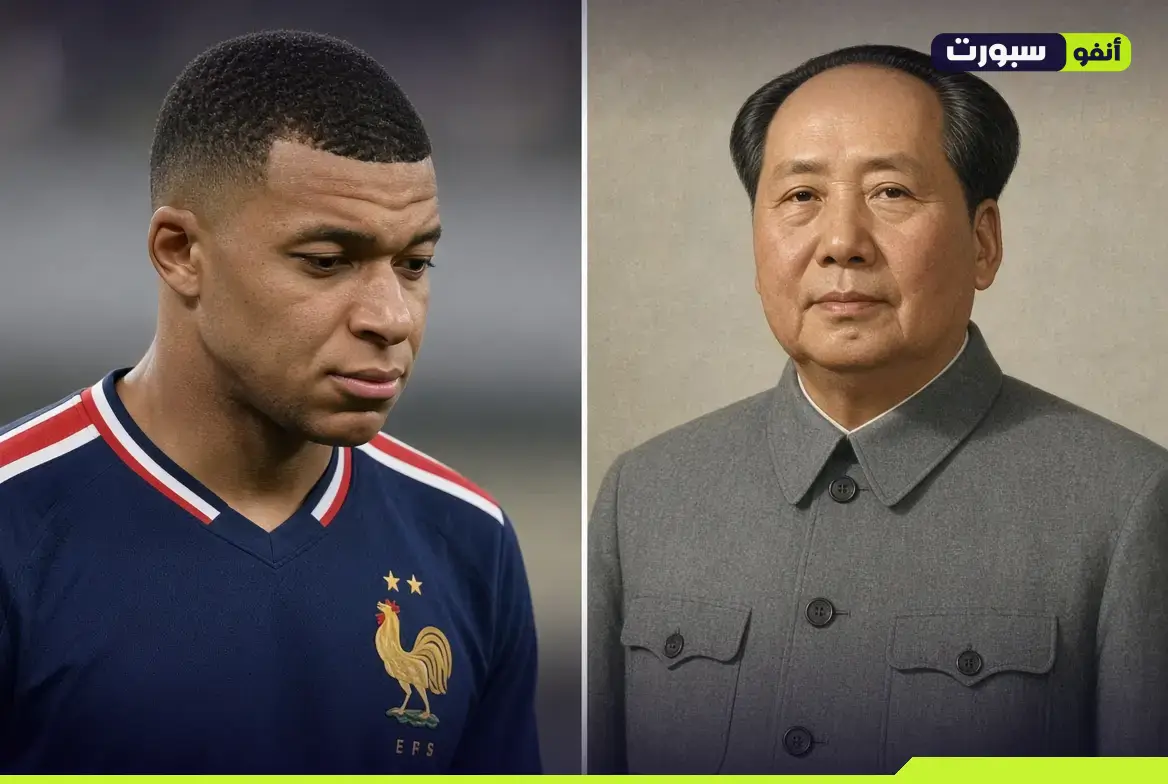
In a surprising development that caused widespread uproar, French star Kylian Mbappé, the Real Madrid forward and France captain, issued a public apology to the Chinese people and Chinese communities around the world after a video clip spread showing him commenting on a satirical meme combining his face with that of the late Chinese leader Mao Zedong, describing him as a “Chinese dictator”.
The apology came after angry reactions in China led a number of major Chinese companies (such as Dongpeng Beverages, Mengniu Dairy and Milkground) to terminate their advertising contracts with him, and the suspension of Spanish La Liga matches on official Chinese television, amid official criticism from the Chinese Foreign Ministry, which affirmed that any words that hurt the feelings of the Chinese people face collective rejection.
In an official statement published in three languages (Arabic, French and Chinese), Mbappé said: “During a recent interview, I commented on a picture of me. My comment was ill-advised, and I now realise that it caused hurt to many people in China and Chinese communities around the world. I apologise to everyone my words upset. That was not my intention at all. I have deep respect for the Chinese people and their history, and I am sincerely sorry.”
Who is Mao Zedong?
Mao Zedong (or Mao Tse-tung) is one of the most prominent political figures of the 20th century and the founder of the People’s Republic of China. He was born on 26 December 1893 in the village of Shaoshan in Hunan Province, central China, to a relatively well-off farming family, where his father was a farmer and grain merchant. He died on 9 September 1976 in Beijing at the age of 82.
Mao joined the communist movement in the 1920s and participated in founding the Chinese Communist Party in 1921. He rose to prominence as a leader during the “Long March” (1934-1935), a famous military retreat of the Red Army, and became the de facto leader of the party from 1935. After the communists’ victory in the civil war over the nationalists (Kuomintang) led by Chiang Kai-shek, he declared the establishment of the People’s Republic of China on 1 October 1949 from Tiananmen Square in Beijing, and became its first president (until 1959) and chairman of the Communist Party until his death.
To his supporters, Mao is considered the architect of modern China, as he led agricultural and industrial reforms, raised levels of education and health, and transformed China from a poor, fragmented country into an emerging power. His critics, however, point to controversial policies such as the “Great Leap Forward” (1958-1962), which led to a massive famine, and the Cultural Revolution (1966-1976), which caused widespread turmoil and significant human losses. Mao remains a sacred figure in official China, where mocking him or describing him negatively is prohibited, and he is considered a national symbol appearing on currency and official portraits.
The incident raised reminders of how sensitive historical symbols are in China and highlighted how a casual comment by a global star can affect his commercial and media relations in Asia’s largest market. Mbappé, who was previously very popular in China, now faces the challenge of regaining the trust of audiences there after this crisis.