
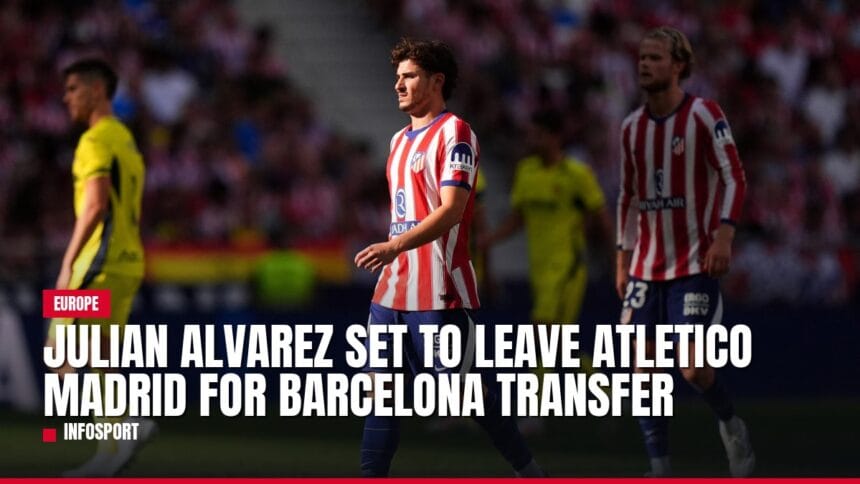
Atlético Madrid has privately authorized Julián Álvarez to pursue talks with Barcelona over a potential move, contradicting the club’s repeated public denials that any deal with their La Liga rivals would be considered. El Chiringuito TV reports that the Spanish side provided written consent to the Argentine striker, a claim journalist Jordi Jota says he has personally verified.
The private green light undermines Atlético’s public stance
Jota revealed the details of Atlético’s position during coverage of the ongoing saga. “One of the conditions that Atlético de Madrid set was that he would talk, and two, he was told, and it was written to him, that the Barça thing was okay. I saw it, and that’s why I’m so sure of what I’m saying,” the journalist stated.
The disclosure exposes a significant gap between Atlético’s hardline messaging throughout the summer and what the club communicated privately to Álvarez. While publicly insisting they would never strengthen a direct competitor, the written authorization suggests negotiations over terms and conditions for a Barcelona transfer were always theoretically possible.
Barcelona’s pivot to Jesus does not close the Álvarez door
Barcelona’s recent finalization of Gabriel Jesus from Arsenal appeared to signal an end to their pursuit of Álvarez for this window. The Catalan club had aggressively targeted the Atlético forward but ultimately concluded that completing a deal in the final stretch of the summer transfer period was unattainable.
Yet Barcelona’s hierarchy has not shelved the Álvarez interest entirely. Sources indicate the club plans to resurrect its pursuit when the January window opens, banking on a shift in financial and competitive circumstances to restart negotiations. If Atlético’s written consent genuinely exists, that January approach carries considerably more weight than a fresh attempt would otherwise suggest.
More Read

What Atlético’s hidden flexibility reveals about their negotiating position
The emergence of written authorization reframes Atlético’s transfer strategy. By granting private consent while maintaining public resistance, the club created room for a future deal without appearing to capitulate to Barcelona’s advances during an active window. The tactic provided Álvarez reassurance that his preferred destination remained attainable while allowing Atlético to reject Barcelona’s summer offers without damaging their reputation among supporters.
If the document’s existence is confirmed, it signals that Atlético always viewed a Barcelona transfer as negotiable under specific financial or timing conditions—a position starkly at odds with their external communications. For Barcelona, the implication is that January talks may encounter considerably less resistance than the summer’s impasse suggested.