Iran’s participation in the 2026 FIFA World Cup has become the most politically charged story of the tournament — before a single match is played. The row erupted on Saturday, just days before the June 11 start of the 2026 World Cup, after Iran lashed out at the United States for failing to provide visas to some of its World Cup squad support staff as the players were preparing to leave Turkey for Mexico. It is a crisis that has shaken the foundations of football’s promise to unite the world.
The situation escalated rapidly in the final days before the tournament. The Iranian embassy in Turkey posted a furious statement on X: “Why do you not say that visas were denied to a large portion of the managerial and executive staff, technical advisers, and others who are an integral part of any national football team? You have now escalated the deliberate and discriminatory treatment against Iran’s national football team to its highest level.”
Iranian news outlets confirmed that those denied visas included Iran’s football federation chief Mehdi Taj, Director Mehdi Kharati, secretary-general of the federation Hedayat Mombini, and Media Director Mohsen Motamedkia. These are not peripheral figures — they are the administrative backbone of an entire national football program.
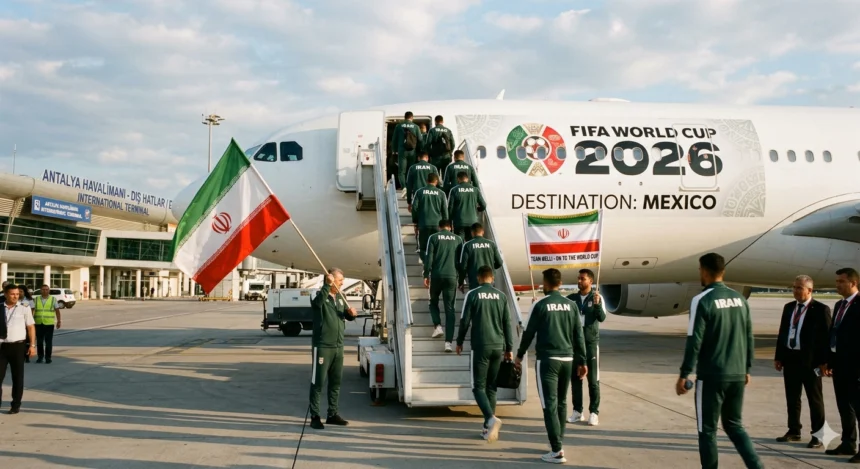
Iran’s squad departed Antalya for Tijuana, Mexico on Saturday, June 6, traveling via Spain, with staff members still without US visas continuing to press for entry while efforts to resolve the situation continued.
Context and Background
This crisis did not appear overnight. President Donald Trump signed an executive order halting visa issuance to a handful of countries, including Iran, which the US designated a “state sponsor of terrorism.” Football was supposed to be exempt — but the reality has proved far messier.
More Read

US Secretary of State Marco Rubio told lawmakers that his country would not allow Iranians with ties to the Islamic Revolutionary Guard Corps to embed themselves in the World Cup delegation — a position that has effectively created a legal gray zone around who qualifies as a protected “team member” under FIFA’s sporting exemptions.
It is the first World Cup, since its inception in 1930, in which a host nation is set to receive a country it is at war with. The US-Iran conflict, now entering its fourth month, has cast a long shadow over what was supposed to be a celebration of global sport.
Iran’s football federation fired back, saying the behavior of co-host the US “contradicts international sports laws” and that it would take the matter up with FIFA.
More Read

Reactions and Impact
FIFA has repeatedly championed the idea that football belongs to everyone and that all participating nations must enjoy equal conditions at the World Cup. Yet, as the 2026 FIFA World Cup approaches, events surrounding Iran’s national team expose the uncomfortable reality that this principle often remains little more than a slogan.
Tehran negotiated a last-minute move of the team’s base from Arizona to Tijuana in Mexico due to the visa issues and a growing feeling in Iran that the squad’s presence in the United States should be kept to a minimum.
The damage extends well beyond the squad itself. Iranian fans eager to support their team were effectively banned from entry by the United States, leaving thousands unable to attend matches in person. For a football team that qualified on pure sporting merit, it is a bitter pill to swallow.
What Comes Next?
Iran are drawn in Group G and will play New Zealand and Belgium in Los Angeles on June 15 and June 21, followed by a match against Egypt in Seattle on June 26. Every time they cross from Mexico into the United States for a match, the diplomatic tension reignites.
FIFA now faces its most uncomfortable test of this tournament: how to enforce the principle of sporting equality when a host nation is at war with a competing one. The world will be watching not just the football — but whether the institution of the World Cup itself can remain above geopolitics.
Iran’s players have earned their place. Whether the world’s most powerful host nation fully lets them play in it remains, as of today, an open and deeply troubling question.