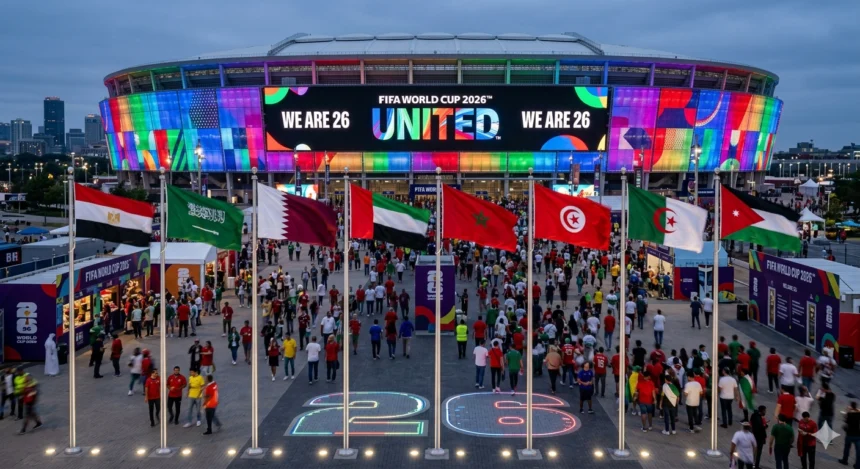
For the first time, eight Arab nations will play at a single FIFA World Cup: Morocco, Egypt, Algeria, Tunisia, Saudi Arabia, Qatar, Iraq, and Jordan. All of them will compete in the 2026 FIFA World Cup, hosted by the United States, Canada, and Mexico, with the tournament kicking off on June 11, 2026.
This record Arab presence is largely due to the World Cup’s expansion from 32 to 48 teams, which increased the number of slots for Africa (CAF) and Asia (AFC). But beyond the numbers, 2026 could be a turning point for Arab football: Morocco returns as a proven semifinalist, Egypt and Algeria bring experienced squads, while Iraq and Jordan arrive after long absences or as first‑timers.
In this article, you’ll find the complete list of the eight Arab teams, how each one qualified, their key players, realistic targets for the tournament, and the logistical challenges they face across North America.
How the 2026 World Cup expansion helped Arab teams
The 2026 FIFA World Cup is the first edition with 48 teams instead of 32. That change directly increased the number of places available to Africa and Asia:
CAF (Africa) received more direct slots, allowing more African Arab nations to qualify without relying on intercontinental play‑offs.
AFC (Asia) also gained additional direct and play‑off spots, opening the door for West Asian Arab teams that previously struggled to reach the finals.
As a result, the 2026 tournament features four African Arab teams (Morocco, Egypt, Algeria, Tunisia) and four Asian Arab teams (Saudi Arabia, Qatar, Iraq, Jordan). In recent World Cups, Arab representation was far lower: only four Arab teams qualified for both 2018 and 2022, and just one in 2010 and 2014.

The 8 Arab teams at the 2026 World Cup
Here is the full list of Arab countries playing at the 2026 FIFA World Cup:
Morocco (CAF – Africa)
Egypt (CAF – Africa)
Algeria (CAF – Africa)
Tunisia (CAF – Africa)
Saudi Arabia (AFC – Asia)
Qatar (AFC – Asia)
Iraq (AFC – Asia)
Jordan (AFC – Asia)
This is the largest Arab contingent in World Cup history and reflects both the expanded format and the growing competitiveness of Arab football at confederation level.
How each Arab team qualified
Morocco
Morocco qualified through the CAF (African) qualification pathway, building on their historic run to the 2022 World Cup semifinals in Qatar. Their squad combines experienced defenders and midfielders with attacking talents who have played in top European leagues.
More Read

Key strength: Defensive organization, tactical discipline, and big‑tournament experience.
What to expect: Morocco will be seen as the leading Arab contender, with expectations to reach at least the Round of 32 and potentially go further if they avoid a very tough group.
Egypt
Egypt returned to the World Cup finals via CAF qualification, led by star forward Mohamed Salah. The Pharaohs have been regular qualifiers in recent cycles but are still searching for a deep knockout‑stage run.
Key strength: Individual quality in attack, especially through Salah, plus a solid defensive core.
What to expect: Egypt’s minimum target will be to reach the Round of 32. Anything beyond that will depend on their group draw and ability to win tight matches.
Algeria
Algeria’s qualification marks a return to the World Cup after a 12‑year absence. The Desert Foxes, who impressed in 2014 with a Round of 16 appearance, rebuilt after missing several recent tournaments.
Key strength: Technical midfielders, pace on the wings, and experience from players in European leagues.
What to expect: Algeria will aim to replicate or exceed their 2014 performance. Reaching the knockout stage will be a realistic goal if they avoid an extremely difficult group.
Tunisia
Tunisia continues its tradition of consistent World Cup appearances, qualifying again through the CAF pathway. The Eagles of Carthage are known for disciplined defending and organized team play.
Key strength: Defensive resilience, tactical discipline, and tournament experience.
What to expect: Tunisia’s target is likely another group‑stage campaign, with hopes of progressing to the Round of 32 if results and goal difference go their way.
Saudi Arabia
Saudi Arabia qualified through the AFC (Asian) route, building on their famous 2022 victory over Argentina. The Green Falcons have invested heavily in player development and domestic league quality.
Key strength: Technical attacking play, familiarity with high‑pressure matches, and confidence from past upsets.
What to expect: Saudi Arabia will target a Round of 32 spot and will be dangerous for any team that underestimates them.
Qatar
Qatar returns to the World Cup after hosting the 2022 tournament, this time qualifying on sporting merit through AFC qualification. The hosts of 2022 have continued to develop their squad and infrastructure.
Key strength: Cohesive unit, familiarity with big tournaments, and investment in player development.
What to expect: Qatar will aim to improve on their 2022 performance, with a realistic goal of competing strongly in the group stage and pushing for a knockout berth.
Iraq
Iraq’s qualification is one of the tournament’s emotional stories: a historic return after 40 years away from the World Cup finals. Their path through AFC qualification involved overcoming significant challenges both on and off the pitch.
More Read

Key strength: Fighting spirit, passionate support, and a squad motivated by a historic opportunity.
What to expect: For Iraq, simply reaching the World Cup is already a milestone. A competitive group‑stage showing and trying to win at least one match would be a successful campaign.
Jordan
Jordan arrives as one of the biggest underdogs among the eight Arab teams, making their World Cup debut in 2026. Their qualification run captured attention across the Arab world, with key players such as Mousa Al‑Tamari and Ali Olwan leading the attack.
Key strength: Team cohesion, counter‑attacking threat, and motivation as first‑timers.
What to expect: Jordan’s primary goal will be to gain experience at this level and try to compete in every group match. Any points or wins would be considered a major achievement.
Logistics and travel: who has the hardest route?
The 2026 FIFA World Cup is spread across 16 host cities in the United States, Canada, and Mexico, including Atlanta, Dallas, Houston, Seattle, Los Angeles, Philadelphia, San Francisco, Boston, Kansas City, Miami, and New York/New Jersey.
For Arab teams, travel distances and time zones can significantly affect performance:
Algeria faces one of the toughest logistical challenges, with reports suggesting they could travel nearly 6,000 kilometres during the group stage depending on their fixtures. That kind of schedule can increase fatigue and complicate recovery.
Egypt, by contrast, may have one of the most manageable routes among Arab teams, with an estimated around 460 kilometres between some of their potential group‑stage cities (for example, between Seattle and Vancouver).
Teams with shorter travel distances and fewer time‑zone changes generally have a slight advantage in recovery and preparation between matches.
Historical context: Arab teams at previous World Cups
Arab nations have been part of the World Cup for decades, but representation was limited until recently:
In 2010 and 2014, only one Arab team qualified for each tournament.
In 2018 and 2022, that number rose to four Arab teams per edition.
In 2026, the number doubles again to eight, thanks to the expanded format.
Historically, the best Arab performances include:
Morocco’s semifinal run in 2022, the deepest ever by an Arab and African team.
Algeria’s Round of 16 appearance in 2014.
Occasional group‑stage wins and draws by Egypt, Tunisia, Saudi Arabia, and others against top opponents.
The 2026 tournament gives Arab football a chance to build on these achievements and show consistent depth across multiple nations, not just one standout team.
What would count as success for each Arab team?
Success looks different for each of the eight Arab sides:
Morocco: Reach at least the Round of 32, with ambitions to go further and confirm their status as a global contender.
Egypt: Advance from the group stage and finally secure a knockout‑stage win at a World Cup.
Algeria: Match or exceed their 2014 Round of 16 performance.
Tunisia: Progress to the Round of 32 and compete strongly in every group match.
Saudi Arabia: Reach the knockout stage and build on their reputation as a team capable of upsets.
Qatar: Improve on their 2022 showing and make a serious push for the Round of 32.
Iraq: Gain valuable experience, try to win at least one group match, and leave a positive impression on the global stage.
Jordan: Compete hard in every game, aim for points, and treat the tournament as a foundation for future campaigns.
If several of these teams reach the Round of 32 or beyond, 2026 could be remembered as the moment Arab football moved from occasional participant to a consistent force at the World Cup.
What comes next for Arab football after 2026?
The 2026 World Cup may be a turning point, but the real test will be what happens next:
Can Arab teams regularly qualify in large numbers even if formats change?
Will clubs and federations use this visibility to develop more youth talent and improve domestic leagues?
Can the success of Morocco and others inspire long‑term investment in coaching, scouting, and infrastructure?
For fans, 2026 offers a rare chance to watch eight Arab nations on football’s biggest stage, each with its own story, style, and ambitions.
FAQ: 8 Arab Teams at the 2026 World Cup
How many Arab teams are in the 2026 World Cup?
Eight Arab teams: Morocco, Egypt, Algeria, Tunisia, Saudi Arabia, Qatar, Iraq, and Jordan.
Which Arab team has the best chance in 2026?
Morocco is generally seen as the strongest Arab contender after their 2022 semifinal run, with Egypt and Algeria also considered capable of reaching the knockout stage.
Did Iraq and Jordan qualify for the 2026 World Cup?
Yes. Iraq returns after a 40‑year absence, while Jordan makes its World Cup debut in 2026.