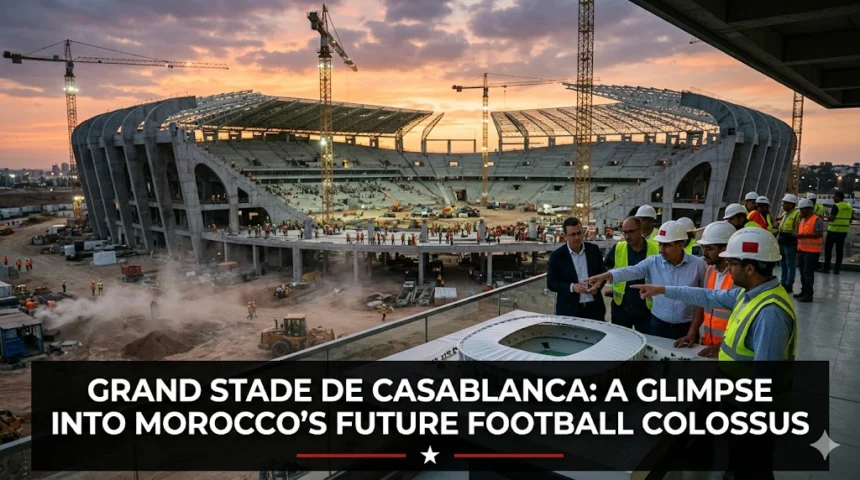
Grand Stade de Casablanca: A Glimpse of Morocco’s Future Football Giant
Morocco is poised to enter a new era in its storied footballing history with the ambitious Grand Stade de Casablanca project. This venture transcends the mere construction of another stadium—it represents a strategic effort to solidify Morocco’s position as a global sporting powerhouse, capable of hosting the world’s most prestigious events.
The Grand Stade de Casablanca will rank among the world’s largest and most advanced football stadiums, embodying the nation’s vision for the future. What distinguishes this project is its dual purpose: serving as a beacon of architectural innovation while functioning as a vibrant hub for world football. This architectural colossus marks a significant advancement in facilities for both players and supporters, meeting FIFA’s exacting standards and delivering an unparalleled experience.
The scale of this undertaking cannot be overstated. With an estimated investment exceeding $500 million, it ranks among Africa’s most ambitious stadium constructions. Notably, the design seamlessly blends cutting-edge technology with traditional Moroccan architectural elements, creating an authentically Moroccan venue that simultaneously adheres to international standards.
This project underscores Morocco’s unwavering commitment to sports infrastructure development. Driven by the nation’s passionate football culture and aspirations to host major tournaments, including the FIFA World Cup, the initiative arrives at a pivotal moment. Morocco’s historic semi-final run at the Qatar World Cup has galvanized sporting aspirations across the country, providing momentum for such ambitious endeavors.
The Grand Stade de Casablanca: A Dream Come True
Several factors have motivated the decision to advance the Grand Stade de Casablanca project, each reflecting Morocco’s dynamic growth and strategic vision for football’s future across the continent.

The timing is particularly strategic. As Casablanca establishes itself as North Africa’s economic engine, the stadium transcends its sporting function to become a symbol of urban modernization. Located in Morocco’s largest metropolitan area with over 3.3 million inhabitants, it ensures maximum accessibility and economic impact.
Matching Football’s Rising Ambitions
Moroccan football has experienced unprecedented growth in recent years. The Atlas Lions have achieved historic milestones in international competitions, generating passionate fan engagement. Yet this success has also exposed a critical need: infrastructure befitting these elevated aspirations.
The national team’s remarkable journey to the 2022 World Cup semi-finals proved transformative. Victories over traditional powerhouses Belgium, Spain, and Portugal demonstrated that Moroccan football had become a formidable competitive force. However, this success simultaneously revealed infrastructure gaps between the team’s international achievements and domestic facilities.

Existing stadiums, though historically significant, present limitations. Constrained capacity, outdated amenities, and technological deficiencies complicate the hosting of elite international competitions. The Grand Stade de Casablanca is designed to address these shortcomings.
Venues such as Stade Mohammed V carry historical significance but fall short of contemporary requirements. Constructed in 1955, it lacks modern broadcasting infrastructure, the premium facilities expected by international delegations, and safety systems mandated by current FIFA regulations. Despite these limitations, fans maintain strong emotional attachments to these traditional grounds. Consequently, the new stadium seeks to honor this heritage while embracing innovation.
This modern facility will serve as a formidable home venue for the national team while comfortably accommodating major tournaments. Beyond these functions, it symbolizes the nation’s determination not merely to participate in, but to lead and excel within, international football.
World Cup Bids and Infrastructure Requirements
Morocco’s aspiration to host the FIFA World Cup reflects its rich footballing heritage and commitment to the sport globally. The nation’s successful joint bid with Spain and Portugal for the 2030 FIFA World Cup necessitates world-class facilities.
This ambition represents a story of persistence. After unsuccessful bids to host the 1994, 1998, 2006, and 2010 tournaments, Morocco’s inclusion in the 2030 bid validates decades of football development and strategic planning. Each previous attempt yielded valuable insights regarding international expectations and infrastructure prerequisites.
FIFA and the Confederation of African Football (CAF) impose rigorous requirements on host nations: substantial stadium capacities, advanced safety systems, comprehensive media facilities, and enhanced fan experiences. The World Cup bid strategy positions the Grand Stade de Casablanca as a centerpiece that surpasses these demanding specifications, establishing new benchmarks for African stadium design.

The Architectural Wonder: Design and Innovation
The Grand Stade de Casablanca’s architectural vision masterfully integrates aesthetic and functional considerations. The design team has synthesized traditional Moroccan geometric principles with modern engineering to create something extraordinary.
The stadium’s exterior showcases intricate patterns inspired by Islamic art while incorporating eco-friendly materials and energy-efficient systems. Solar panels integrated into the roof structure will generate renewable energy, aligning with Morocco’s environmental sustainability commitments. The nation’s renewable energy initiatives, including the world’s largest solar complex in Ouarzazate, demonstrate this dedication to green technology.
What distinguishes this venue is its adaptive design philosophy. The stadium’s versatility accommodates diverse events, from intimate football matches to major cultural celebrations. This flexibility ensures long-term economic viability beyond major tournament hosting.
Economic Impact and Legacy Planning
Beyond its sporting significance, the Grand Stade de Casablanca presents substantial economic opportunities. Construction alone will generate thousands of jobs, while operations will create sustained employment in hospitality, security, maintenance, and event management.
The economic benefits extend throughout the broader economy. Increased tourism, regular events, and stimulus to local businesses—restaurants, hotels, and transport services—will all benefit from the stadium’s presence. International football matches and concerts will attract visitors from across Africa and Europe, establishing Casablanca as a major entertainment destination.
Notably, legacy planning has guided the project from inception. The stadium was designed with financial sustainability in mind, avoiding dependence on public resources. Multiple revenue streams—naming rights, corporate hospitality, retail space, and non-sporting events—will ensure long-term viability.
Technical Specifications and Modern Features
According to its technical specifications, the Grand Stade de Casablanca will rank among the world’s most advanced sports venues. Its planned capacity of approximately 93,000 will make it one of Africa’s largest stadiums, surpassing Cairo’s Borg El Arab Stadium and Johannesburg’s Soccer City.
Advanced lighting systems will comply with high-definition television broadcast standards, while state-of-the-art audio systems ensure clear communication throughout the facility. The pitch will feature the latest grass technology, employing hybrid turf systems that combine natural grass with synthetic fibers to provide optimal playing conditions year-round.
Wide concourses, multiple food and beverage outlets, and modern restroom facilities have all been designed prioritizing the fan experience. Premium areas include luxury suites, club lounges, and dedicated corporate entertaining spaces. The venue adheres to international accessibility standards, accommodating fans with disabilities.
Patriotism and Cultural Significance
The Grand Stade de Casablanca extends far beyond sports infrastructure—it represents national achievement and cultural pride. For Moroccans, football transcends entertainment, serving as a unifying force that bridges social, economic, and regional divisions.
The stadium will incorporate design elements honoring Morocco’s rich cultural heritage. Interior spaces will showcase traditional craftsmanship, while the overall aesthetic reflects the country’s position as a bridge between Africa, Europe, and the Middle East. This cultural authenticity ensures the venue feels distinctly Moroccan rather than generically international.
The project signifies Morocco’s emergence as a regional leader. While neighboring nations face various challenges, Morocco’s capacity to deliver world-class infrastructure projects demonstrates stability, vision, and execution capability extending well beyond football.
The Grand Stade de Casablanca is ultimately more than an architectural achievement—it is Morocco’s football ambitions manifest in steel, concrete, and determination. As the stadium rises, it reflects the nation’s transformation from World Cup aspirant to World Cup host, from regional participant to global competitor. When the Atlas Lions eventually grace their new home pitch, they will do so in a stadium matching their soaring ambitions and remarkable legacy.