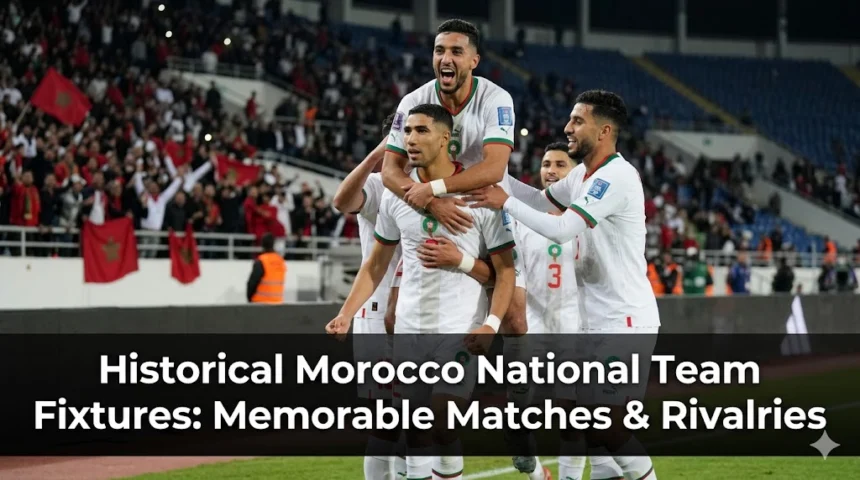
Morocco National Team Fixtures: A Historical Overview
The history of the Morocco national football team is a rich tapestry, woven with moments of triumph, heartbreak, and unwavering national pride. The Morocco national team’s historical fixtures offer a glimpse into the team’s evolution from its early days to its current status as a powerhouse in Africa and beyond. These matches stand as testament to the team’s development, the memorable contests, and fierce rivalries that have shaped Moroccan football for decades. Whether historic World Cup runs, continental triumphs, or recent global successes, the Atlas Lions have etched their name into football history.
For a comprehensive view of the team’s current performance and future challenges, explore our main page on Recent Matches and Upcoming Fixtures of the Morocco National Team.
The Early Years: Foundation and Formation
Formation and Early Games
The Moroccan national soccer team, known as the Atlas Lions, was officially established following the country’s independence in 1956. Their first international match came against Iraq on 19 October 1957, ending in a 3–3 draw. These early fixtures were instrumental in shaping the team’s identity and laying groundwork for future achievements.
Initially, Morocco competed mainly against other African and Arab nations, participating in friendly matches and regional tournaments. Such games proved crucial for building experience and developing team cohesion, preparing them for larger international competitions.
First International Competitions
Morocco’s early competitive experience included Olympic Games qualifiers and African Cup of Nations (AFCON) preliminaries. They made their continental debut in 1972, though success came gradually. These formative experiences imparted valuable lessons and helped develop their tactical approach and player progression.

Breaking Through: Early Tournament Success
The 1970 World Cup: A Continental Breakthrough
A watershed moment came during qualification for the 1970 FIFA World Cup in Mexico. Morocco became the first African country to qualify for the World Cup through a qualification process (Egypt had been invited to the 1934 tournament). This historic achievement opened doors for the entire continent.
In Mexico, facing West Germany, Peru, and Bulgaria proved challenging. While Morocco lost to West Germany (2-1) and Peru (3-0), they secured a historic 1-1 draw against Bulgaria, earning their first World Cup point. This performance demonstrated rising potential and hinted at greater things ahead.
1976 AFCON Victory: Continental Dominance
Following their World Cup appearance, Morocco reached its peak by capturing the African Cup of Nations title in Ethiopia under Romanian coach Gheorghe Mărdărescu. The Atlas Lions displayed considerable skill and composure throughout the tournament.

Using a unique round-robin final format, Morocco defeated Nigeria and Egypt while drawing with Guinea in their final group match to claim the title. This victory established them as a major African force and remains among the most cherished moments in Moroccan football history.
The Golden Generation: The 1980s
African Pioneers at the 1986 World Cup
The 1980s witnessed the emergence of a gifted generation of players who would lead Morocco to new heights. Their crowning achievement came with qualification for the 1986 FIFA World Cup in Mexico, where they made history as the first African nation to reach the knockout stages.
Drawn alongside England, Poland, and Portugal, Morocco defied expectations as underdogs. They drew goalless with both Poland and England before delivering a stunning 3-1 victory over Portugal in an inspiring display of attacking football. This group-topping finish reverberated globally, showcasing African football’s potential.
Their knockout campaign ended with a 1-0 loss to eventual finalists West Germany, though their performance against one of the world’s best teams inspired many. The tournament demonstrated that African teams belonged on football’s biggest stage.
Key Players and Tactical Innovation
Morocco’s success stemmed from tactical discipline, individual brilliance, and strong team unity. Notable figures included legendary goalkeeper Badou Zaki—who later managed the national team—and dynamic midfielders Mohammed Timoumi and Aziz Bouderbala. The team employed a well-organized defense highly effective against stronger European opponents, complemented by swift counterattacks.
The 1990s: Challenges and Consolidation
World Cup Appearances: 1994 and 1998
Morocco qualified for two World Cups during the 1990s, cementing their position as regular participants on the global stage. They competed in the 1994 World Cup in the USA and the 1998 World Cup in France, being eliminated at the group stage on both occasions, though their performances earned widespread praise.

The 1994 campaign saw Morocco lose all three matches. Their 1998 experience in France proved particularly heartbreaking. Grouped with Brazil, Norway, and Scotland, they played exhilarating football, drawing 2-2 with Norway, losing 3-0 to Brazil, and producing a magnificent 3-0 victory over Scotland. Despite this standout win, they narrowly missed knockout qualification on goal difference—a cruel conclusion to a promising campaign.
AFCON Performances: Near Misses
Throughout the 1990s, Morocco competed regularly in the African Cup of Nations without recapturing their 1976 triumph. They frequently reached the later stages but fell short in crucial matches. These experiences highlighted the competitive nature of African football, where fine margins often determine success and disappointment.
The Twenty-First Century: Mixed Fortunes
Mid-2000s to 2010s: AFCON Finalists
Morocco’s continental fortunes revived in the early 2000s. The Atlas Lions reached the 2004 African Cup of Nations final in Tunisia under Badou Zaki, displaying attractive, attacking football throughout the tournament. They eliminated powerhouses including Algeria and Mali en route to the final before losing narrowly to hosts Tunisia 2-1. Though disappointing, the run reignited faith in the team’s continental pedigree.
Rebuilding and Qualification Difficulties
Following the 2004 AFCON final, Moroccan football experienced fluctuating fortunes. The team struggled to secure consecutive World Cup qualifications and underachieved at subsequent continental tournaments. Frequent coaching changes and a search for stable squad identity characterized this period. Despite these challenges, passionate supporters remained steadfast, eager to watch their national team matches live.
The Modern Era: Renewed Hope and Global Impact
Return to the World Stage: 2018 World Cup
Morocco returned to the FIFA World Cup in 2018 in Russia, ending a 20-year absence. Under coach Hervé Renard, the Atlas Lions employed a disciplined, resilient approach. Competing against Spain, Portugal, and Iran, they demonstrated considerable courage and determination.
Results saw losses to Iran (1-0) and Portugal (1-0), but they drew 2-2 with Spain after equalizing late in the match. Though eliminated at the group stage, their performances against two European giants signaled Morocco’s resurgence as a formidable opponent.
Historic Achievement: Qatar 2022 World Cup
The most remarkable chapter in Moroccan football came at the 2022 FIFA World Cup in Qatar. Under coach Walid Regragui, Morocco captured global attention by becoming the first African and Arab nation to reach the World Cup semi-finals. This extraordinary journey resulted from tactical brilliance, unshakeable team spirit, and passionate fan support.
In the group stage, they topped a formidable group containing Belgium, Croatia, and Canada, drawing with Croatia (0-0), defeating Belgium (2-0), and beating Canada (2-1). They sensationally defeated Spain on penalties in the Round of 16 before shocking Portugal 1-0 in the quarter-finals. This historic run included a memorable Morocco vs Portugal match preview, ultimately ending with a semi-final loss to defending champions France, yet securing their place in football history.
Iconic Rivalries and Classic Encounters
Throughout its history, Morocco has developed fierce rivalries with various nations, particularly within Africa and the Arab world. These matches carry high stakes, fervent atmospheres, and unforgettable moments.
Algeria
The Morocco-Algeria rivalry ranks among African football’s most intense. Meetings between these North African neighbors overflow with emotion and national pride. Their encounters in AFCON and World Cup qualifiers produce classic contests, making them highly anticipated events on the Morocco National Team fixture calendar.
Egypt
Another major rivalry exists with Egypt, Africa’s most successful AFCON nation. Matches against the Pharaohs typically feature tactical sophistication, with both teams possessing rich footballing traditions. Such fixtures have been central to North African football history.
Tunisia
The Tunisia rivalry intensified following their 2004 AFCON final encounter. These closely contested matches showcase the competitive nature of their footballing cultures.
Other Notable Opponents
Morocco has also had memorable meetings with African powers like Nigeria, Cameroon, and Ghana, as well as European and South American sides in World Cup competitions. Each encounter enriches the team’s historical narrative.
Iconic Moments and Memorable Matches
Morocco vs West Germany (1970 World Cup)
Morocco’s inaugural World Cup match against West Germany showcased their competitive spirit. An early goal from Houmane Jarir in their 2-1 defeat demonstrated their ability to compete with elite opponents, announcing Morocco’s arrival on football’s greatest stage.
Morocco vs Portugal (1986 World Cup)
Perhaps Morocco’s most iconic victory came from their 3-1 Group Stage triumph over Portugal at the 1986 World Cup. Goals from Abderrazak Khairi (2) and Abdelkrim Merry powered them to group-topping success that defied expectations. This match frequently resurfaces in discussions about Moroccan football’s past glories and recent developments.
Morocco vs Scotland (1998 World Cup)
A commanding 3-0 Group Stage victory over Scotland featured goals from Salaheddine Bassir (2) and Abdeljalil Hadda. Though this masterclass performance remains memorable, Morocco’s subsequent group-stage elimination on goal difference deepened the legend of this talented squad.
Spain vs Morocco (2022 World Cup Round of 16)
The Round of 16 encounter with Spain exemplified tactical excellence. Following a goalless draw, Morocco prevailed 3-0 on penalties, with goalkeeper Yassine Bounou emerging as the decisive factor. This victory sparked nationwide celebration and marked a defining moment in their historic tournament run.
Morocco vs Portugal (2022 World Cup Quarter-Final)
Morocco’s quarter-final victory over Portugal represented another stunning upset, sending them to their first-ever World Cup semi-final and making them the first African and Arab nation to reach this stage. Youssef En-Nesyri’s decisive header secured a 1-0 win, cementing this match among their greatest achievements.
Development of Moroccan Football
Coaching Philosophy and Player Development
Over the years, the Moroccan national team has embraced varying coaching philosophies, from defensive solidity to expansive attacking football. Investment in local talent development through academies, coupled with recruitment of Moroccan diaspora players, has proven vital. The team’s success stems from balanced integration of homegrown and internationally-based talent.
Diaspora Players’ Contribution
Players of Moroccan descent—born and raised in Europe, particularly the Netherlands, France, and Belgium—have significantly shaped the team’s evolution. Exposure to top European leagues and advanced training methodologies has elevated squad quality and professionalism, substantially enhancing their global competitiveness.
Home Support and Atmosphere
Moroccan supporters are renowned for passionate, vociferous backing both domestically and abroad. The atmosphere generated by “Ultras” and fan groups creates a crucial home advantage, inspiring players and unsettling opponents. This consistent support forms a cornerstone of Morocco national team history.
Future Prospects: Building on a Strong Foundation
Translating Success Into Sustained Achievement
Morocco’s extensive history serves both as a source of pride and a benchmark for future ambitions. The achievements of recent generations, particularly the 2022 World Cup semi-finalists, have elevated expectations. The current squad, featuring Achraf Hakimi, Hakim Ziyech, and Yassine Bounou, seeks to extend this legacy in upcoming competitions, including Morocco National Team Fixtures 2024: Full Schedule & Match Dates.
The historical record of Moroccan national team performances speaks to resilience, talent, and national spirit. With upcoming friendlies and competitive fixtures ahead, the lessons learned and victories achieved will undoubtedly serve as foundations for future generations of Atlas Lions.
Frequently Asked Questions
What was Morocco’s first major international achievement?
Morocco’s inaugural major achievement occurred when they qualified for the 1970 FIFA World Cup, becoming the first African nation to achieve this through qualification. They subsequently won the African Cup of Nations in 1976.
How many times has Morocco reached the World Cup knockout stages?
Morocco became the first African nation to reach the World Cup knockout stages in 1986. They topped their group before narrowly losing to West Germany in the Round of 16.
Who are the most iconic players in Morocco’s history?
Iconic figures include Badou Zaki, Mohammed Timoumi, and Aziz Bouderbala from the 1980s era, alongside more recent stars such as Mustapha Hadji, Noureddine Naybet, Hakim Ziyech, Achraf Hakimi, and Yassine Bounou.
What is Morocco’s best African Cup of Nations performance?
Morocco’s highest continental achievement was winning the African Cup of Nations in 1976. They also reached the final in 2004.
When did Morocco reach the World Cup semi-finals?
Morocco made history in 2022 by becoming the first African and Arab nation to reach the semi-finals of the FIFA World Cup.