
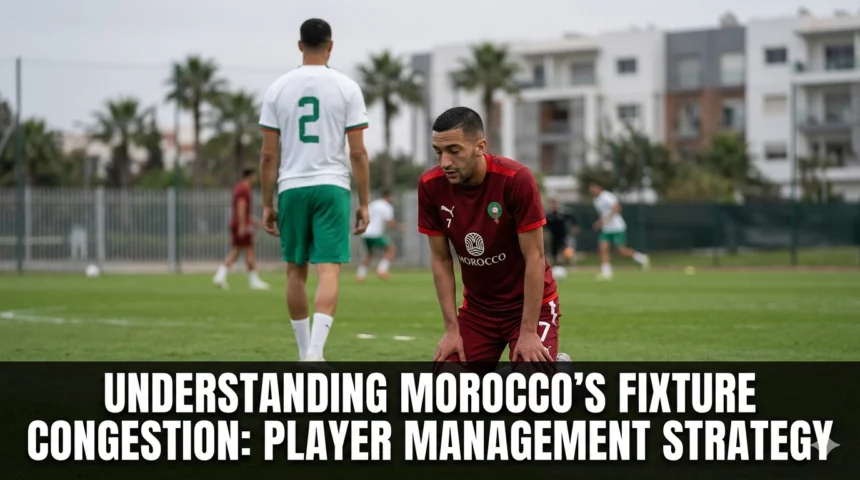
Modern elite football leaves little room for rest. For Morocco, the demands are even greater: many of their key players compete in top European leagues, then travel to join the national team for AFCON qualifiers, World Cup qualifiers, friendlies, and major tournaments. This constant cycle of club matches, international duty, and long‑haul travel creates fixture congestion and raises the risk of fatigue, injury, and burnout.
This article explains how Morocco’s national team manages player workload under pressure: the rotation policies, sports science methods, and tactical choices that help Walid Regragui keep his squad fit and competitive throughout the season.
Why fixture congestion is especially tough for Morocco
Fixture congestion happens when players face many matches in a short time across multiple competitions, with limited recovery between them. For Morocco, several factors make this worse than for many other national teams.
Club commitments in Europe
Most of Morocco’s core players are based in top European leagues:
Weekly domestic league matches
Domestic cups
Continental competitions such as the UEFA Champions League and Europa League
These players are often key figures for their clubs, meaning they rarely get “easy” weeks with reduced minutes. When an international window arrives, they must immediately switch from club rhythms to national team tactics and travel schedules.
International schedule: AFCON, World Cup qualifiers, friendlies
Morocco’s calendar regularly includes:
Africa Cup of Nations (AFCON) qualifiers and tournaments
FIFA World Cup qualifiers
International friendlies used to test tactics and integrate new players
Each block of matches matters: qualifiers decide tournament participation, while friendlies help the coach experiment without official pressure. But together, they create a near‑continuous cycle of call‑ups, travel, and matches.
Travel, time zones, and climate
Moroccan players are scattered across Europe, from Spain and France to Germany, the Netherlands, and beyond. Joining the national squad often means:
Long flights to Morocco or to African/Asian away venues
Significant time zone changes
Different climates and altitudes
These factors disrupt sleep patterns, recovery routines, and training consistency. Managing them properly is essential to reduce fatigue and injury risk.
How fixture congestion affects players
The impact of a packed schedule shows up in three main areas: physical health, mental state, and on‑field performance.
Physical fatigue and injury risk
Repeated matches without enough rest increase:
Muscle fatigue
Risk of strains, knocks, and overuse injuries
Longer recovery times between games
When key players get injured during international windows, it affects both the national team and their clubs, creating tension around call‑ups and minutes played.
Mental fatigue and burnout
Elite players face constant pressure to perform for club and country. Add frequent travel, media attention, and limited personal time, and the mental load becomes heavy. Signs of mental fatigue include:
Reduced motivation
Higher stress levels
Difficulty concentrating during matches and training
Without proper support, this can lead to burnout, where players feel emotionally and mentally exhausted.
Performance decline
Fatigue, whether physical or mental, affects performance:
Slower decision‑making
Reduced sprint capacity and agility
More technical errors
In tight qualifiers or tournament matches, even small drops in sharpness can change results.
Morocco’s strategies to manage player workload
To cope with these challenges, Morocco uses a multi‑layered approach that combines squad planning, sports science, and tactical choices.
1. Strategic squad rotation
Walid Regragui benefits from a deep squad, which allows him to rotate players without a huge drop in quality. Rotation is used in several ways:
Resting key players in less critical matches (e.g., some friendlies or easier qualifiers)
Giving minutes to squad players and emerging talents to build depth
Avoiding overuse of a small core of stars across every window
Players like Achraf Hakimi, Sofyan Amrabat, and Azzedine Ounahi are vital for Morocco, but they are not automatically started in every match. In congested periods, some may:
Start on the bench
Play fewer minutes
Be substituted earlier
This spreads the physical load and reduces the chance that one or two players carry the entire burden.
2. Individualized training and recovery plans
Not all players have the same workload or recovery needs. Morocco’s sports science staff designs customized programmes based on:
Recent club minutes and competition intensity
Travel distance and time zone changes
Any existing niggles or injury history
These plans may include:
Active recovery sessions (light cycling, pool work, mobility drills)
Targeted strength and conditioning to address weak points
Extra rest days for players arriving with high fatigue markers
The goal is not only to prepare for the next match, but to protect players’ long‑term health and career longevity.
3. Medical and performance monitoring
Morocco’s medical team uses data to guide decisions:
GPS trackers and wearables during training to monitor load
Regular checks of heart rate, sleep quality, and perceived fatigue
Blood tests and other physiological markers when needed
This information helps staff answer questions like:
Is this player ready for full training or should his load be reduced?
Is there an early warning sign of injury risk?
Does this player need extra recovery time before the next match?
Decisions on starting lineups and substitutions are increasingly informed by this data, not just by tactical preference.
4. Coordination with clubs
Effective player management requires cooperation between:
The national team’s coaching and medical staff
The players’ club coaches and medical teams
Through regular communication, both sides share information on:
Current fitness and any minor injuries
Training loads in the weeks before international duty
Agreed plans for a player’s minutes and recovery
This collaboration helps avoid situations where a player is pushed too hard by one side while the other is unaware.
5. Tactical adjustments to conserve energy
Coaching choices on the pitch also help manage workload:
Against weaker opponents, Morocco may:
Control possession to reduce high‑intensity pressing
Use a more compact defensive shape to limit chasing
In matches with quick turnarounds, the coach may:
Make earlier substitutions to rest key legs
Shift formations to reduce individual defensive or attacking burdens
These adjustments don’t mean playing passively; they mean playing intelligently to balance results and player welfare.
6. Psychological support
Mental fatigue is as important as physical fatigue. Morocco’s setup includes:
Access to sports psychologists
Team‑building activities to strengthen group cohesion
A culture where players can discuss stress, pressure, or personal issues
During long tournaments like AFCON, maintaining mental freshness is crucial. A supported, cohesive squad copes better with setbacks, travel, and pressure moments.
How Morocco has handled congested periods in practice
After the 2022 World Cup
Morocco’s historic run to the 2022 World Cup semifinals left many players emotionally and physically drained. They returned to their clubs with minimal rest and immediately faced:
Demanding league schedules
Continental competitions
Continued media attention and public expectations
The national team staff had to:
Reintegrate exhausted players carefully
Manage the emotional aftermath of the tournament
Plan friendly matches and training camps with recovery in mind
Rather than pushing immediately into another intense cycle, the focus was on gradual reintegration and avoiding early burnout.
During AFCON campaigns
Tournaments like AFCON compress many high‑stakes matches into a few weeks, often in challenging climates. For Morocco, this means:
Strict recovery protocols between games (nutrition, hydration, sleep, light training)
Careful rotation in the group stage when possible
Tactical flexibility to adapt to opponents without overexerting the squad
Even when results have not matched expectations, the ability to maintain physical intensity throughout the tournament reflects solid preparation and in‑tournament management.
Across World Cup qualifying windows
World Cup qualifiers are spread over multiple international breaks, sometimes across a year or more. This “marathon” format requires:
Balancing the need for points in each window with long‑term squad health
Monitoring players’ club form and fatigue before each call‑up
Using the full squad, not just the usual starters, to keep everyone fresh
Having a large, versatile group allows Regragui to absorb injuries and fatigue without a major drop in competitiveness.
The coaching staff’s role in player welfare
Walid Regragui’s philosophy goes beyond tactics; it shapes how player welfare is prioritized.
Regragui’s approach
Regragui emphasizes:
A strong collective over reliance on individual stars
Squad depth and mental resilience
A “family” atmosphere where players feel supported
He shows willingness to:
Rotate his lineup based on form and fatigue
Trust younger or less‑used players in certain matches
Rest key names when the situation allows
This progressive approach helps ensure Morocco’s success does not depend on a handful of players being available and fit at all times.
Building a resilient team
The coaching staff works on:
Interpersonal relationships within the squad
A culture of mutual support and accountability
A winning mentality that helps players push through difficult periods
Strong team spirit can partly offset the negative effects of fixture congestion, as players feel they are part of a shared mission rather than just enduring a busy schedule.
Looking ahead: sustaining success under pressure
As Morocco cements its status as a global football power, the demands on its players will only increase. To stay competitive, the federation must continue evolving its player management approach.
Long‑term planning
Sustainable success requires:
Identifying promising young talents early
Integrating them gradually into the senior squad
Managing their minutes and development to avoid early overuse
This ensures a steady pipeline of players ready for international football without burning out too soon.
Balancing results and health
The core challenge remains: how to win now while protecting players’ futures. This means:
Ongoing investment in sports science and medical infrastructure
Open communication between federation, clubs, and players
A culture that treats player welfare as a priority, not an afterthought
If Morocco maintains this balance, it can remain competitive across multiple tournaments without sacrificing the health and careers of its key players.
FAQ: Morocco’s Player Workload and Fixture Congestion
What is fixture congestion?
Fixture congestion occurs when players face many matches in a short period across multiple competitions (league, cups, continental tournaments, international duty), with limited time for rest and recovery.
Why is managing Morocco’s players especially challenging?
Many Moroccan stars play in demanding European leagues, then travel long distances for AFCON and World Cup qualifiers, often across different time zones and climates. This combination increases physical and mental strain.
How does Morocco rotate its squad?
Coach Walid Regragui uses rotation to rest key players in less critical matches, give minutes to squad players, and avoid overusing a small core of stars. This helps spread the workload and reduce injury risk.
What role does sports science play?
Morocco’s medical and performance staff monitor training load, sleep, fatigue markers, and injury risk using GPS, wearables, and medical tests. This data guides decisions on training intensity, playing time, and recovery protocols.