
The ‘What Ifs’: Analyzing Morocco’s Near Misses and World Cup Performance Setbacks
The narrative of Morocco’s FIFA World Cup Campaigns and Performance is one of immense passion, occasional brilliance, and often, the agonizing sting of “what if.” From their debut in 1970 to their historic run in 2022, the Atlas Lions have consistently demonstrated flashes of world-class talent and tactical acumen. However, their journey has also been punctuated by numerous near misses and setbacks that have shaped their story on football’s grandest stage. This article examines these pivotal moments, exploring the factors that contributed to heartbreaks and the lessons learned that ultimately paved the way for future achievements.
Early Campaigns: Seeds of Potential and Missed Opportunities
Morocco’s initial World Cup forays were marked by raw talent and the steep learning curve of international football. Though these early campaigns didn’t always yield deep tournament runs, they laid the groundwork for future generations and highlighted the potential within Moroccan football. For more context on these appearances, explore The Dawn of an Era: Morocco’s Debut and Early World Cup Campaigns.
The Inaugural Journey: Mexico 1970
In 1970, Morocco made history by becoming the first African nation to qualify for the FIFA World Cup since Egypt in 1934. Placed in Group 4 alongside West Germany, Peru, and Bulgaria, their debut proved challenging from the start. Despite losing all three matches, their performance against West Germany showcased resilience. They took a surprising lead through Houmane Jarir before eventually succumbing 2-1 to the formidable German side. Though brief, this tournament experience was invaluable, demonstrating that Moroccan football could compete on the world stage.
A Historic Group Stage: Mexico 1986
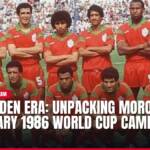
Sixteen years later, Morocco returned to Mexico and etched their name deeper into World Cup lore. Grouped with England, Poland, and Portugal, the Atlas Lions defied expectations. They secured draws against Poland (0-0) and England (0-0), showcasing disciplined defending and tactical maturity. The climax came in their final match against Portugal, where they delivered a stunning 3-1 victory, with goals from Abderrazak Khairi (twice) and Abdelkrim Merry “Krimau.” This victory meant Morocco topped their group, becoming the first African team to reach the knockout stages of a FIFA World Cup.
Their tournament ended in the Round of 16 against West Germany, where a late Lothar Matthäus free-kick secured a 1-0 victory for the Germans. While reaching the Round of 16 felt within reach, the narrow exit left lingering questions about how far they might have progressed. Nevertheless, their 1986 campaign represented a monumental achievement and a moment of national pride.

The 1990s: A Period of Frustration and Close Calls
The 1990s proved a rollercoaster for Morocco, marked by strong qualification campaigns yet heartbreaking group stage exits. The team consistently fielded capable squads, but circumstances often seemed to conspire against them.
Italy 1990: Qualification Heartbreak
After their 1986 success, expectations were high for Morocco to qualify for Italy 1990. They advanced through the initial qualification rounds confidently, setting up a decisive two-legged play-off against Cameroon. The first leg at home ended goalless, setting the stage for a tense return in Yaoundé. In a closely contested match, Cameroon emerged victorious with a 2-0 win, denying Morocco consecutive World Cup appearances. This near miss was particularly painful for a team that had shown such promise just four years earlier.
USA 1994: The “Group of Death” and Unfulfilled Promise
Morocco successfully qualified for USA 1994, only to draw Belgium, Saudi Arabia, and the Netherlands—widely considered the tournament’s most challenging group. The Atlas Lions found themselves in an unenviable position and lost all three matches. The 1-0 defeat to Belgium and 2-1 loss to Saudi Arabia proved particularly frustrating, as Morocco often played attractive football but lacked clinical finishing. This campaign highlighted a recurring pattern: their ability to compete with top teams, but failure to convert promising opportunities into wins.

France 1998: The Agony of the Final Match
The 1998 World Cup stands as one of Morocco’s most agonizing moments. Drawn in Group A with Brazil, Norway, and Scotland, they had a seemingly navigable path. They opened with a hard-fought 2-2 draw against Norway, demonstrating attacking capability. A 3-0 defeat to a star-studded Brazil side was a setback, but their commanding 3-0 victory over Scotland in the final group match left them on the brink of qualification.
Morocco finished with four points, level with Norway. Qualification hinged on the Brazil vs. Norway result—they needed Brazil to win or draw. In a stunning turn, Norway pulled off a late 2-1 victory, courtesy of a controversial penalty. This result snatched second place from Morocco on goal difference, sending the Atlas Lions home. The players and fans felt cruelly robbed, viewing this setback as bad luck impacting their World Cup aspirations.
The Long Wait: Absence and Missed Qualifications
Following 1998’s heartbreak, Morocco entered a 20-year period without World Cup qualification, failing to advance for four consecutive tournaments. This extended absence represented a significant setback for the nation’s footballing ambitions and underscored the fierce competition within African qualifiers.
Near Misses in Qualifiers (2002, 2006, 2010, 2014)
The early 2000s and 2010s saw Morocco consistently fall short in World Cup qualification’s final stages.
* **2002:** Morocco finished second in their group behind Senegal, missing out on a Japan/South Korea spot.
* **2006:** They finished second again, this time behind Tunisia. A 2-2 draw with Tunisia proved a particularly painful missed opportunity.
* **2010:** Morocco’s South Africa campaign proved largely disappointing, finishing bottom of their final qualification group.
* **2014:** The team showed improvement but ultimately finished second to Ivory Coast, failing to progress to the final play-off round.
These consistent qualification shortfalls, often by narrow margins, highlighted systemic issues within Moroccan football during this period and interrupted the continuity necessary for sustained development.
The Impact of Setbacks
The prolonged absence had tangible consequences. A generation of talented Moroccan players missed opportunities to showcase their abilities on football’s biggest stage, and the national team lost invaluable experience that major tournaments alone can provide. This period of frustration among fans intensified pressure on the football federation to implement reforms and strategic changes.

Return to the Global Stage: Russia 2018 – A Resilient Performance Despite Early Exit
After a 20-year absence, Morocco finally qualified for the FIFA World Cup in Russia 2018, igniting national excitement. Their return, however, presented another challenging draw that tested their resilience.
The “Group of Death” Again
Drawn into Group B alongside European champions Portugal, 2010 World Cup winners Spain, and Iran, Morocco faced another formidable grouping. The draw immediately raised questions about their progression chances, but the team, under coach Hervé Renard, remained determined to defy expectations.
Promising Displays, Unlucky Outcomes
Morocco’s performances showcased strong tactical discipline, fluid attacking play, and determination. In their opening match against Iran, they dominated possession and created numerous chances but were undone by an unfortunate own goal in the dying minutes, losing 1-0.
Against Portugal, Morocco delivered an impressive display, pushing Cristiano Ronaldo’s side to their limits. Despite creating clear-cut opportunities, they fell to an early Ronaldo header, losing 1-0. The match exemplified their attacking intent and defensive solidity, though a lack of clinical finishing and questionable refereeing decisions frustrated players and fans alike.
Their final group match against Spain, already eliminated, saw Morocco play with freedom and flair. They twice took the lead against the 2010 champions, with goals from Khalid Boutaïb and Youssef En-Nesyri. However, a late, controversial equalizer from Iago Aspas, awarded after VAR review, resulted in a 2-2 draw. While a point against Spain was commendable, it wasn’t enough to progress. The team exited without a win, despite arguably being one of the tournament’s most impressive bottom-placed finishers—a testament to their improved performances, yet a cruel reminder of how narrow the margins truly are.
Qatar 2022: The Pinnacle, Yet What Could Have Been?
The 2022 FIFA World Cup in Qatar marked an unprecedented chapter in Morocco’s footballing history. Under coach Walid Regragui, the Atlas Lions embarked on a fairytale run that captivated millions globally. While achieving historic milestones, even this incredible journey contained “what if” moments, particularly in later stages. For a full analysis, see Morocco’s 2022 World Cup Performance Analysis.
A Historic Semi-Final Run: Overcoming Expectations
Morocco’s path to the semi-finals was nothing short of miraculous. They topped their group featuring Croatia, Belgium, and Canada, defeating Belgium 2-0 and Canada 2-1, with a goalless draw against eventual finalists Croatia. Knockout clashes followed where they continued defying expectations.
* **Round of 16 vs. Spain:** A disciplined defensive display and heroic penalty shootout performance by goalkeeper Yassine Bounou saw Morocco eliminate Spain.
* **Quarter-finals vs. Portugal:** Youssef En-Nesyri’s header secured a famous 1-0 victory, making Morocco the first African and Arab nation to reach the World Cup semi-finals.
These victories reflected unbreakable team spirit, tactical brilliance, and passionate fan support, elevating their tournament performances to unprecedented heights.
The Semi-Final Challenge: Tactical Battles and Missed Chances
Facing defending champions France in the semi-final, Morocco encountered a tense match. France took an early lead through Theo Hernandez, but Morocco responded with courage and skill, dominating possession for extended periods and creating several dangerous opportunities. Jawad El Yamiq’s acrobatic overhead kick struck the post, showcasing their determination and attacking intent.
However, a combination of resolute French defending, clinical finishing by Randal Kolo Muani for France’s second goal, and perhaps accumulated fatigue meant Morocco couldn’t find the equalizer. The 2-0 defeat ended their final dream, though it reflected their effort and belief throughout. The “what if” centers on those missed opportunities and the early goal conceded, questioning how a different start might have altered this pivotal match’s outcome.
The Bronze Medal Match: Fatigue and Resilience
Just days after their emotionally and physically demanding semi-final, Morocco faced Croatia in the third-place play-off. Despite injuries and considerable fatigue, they fought valiantly but lost 2-1. The team’s unbroken spirit remained evident, and they left Qatar having achieved something truly extraordinary. While the bronze medal would have provided a fitting conclusion, the exhaustion following such an intense tournament meant the final push remained just beyond reach.
Analyzing Common Themes in Morocco’s World Cup Setbacks
Looking across Morocco’s World Cup history, several recurring themes emerge that have contributed to their near misses and setbacks. Understanding these patterns illuminates the evolution of The Evolution of Morocco’s World Cup Performance.
Tough Group Draws
Time and again, Morocco has faced challenging groups, often labeled “Groups of Death.” In 1994, 2018, and even their 1970 debut, they encountered multiple footballing powers. While difficult draws test a team’s mettle, they also significantly reduce the margin for error, making progression an uphill battle from the outset.
Crucial Moments and Clinical Finishing
A consistent pattern across several campaigns has been the inability to convert promising opportunities into goals at critical junctures. Whether in 1994, 1998, or 2018, Morocco often played attractive football and created chances but lacked the clinical edge necessary against top-tier opposition. This became less pronounced in 2022 but still played a role in their semi-final performance.
Qualification Hurdles
The African qualification process for the World Cup remains notoriously challenging, involving extensive travel, varying playing conditions, and intense competition. Morocco’s 20-year absence between 1998 and 2018 underscores how difficult simply reaching the tournament can be.
The Weight of Expectation
As a prominent footballing nation in Africa and the Arab world, Morocco carries the hopes of a vast fanbase. This can translate into immense pressure during crucial matches, potentially affecting individual and team performance.
Refereeing Decisions
While not solely responsible for setbacks, controversial refereeing decisions have occasionally influenced Morocco’s World Cup disappointments, notably in 1998 against Norway and in 2018 against Spain and Portugal, adding to frustrations surrounding their performances.
The Evolution and Future Outlook
Despite setbacks and “what ifs,” Morocco’s World Cup journey ultimately tells a story of resilience, growth, and increasing ambition. The experiences—both triumphant and disappointing—have forged a stronger national team and contributed to football’s development within the country. To learn more about this impact, read Beyond the Pitch: How World Cup Success Transformed Moroccan Football.
Learning from the Past
Each near miss and early exit has provided invaluable lessons. The tactical discipline of 1986, the attacking flair of 1998, and the resilience of 2018 all informed the comprehensive approach adopted in 2022. Focusing on developing local talent, integrating diaspora players, and investing in coaching infrastructure proved crucial. The emergence of Moroccan World Cup Legends: Top Players Who Shined on the Global Stage has also inspired new generations.
Building on Recent Success
The historic semi-final achievement in Qatar 2022 represents not merely a peak but a new benchmark for Moroccan ambition. It has instilled belief that they belong among the world’s elite. The challenge ahead involves maintaining this momentum, consistently qualifying for major tournaments, and building on the tactical innovations and team spirit that defined their 2022 campaign. Focus will remain on refining Tactical Masterclasses and Coaching Strategies: Morocco’s World Cup Approaches for sustained success.
The “what ifs” will forever remain part of Morocco’s rich World Cup history, adding drama and emotion to their narrative. Yet these near misses have served as powerful motivators, pushing them to achieve the extraordinary. The future looks brighter than ever, with Morocco now recognized as a formidable force on the global stage, ready to transform past frustrations into future triumphs. For a comprehensive overview, refer to Morocco’s Complete FIFA World Cup History: Every Campaign Explored.
FAQ
What is Morocco’s best World Cup performance to date?
Morocco’s best World Cup performance was in 2022, when they became the first African and Arab nation to reach the semi-finals of the tournament. They finished in fourth place overall, an unprecedented achievement.
Which World Cups has Morocco qualified for?
Morocco has qualified for the FIFA World Cup six times: 1970, 1986, 1994, 1998, 2018, and 2022. Each appearance has added a unique chapter to their footballing history.
What was the biggest “near miss” for Morocco in a World Cup group stage?
The biggest “near miss” was arguably in the 1998 World Cup. Morocco secured four points in their group, including a 3-0 win over Scotland, but were eliminated on goal difference after Norway controversially defeated Brazil in the final group match, preventing them from advancing.
How did Morocco perform in the 1986 World Cup?
In the 1986 World Cup, Morocco made history by becoming the first African nation to top their group and reach the knockout stages. They drew with England and Poland and famously defeated Portugal 3-1, before losing narrowly to West Germany in the Round of 16.
What challenges has Morocco faced in World Cup qualification?
Morocco has faced significant challenges in World Cup qualification, including tough group draws in the African qualifiers, inconsistent team performances in the early 2000s, and fierce competition from other strong African nations. This led to a 20-year absence from the tournament between 1998 and 2018.