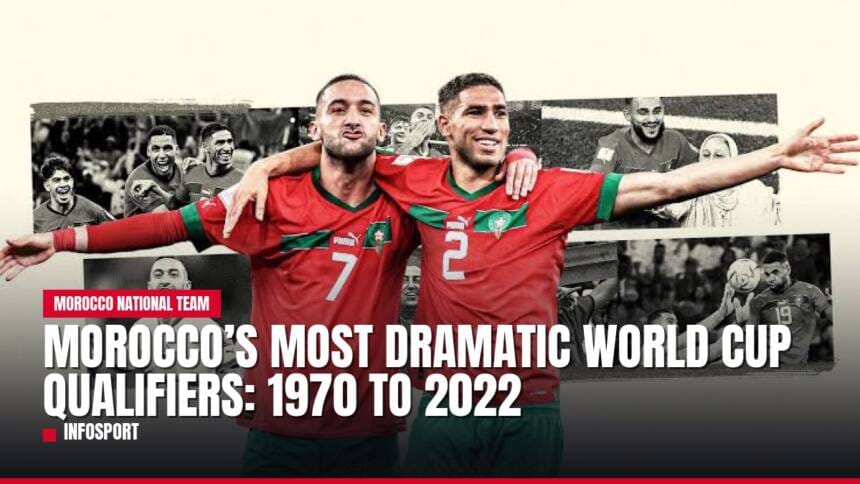
The Road to the World Cup: Morocco’s Most Dramatic Qualification Campaigns
Morocco’s journey to the FIFA World Cup has never been a formality. Across six qualification campaigns spanning more than five decades, the Atlas Lions have delivered moments of sheer brilliance, agonising near-misses, and performances that etched themselves permanently into the nation’s sporting memory. This is the story of how Morocco earned its place on the world stage — one dramatic qualifier at a time.
Breaking Barriers: Mexico 1970 — Africa’s Ultimate Test
The 1970 World Cup qualification marked Morocco’s first successful attempt to reach the global stage. The road to Mexico was demanding by design: only one spot was available for the entire African continent, requiring the Atlas Lions to navigate multiple knockout rounds against Senegal, Tunisia, and Nigeria.
The Decisive Playoff Against Nigeria
The most dramatic phase came in the final playoff. After a 2-1 loss in Lagos, Morocco needed a home victory in Casablanca. They delivered — winning 2-1 to level the aggregate at 3-3. With the tie deadlocked, a neutral-venue playoff was required.
The decider was held in Marseille, France. In a gritty, composed performance, Morocco defeated Nigeria 2-1, securing their historic berth at the 1970 FIFA World Cup. It was the first time a Moroccan side had qualified for football’s greatest tournament, and it ignited a national passion that has never dimmed.
The Golden Generation: Mexico 1986 — Topping the Group
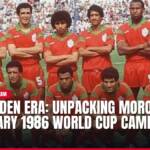
The 1986 qualification campaign is arguably the most celebrated in Morocco’s history — not just for reaching the tournament, but for what followed. Under coach José Faria, the Atlas Lions were tactically astute and collectively strong, navigating past Sierra Leone, Malawi, and Egypt before reaching the decisive stage.

The North African Showdown Against Libya
The final playoff pitted Morocco against regional rivals Libya — a tie loaded with political tension that amplified every moment on the pitch. Morocco won the first leg in Rabat 3-0, then held firm in a hostile Tripoli atmosphere, conceding twice but advancing 3-1 on aggregate.
What followed in Mexico justified every dramatic moment of qualification. Morocco topped a group containing England, Poland, and Portugal — becoming the first African nation to reach the World Cup knockout stages. The qualification was merely the prologue to a legendary campaign.
Heartbreak and Redemption: USA 1994 & France 1998
The Agony of 1994: Goal Difference Destroys a Dream
Morocco’s 1994 qualification story remains one of African football’s most painful. In a tight final group alongside Zambia and Senegal, Morocco needed to win their final match against Zambia in Casablanca. They did — 1-0, courtesy of Abdeslam Laghrissi. The celebrations erupted.

Then came the news: Zambia had also won. On goal difference, Zambia pipped Morocco to the qualification spot. Joy turned to devastation in minutes. It remains one of the cruelest results in Morocco World Cup qualification history.
Redemption in 1998: Hadji, Naybet, and a Return to the Stage
Morocco responded with renewed determination. The France 1998 campaign introduced a talented generation featuring Mustapha Hadji and Noureddine Naybet. In a final group with Ghana, Zambia, and Gabon, Morocco were consistent throughout — sealing qualification with a decisive final-day win over Ghana. The scenes at full-time reflected years of pent-up frustration finally released.
The 20-Year Drought and Russia 2018: Renard’s Masterpiece
After France 1998, Morocco failed to qualify for four consecutive World Cups — 2002, 2006, 2010, and 2014. Two decades of absence created immense pressure on every subsequent campaign, making the 2018 qualification the most emotionally charged in a generation.
The “Group of Death” — Ivory Coast, Gabon, Mali
Morocco were drawn into one of Africa’s toughest qualifying groups. Ivory Coast, who had qualified for the previous three World Cups, were considered heavy favourites. Under coach Hervé Renard, Morocco responded with a defensive masterclass — conceding zero goals across the entire group stage — while winning the matches that mattered.
The Iconic Night in Abidjan — November 11, 2017
The decisive match was played in Abidjan before a hostile crowd expecting an Ivory Coast victory. Morocco needed only a draw. Instead, they delivered one of the finest performances in their qualification history.
Goals from Nabil Dirar and Medhi Benatia in the first half silenced the stadium. The final score: Morocco 2-0 Ivory Coast. It ended a 20-year World Cup drought and sparked nationwide celebrations on a scale Morocco had rarely witnessed. Renard’s tactical discipline and the squad’s collective belief had produced something extraordinary.

Consecutive Qualifications: The Road to Qatar 2022
With Russia 2018 secured, the pressure shifted to maintaining momentum. Under coach Vahid Halilhodžić, Morocco dominated their Qatar 2022 group — beating Guinea-Bissau, Guinea, and Sudan in all six matches, scoring 20 goals and conceding just one.
The DR Congo Playoff: Tissoudali, Ounahi, Hakimi
The final hurdle was a two-legged playoff against DR Congo. Morocco drew the first leg in Kinshasa 1-1, with Tarik Tissoudali scoring a vital away goal. The return leg in Casablanca was one-sided: Morocco 4-1 DR Congo, with Azzedine Ounahi scoring twice and Achraf Hakimi adding a fourth. The aggregate 5-2 victory secured back-to-back World Cup appearances for the first time since 1998.
That qualification set the stage for Morocco’s historic run to the semi-finals of the 2022 World Cup in Qatar — the best performance by an African nation in the tournament’s history.
The Enduring Legacy
Morocco’s World Cup qualification history is not simply a record of results. It is a story of national resilience — of painful near-misses and triumphant comebacks, of generations of players who carried an entire country’s dreams across continents and decades. From the pioneering class of 1970 to the back-to-back qualifiers of 2018 and 2022, each campaign has added a chapter to one of African football’s richest narratives.
The Atlas Lions have qualified six times. Every single one of those qualifications came with a story worth telling.
Frequently Asked Questions
What was Morocco’s first ever World Cup qualification?
Morocco first qualified for the FIFA World Cup in 1970, becoming the second African nation (after Egypt in 1934) to reach the tournament. Their dramatic playoff victory over Nigeria in Marseille secured the historic spot.
How many times has Morocco qualified for the World Cup?
Morocco have qualified for the FIFA World Cup six times: 1970, 1986, 1994, 1998, 2018, and 2022. Each campaign has contributed to one of African football’s richest qualification histories.
Which World Cup qualification campaign is considered Morocco’s most dramatic?
The 2018 qualification is widely considered the most emotionally charged — a 2-0 away win in Abidjan ended a 20-year drought. The 1970 neutral-venue playoff and the 1994 goal difference heartbreak are equally significant moments.
Who coached Morocco to their 1986 World Cup qualification?
Brazilian coach José Faria led Morocco to the 1986 World Cup, where they famously topped a group containing England, Poland, and Portugal — becoming the first African side to reach the knockout stages.
What was the significance of Morocco’s 2022 World Cup qualification?
It marked Morocco’s second consecutive World Cup appearance — a feat not achieved since 1998 — and set the platform for their historic semi-final run in Qatar, the best result by an African nation in World Cup