
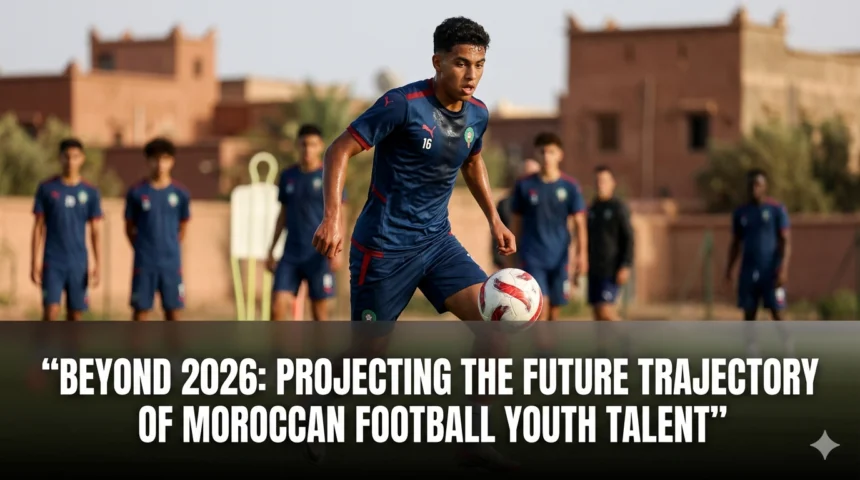
Morocco’s historic run to the 2022 FIFA World Cup semi‑finals was built on years of investment in youth football. As the focus shifts toward 2026 and beyond, the question is no longer whether Morocco can produce world‑class players, but how it will sustain and deepen that pipeline.
This article outlines the future trajectory of Moroccan youth football: the key pillars of the FRMF’s strategy, the role of technology and diaspora, and how these plans are expected to impact the senior national team, youth teams, domestic league, and women’s football.
If you’re looking for a general overview of current youth development, see our Morocco youth development overview. This page focuses on what comes next after 2026.
Foundation: what Morocco has already built
Before looking ahead, it’s important to recognize the base Morocco is building on:
Mohammed VI Football Academy and other elite academies providing high‑level training and education.
A growing network of regional and club academies (Wydad, Raja, FAR, FUS, etc.).
Improved coaching education and more structured youth competitions.
A proven diaspora integration model, with many senior players developed in European academies.
Increasing use of data, video analysis, and sports science at top clubs and in national youth setups.
Players like Azzedine Ounahi, Youssef En‑Nesyri, and Nayef Aguerd are products of this system. The challenge now is to scale and modernize it for the next cycle.

Strategic pillars for youth development beyond 2026
Morocco’s future youth strategy rests on several interconnected pillars. Together, they aim to create a sustainable ecosystem that keeps producing top talent year after year.
1. Regional growth and enhanced academy systems
The Mohammed VI Academy sets the standard, but the future depends on scaling that model:
Establishing more regional centres of excellence across Morocco, not just in major cities.
Ensuring these centres have:
Qualified coaches (with modern licenses).
Decent pitches, gyms, and medical support.
Clear pathways into national youth teams and pro clubs.
The goal is a tiered system:

Local academies → regional hubs → national academy → U‑teams → senior football.
This expands the talent pool and reduces the risk of missing players in remote areas.
2. Advanced coaching methodologies and professional development
Talent alone isn’t enough; coaching quality is the multiplier.
Future priorities include:
More specialized coaching courses (youth-specific, position-specific).
Training in:
Modern tactics and periodization.
Sports science and load management.
Psychology and man‑management for youth players.
Partnerships with European clubs and federations for exchange programs and joint courses.
The aim is to ensure youth coaches are not just former players, but modern educators who understand how to develop 21st‑century footballers.
3. Data‑driven scouting and talent identification
Scouting is moving from “eye test” to data‑informed decisions.
Morocco’s future system is expected to rely more on:
More Read

Digital scouting platforms connecting local spotters with national evaluators.
Basic performance metrics (games played, goals, assists, minutes) plus:
Technical data (pass completion, duels won).
Physical data (speed, distance covered – where available).
Psychological and cognitive assessments (decision‑making, resilience).
This helps:
Identify talent earlier and more accurately.
Track progress over time, not just in isolated tournaments.
Reduce bias and ensure players from all backgrounds get a fair chance.
4. Holistic player development (football + life)
Modern youth development recognizes that football careers are short and uncertain.
Morocco’s future approach emphasizes:
Strong links between academies and schools/universities.
Support for:
Mental health (psychologists, counseling).
Nutrition and lifestyle education.
Financial literacy and career planning.
The goal is to produce well‑rounded individuals who can succeed even if a pro career doesn’t work out. This also reduces pressure on young players and helps them make better decisions.
5. Diaspora integration and engagement
The diaspora will remain a core pillar of Morocco’s talent model.
Future efforts are likely to include:
More structured scouting networks in:
Regular diaspora youth camps and tournaments.
Clearer pathways from:
European youth clubs → Moroccan U‑teams → senior national team.
Better integration support:
Language and cultural orientation.
Clear communication about expectations and opportunities.
This ensures that talented Moroccan‑origin players in Europe feel connected to the Atlas Lions project and see a realistic route to the national team.
6. Technology integration and innovation
Technology will be a key differentiator.
Expected tools in youth academies include:
Wearables and GPS to monitor:
Training load, speed, distance.
Fatigue and injury risk.
Video analysis platforms for:
Individual and team tactical review.
Opponent analysis even at youth level.
VR/AR training for:
Decision‑making under pressure.
Spatial awareness and pattern recognition.
AI‑supported development plans:
Personalized training programs based on data profiles.
Early warning signs for stagnation or injury risk.
These tools won’t replace coaches, but they will help them make smarter, more individualized decisions.
Strategy at a glance: Morocco’s youth development pillars (2026–2030)
This simplified table summarizes the main pillars and expected impact.
This table should be the main reason users (and Google) value this page: it directly answers “What is Morocco’s youth football plan beyond 2026?” with a clear, structured overview.
Challenges to manage on the way
Even with a strong plan, Morocco will face challenges.
Maintaining investment and funding
Youth development is expensive and long‑term.
Sustained support from:
Government and FRMF.
Private sponsors and partners.
Diversifying funding (sponsorships, commercial deals, international grants) will be key to avoid boom‑bust cycles.
Retaining talent and managing “brain drain”
As Moroccan youngsters improve, European clubs will try to sign them earlier.
Early moves can be good for individual players but may:
Reduce the time they spend in Moroccan academies.
Weaken domestic clubs’ ability to build around local stars.
Morocco will need to:
Make domestic pathways attractive (facilities, coaching, exposure).
Ensure that even if players leave early, they remain connected to the national setup.
Adapting to global trends and competition
Football evolves fast: new tactics, physical demands, and technologies.
Morocco must:
Continuously benchmark against top academies worldwide.
Be willing to update methods rather than stick to old models.
Staying innovative is essential to keep pace with other nations investing heavily in youth.
Expected impact: from youth setups to senior success
If executed well, this strategy should have clear effects at multiple levels.
Senior national team
A deeper pool of technically and tactically strong players.
Smoother transitions as veterans retire.
More consistent qualification for World Cups and deep runs in AFCON.
Youth national teams (U‑17, U‑20, U‑23)
Stronger performances at youth World Cups and African championships.
More players using these tournaments as a springboard to senior football.
Clearer pathways from local academies to youth national teams.
Domestic league (Botola)
More homegrown players ready for senior football.
Higher overall quality, making the league more competitive and attractive.
Better preparation for Moroccan players before moving abroad.
Women’s football
Same principles applied to girls’ academies and youth national teams.
Building on the women’s team’s 2023 World Cup appearance to inspire more girls to play.
Clearer pathways from school/local clubs to senior women’s national team.
International cooperation and partnerships
Morocco’s strategy is not isolated; it will continue to rely on international partnerships:
Collaborations with European clubs for:
Youth training methods.
Coach exchanges and joint camps.
Knowledge sharing with federations that have strong youth systems.
Facilitating player moves to top leagues while keeping ties with Moroccan youth setups.
These partnerships accelerate learning and ensure Moroccan players and coaches stay connected to global best practices.
FAQ: Morocco’s Youth Football Future Beyond 2026
What is Morocco’s youth football strategy beyond 2026?
It focuses on six main pillars: expanding academies and regional hubs, improving coaching education, using data‑driven scouting, supporting players holistically (education, mental health, life skills), strengthening diaspora integration, and leveraging technology (wearables, video, VR/AR, AI).
What role will technology play in Morocco’s youth football future?
Technology will support performance monitoring (GPS, wearables), tactical learning (video analysis, VR/AR), and personalized development plans (AI‑based insights). The goal is smarter training, fewer injuries, and faster tactical understanding.
What are the main challenges for Moroccan youth football development?
Key challenges include sustaining long‑term investment, retaining top talent in the domestic system long enough, and continuously adapting to global football trends so Morocco doesn’t fall behind other nations.
How will this affect the senior national team?
Over time, Morocco should have a deeper, more versatile squad, with smoother transitions between generations. This should translate into more consistent qualification for major tournaments and deeper runs at World Cups and AFCON.
Are women’s football and youth development linked in this plan?
Yes. The same principles (academies, coaching, scouting, holistic support, technology) are intended to apply to women’s football as well, building on the women’s national team’s recent World Cup experience to create stronger pathways for girls.