Mohammed V Stadium: The Legendary Roar of Casablanca for Morocco
The Mohammed V Stadium in Casablanca stands as a giant in Moroccan football. More than just a sports arena, it represents a place where passion, history, and the roar of devoted fans converge. This legendary venue serves as a cultural monument, deeply embedded in the hearts of Moroccans and integral to the national team’s identity.
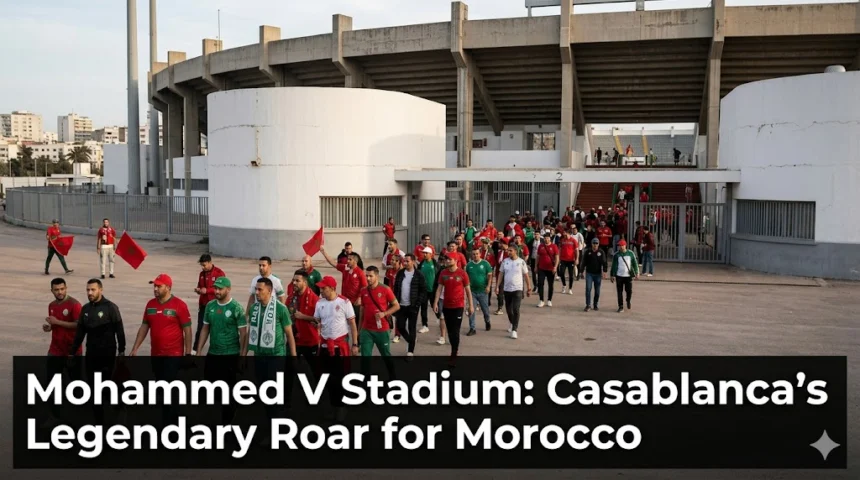
What makes this stadium truly remarkable is its ability to transform ordinary matches into extraordinary spectacles. Its 67,000 passionate supporters create an acoustic environment that visiting teams often describe as both intimidating and mesmerising. Beyond sheer volume, the atmosphere emerges from rhythmic chants, a forest of red and green flags, and a tangible sense of camaraderie reverberating through the concrete stands.
As the home of the Atlas Lions, Mohammed V Stadium embodies the passion and ambition of Moroccan football. It hosts everything from thrilling local derbies to crucial international matches, its legacy marked by countless moments of triumph, heartbreak, and unforgettable athletic achievements. Few African football venues have witnessed more memorable occasions—from World Cup qualifiers that sent entire neighbourhoods into celebration to continental championship matches that have defined generations.
This article explores the historical significance, architectural brilliance, and rich heritage of this iconic venue. We examine what elevates it to legendary status for both local clubs and the national team, the place where a nation’s collective dreams find expression. Additionally, we investigate how the stadium has shaped Moroccan football culture and continues to influence the beautiful game across North Africa.
History of Mohammed V Stadium, Casablanca
The stadium’s story mirrors Morocco’s passionate devotion to football and reflects the country’s evolution and ambitions across the decades. This trajectory parallels the transformation of Moroccan football itself, which has developed from a colonial-era pastime into a national obsession uniting millions across social and economic divides.

The stadium’s modernisation paralleled Morocco’s own progress toward development. Each renovation represented not merely sporting ambition but a desire to showcase the country’s capabilities on the international stage. In essence, the venue became a symbol of national pride extending far beyond the sport itself.
Start and Naming: From Marcel Cerdan to Mohammed V
Opened on March 6, 1955, the stadium was originally called Stade Marcel Cerdan, named after the renowned French boxer. This naming reflected the colonial influence of the era, as Cerdan—born in Algeria but celebrated as a French sporting hero—embodied the colonial practice of imposing French cultural references on Moroccan infrastructure.
The original structure was modest by today’s standards, with a capacity of approximately 35,000 spectators. Even then, local football enthusiasts recognised the venue’s potential. The design featured distinctive characteristics—steep stands that brought fans close to the action and excellent sightlines from nearly every seat.
More Read

With Morocco’s independence came a rapid and symbolic transformation. In 1956, the stadium was renamed Stade d’Honneur (Stadium of Honour), celebrating the nation’s new sovereignty. This watershed moment announced Moroccan identity through its sporting infrastructure. The renaming ceremony itself became a celebration of independence, with thousands of citizens gathering to witness this symbolic reclamation.
Debate over the proper name for this national venue was inevitable during the transition period. Some proposed names honouring Morocco’s rich cultural heritage, while others advocated for recognising local sporting figures. The temporary “Stadium of Honour” designation bridged the gap between colonial past and future tribute to royalty.
The stadium received its current and most cherished name in 1970: Mohammed V Stadium, honouring the late King Mohammed V, a revered figure who led Morocco to independence. This final renaming solidified its status as a national treasure and forged an enduring emotional connection between the monarchy, the people, and their beloved football.
Major Renovations and Milestones
Over the decades, Mohammed V Stadium has undergone several significant renovations to maintain its position as a premier sporting venue. These upgrades typically coincided with major international tournaments or evolving demands of modern football, presenting both challenges and opportunities to enhance the spectator experience and technical infrastructure.
A major overhaul occurred in 1983 in preparation for the Mediterranean Games hosted by Casablanca. This substantial upgrade increased capacity and elevated facilities to international standards. The project encompassed modern floodlighting systems, improved pitch drainage, and enlarged concourse areas. Remarkably, the entire renovation was completed in just 18 months, demonstrating Moroccan engineering excellence and determination.
The 1983 renovation introduced architectural elements that contributed to the venue’s distinctive character. The addition of arched roof sections not only enhanced weather protection but also optimised acoustic properties. These design choices proved instrumental in establishing the intimidating atmosphere the stadium is renowned for today.

Further improvements followed in 2000, 2007, and most recently in 2016-2017, with emphasis on seating comfort, lighting, pitch quality, and spectator safety. These ongoing initiatives reflect the stadium’s commitment to delivering a world-class experience. The 2016-17 refurbishment proved particularly comprehensive, introducing cutting-edge technology including LED lighting systems, enhanced pitch irrigation, and improved accessibility for disabled supporters.
Design and Ambience: Architectural Wonder
Beyond its impressive capacity, the Mohammed V Stadium’s architectural brilliance lies in its design. Acoustics experts describe the venue as a ‘cauldron effect’—the steep gradient of stands and partially enclosed bowl shape exponentially amplify crowd noise. The architects masterfully balanced functionality with aesthetic appeal, creating spaces that feel simultaneously intimate and grandiose.
The stadium’s distinctive red-and-white design represents Morocco’s national colours and draws inspiration from traditional Moroccan architecture. The facade’s geometric patterns originate from Islamic art, providing a unique visual identity that distinguishes it from conventional modern stadiums. The entrance gates feature intricate tilework, serving as a remarkable testament to local craftsmanship and cultural pride.
Club Football: The Home of Legends
While serving as the national team’s fortress, the stadium also functions as home ground for several prestigious Moroccan clubs. Two of the nation’s most successful sides, Raja Casablanca and Wydad Casablanca, are based here. The rivalry between them, known as the Casablanca Derby, produces some of African football’s most electric atmospheres.
What renders these derby matches so special is their ability to divide not just the stadium but the entire city. The rivalry, though fierce, remains largely good-natured, with families split between red (Wydad) and green (Raja), creating a legendary atmosphere. Security at these matches runs high, reflecting the intense emotions they generate rather than any concerns about violence.
Other major Moroccan clubs, including FAR Rabat and AS Salé, have also played significant matches here. The venue frequently serves as a neutral ground for cup finals and crucial championship deciders, further establishing its role as the country’s premier football destination.
International Glory: The Fortress of the Atlas Lions
For Morocco’s national team, this venue represents far more than a home ground—it’s a fortress where the Atlas Lions have achieved some of their finest moments. The stadium has witnessed qualification celebrations for several World Cups, including the memorable campaigns leading to Russia 2018 and Qatar 2022.
One of the most iconic moments in the venue’s history occurred during the 2004 Africa Cup of Nations qualifiers, when a dramatic last-minute goal secured Morocco’s tournament place and sent 67,000 fans into unison celebration. Those images became a symbol of the passionate Moroccan football fanbase.
The psychological impact on visiting sides is frequently noted. The combination of Casablanca’s altitude (200 metres above sea level), intense crowd support, and unfamiliar environment has proven decisive in many crucial matches. European teams in particular have struggled with the unique pressures this venue generates.
Football’s Cultural Impact
Mohammed V Stadium’s influence extends well beyond football. It has hosted significant cultural events, political rallies, and religious gatherings, becoming a hub of Moroccan public life and a focal point for community gatherings during major national celebrations.
Notably, the venue has become synonymous with social mobility and aspiration throughout Morocco. For many young Moroccans, performing at this ground represents the ultimate validation of their footballing abilities. This aspirational quality has inspired numerous youth development programmes across the country.
The stadium’s economic impact on Casablanca proves substantial. Match days draw thousands of visitors who support local businesses and create employment opportunities. The venue has become integral to Casablanca’s tourist infrastructure, with many visitors timing their trips to coincide with matches.
Beyond economics, the stadium has played a vital role in breaking down social barriers within Moroccan society. Match days unite people from all backgrounds under one roof, bound by shared hopes and dreams for their team. This democratising effect of football has fostered social cohesion and strengthened national identity in ways extending far beyond the ninety minutes of play.