
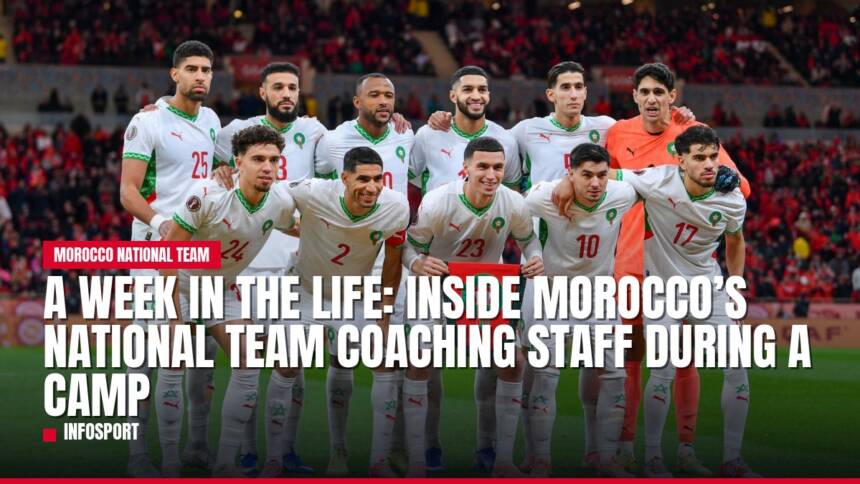
When fans see the Morocco national team step onto the pitch for a qualifier or tournament match, they see the players and head coach. But behind every tactical setup, training session, and in‑game decision is a large, specialized coaching staff working long hours before and during each international camp.
This article goes behind the scenes to show what a typical week looks like for Morocco’s coaching team during an international window: from video analysis and tactical meetings to training drills, set‑piece work, and match day management. It explains how each staff member contributes to turning a group of club players into a cohesive national side.
If you’re looking for a full list of current coaches and their roles, see our Morocco national team coaching staff overview. This page focuses on how they work together in a typical camp week.
How a Morocco camp week is structured
National team coaches don’t have players every day like clubs do. Instead, they work in intense blocks during international windows: a few days of training followed by one or two matches.
A typical camp week with a match might look like this:

Day 1 (Monday): Arrival, medical checks, initial video and tactical meeting.
Day 2 (Tuesday): First full training session, tactical implementation, individual feedback.
Day 3 (Wednesday): Opponent analysis, set‑piece workshops, second training session.
Day 4 (Thursday): Tactical refinement, cohesion drills, team meeting.
Day 5 (Friday): Light session, final tactical walkthrough, press conference.
Day 6 (Saturday): Match day.
Day 7 (Sunday): Recovery, initial debrief, early scouting for next window.
This rhythm changes slightly depending on whether there’s one match or two, but the core elements remain similar.
Monday: Arrival, medical checks, and strategic briefing
The week usually starts with players arriving from their clubs, often across different time zones.
Medical and fitness screening
The medical and fitness team runs checks on each player:
Muscle fatigue, minor knocks, travel fatigue.
GPS and load data from recent club matches (when available).
Players with issues are flagged for individualized recovery plans (extra rest, physio, light gym work).
This step is critical: the coaching staff must know who is fully available, who needs managed loads, and who might be a injury risk.

Initial tactical meeting
The head coach leads a meeting with assistants, analysts, and fitness staff.
They review:
Recent Morocco matches (if any).
General form and fitness of key players.
Initial ideas for the upcoming opponent.
This meeting sets the strategic blueprint for the week: formation ideas, pressing triggers, defensive shape, and key tactical messages.
Tuesday: First training session and tactical implementation
Tuesday is usually the first full day on the pitch.
Designing targeted drills
The head coach and assistants design sessions to:
Implement the chosen formation (e.g., 4‑3‑3, 4‑2‑3‑1).
Work on defensive shape and pressing schemes.
Practice attacking transitions and final third combinations.
Drills are often position‑specific:
Defenders and midfielders work on compactness and pressing coordination.
Forwards and wingers focus on movement, timing of runs, and finishing.
Individual feedback
Assistants and the head coach pull players aside for one‑on‑one feedback:
Review clips from recent club games.
Clarify tactical roles for this camp (e.g., when to invert, when to stay wide).
Build confidence and ensure everyone understands expectations.
This is where the game plan starts to move from theory to practice.
Wednesday: Opponent analysis and set‑piece workshops
Mid‑week is heavily focused on the next opponent.
Video analysis sessions
The performance analysts prepare detailed video packages:
Opponent’s typical formation and variations.
Key players’ tendencies (where they like to receive the ball, preferred foot, pressing behavior).
Defensive vulnerabilities (spaces behind full‑backs, weak side in transition).
Players attend group video sessions:
The head coach highlights key patterns to exploit or neutralize.
Specific instructions are given to certain players (e.g., “track this runner”, “attack this channel”).
Set‑piece preparation
Set pieces are rehearsed intensively:
Offensive corners and free kicks: who takes them, planned runs, decoy movements.
Defensive set pieces: zonal vs man‑marking, who marks key threats, near/far post responsibilities.
The goalkeeping coach works with keepers on:
Organizing the wall.
Commanding the box on crosses.
Anticipating shots from set plays.
These details often decide tight matches, so they receive disproportionate attention relative to the time spent.
Thursday: Refinement, cohesion, and team meeting
By Thursday, the basic game plan is in place. The focus shifts to refinement and unity.
More Read

Fine‑tuning tactics
Training becomes more game‑like:
Small‑sided games with specific constraints (e.g., must press within 6 seconds of losing the ball).
Scenario drills (chasing a goal, protecting a lead, playing with 10 men).
The head coach makes small adjustments:
Tweaking midfield roles.
Adjusting full‑back positioning.
Clarifying who is the primary ball‑winner vs the primary distributor.
Team meeting and motivation
A team meeting reinforces:
The tactical plan in simple terms.
The mental approach (discipline, concentration, resilience).
The collective identity Morocco wants to show (compact, brave on the break, united defensively).
The head coach and senior players often speak to build belief and emphasize that every role matters, from starters to substitutes.
Friday: Final walkthrough, media, and travel
The day before the match balances light physical work with mental preparation and media duties.
Light training and tactical walkthrough
The session is short and light:
Activation work, short passing patterns.
Final reminders on set pieces and key tactical points.
The focus is on clarity and confidence, not fatigue.
Press conference and media
The head coach faces the media:
Discusses squad availability (without giving too much away).
Talks about the opponent and the team’s mindset.
This is part of managing external pressure and protecting the squad from distractions.
Travel and logistics
For away matches, the team manager and logistics staff handle:
Flights, hotels, meals, training ground bookings.
Ensuring players can focus only on football.
Good logistics are invisible when done well, but critical for performance.
Saturday: Match day – from warm‑up to final whistle
Match day is where the week’s work is tested.
Pre‑match routines
The coaching staff oversee:
Warm‑up structure (physical activation, positional drills).
Final individual reminders (e.g., “watch his runs”, “stay compact here”).
The head coach delivers a final team talk:
Reiterates the plan in 3–4 clear points.
Emphasizes mentality: discipline, bravery, unity.
In‑game management
During the match:
The head coach and assistants watch specific triggers:
Is the pressing working?
Are we vulnerable on one flank?
Which matchups are we winning or losing?
Adjustments might include:
Changing formation or roles at halftime.
Substitutions to add freshness or change the attacking profile.
Specific instructions to full‑backs or midfielders based on how the game is unfolding.
Halftime and post‑match debrief
At halftime:
Quick tactical tweaks and motivational messages.
Focus on 2–3 key adjustments, not a complete overhaul.
After the match:
An initial debrief sets the tone for recovery and analysis.
The staff note key moments to review in more detail later.
Sunday: Recovery, initial analysis, and early scouting
After the match, the cycle starts turning toward the next window.
Player recovery
The medical and fitness team manages:
Recovery sessions (light gym, pool work, stretching).
Treatment for knocks and fatigue.
Players who featured heavily may get extra rest, while others do light activation.
Initial match analysis
The coaching staff review:
What worked tactically.
What needs improvement (defensive transitions, set‑piece defending, chance creation).
This feeds into planning for:
The next match in the window (if there is one).
The next international break.
Scouting and long‑term planning
Even during a camp, the staff think ahead:
Which youth players are ready for future call‑ups?
Which diaspora talents should be monitored more closely?
How does this squad fit into longer‑term plans for AFCON and World Cup cycles?
This long‑term view is what separates a reactive setup from a sustainable national team project.
Beyond the pitch: coordination with FRMF and clubs
Not all work happens on the training ground.
Coordination with the FRMF
The head coach and staff coordinate with the Royal Moroccan Football Federation (FRMF) on:
Squad selection policies.
Logistics for camps and travel.
Integration with youth teams and academies.
This ensures the senior team’s needs are aligned with the federation’s broader strategy.
Communication with clubs
Staff maintain contact with club medical and coaching teams to:
Monitor player loads and injury risks.
Agree on rehabilitation plans for players returning from injury.
Ensure consistent messages about player usage and fitness.
This collaboration is essential for managing players who spend most of the year at clubs abroad.
FAQ: Behind the Scenes with Morocco’s Coaching Staff
What are the main roles within Morocco’s national team coaching staff?
The staff typically includes a head coach, several assistant coaches, a goalkeeping coach, fitness and conditioning coaches, performance analysts, and a medical team (doctors, physiotherapists, nutritionists). Each role focuses on a specific area: tactics, individual player development, physical preparation, video analysis, and player health.
How does the coaching staff use technology in preparation?
They rely heavily on video analysis software to study both Morocco’s matches and opponents, GPS and load monitoring during training, and data platforms to track player performance. This helps them design targeted sessions, manage fatigue, and make informed tactical decisions.
What is the biggest difference between a national team coach and a club coach?
A national team coach has much less time with players, working mainly during international windows. They must quickly implement tactics, manage players from different club systems, and handle extensive travel and logistics, all while under intense national pressure.
How does the staff balance short‑term match prep with long‑term planning?
Immediate match preparation dominates the days before a game, but part of the week (especially early and late in the camp) is used for long‑term discussions: player development pathways, scouting new talents, and aligning with FRMF’s vision for future tournaments.