Morocco’s historic run to the 2022 FIFA World Cup semi‑finals was a landmark moment for African and Arab football. While tactics, coaching, and team spirit were crucial, one factor stands out: the central role of the Moroccan diaspora.
Most of the players in that squad were born or raised outside Morocco, primarily in France, the Netherlands, Spain, and Belgium. They developed in top European academies, then chose to represent the Atlas Lions. This article explains how Morocco’s diaspora strategy turned a global community into a competitive advantage, and how that directly shaped the 2022 World Cup team.
If you’re looking for a match‑by‑match breakdown of Morocco’s 2022 campaign, see our 2022 World Cup performance analysis. This page focuses on the diaspora’s role in building that squad.
Morocco’s diaspora: a global talent pool
Moroccans are one of the largest and longest‑standing diaspora communities in the world, with major populations in:
Generation after generation, Moroccan families have raised children who:

Grow up in European football systems (academies, youth leagues).
Maintain strong cultural and family ties to Morocco.
Face a choice: represent their country of birth or their country of origin.
For the Royal Moroccan Football Federation (FRMF), this diaspora is not just a community – it’s a strategic talent pool that vastly expands the number of players eligible for the national team.
FRMF’s diaspora strategy: scouting, integration, and belonging
Morocco’s success with diaspora players is not accidental. It’s the result of a long‑term, proactive strategy by the FRMF.
Scouting networks across Europe
The FRMF maintains scouting networks in key countries (France, Netherlands, Spain, Belgium).
They monitor:
Youth academies (Ajax, Heerenveen, Real Madrid, PSG, etc.).
Regional leagues and youth national teams.
Promising players with Moroccan roots are invited to:
Training camps with Moroccan youth teams.
Tournaments where FRMF coaches can assess them in person.
This ensures that talented youngsters are identified early and don’t slip away to other national teams.
More Read

Integration into the national setup
Once identified, players are gradually integrated:
Call‑ups to U‑17, U‑20, U‑23 teams.
Participation in training camps with the senior squad.
Cultural orientation (language, media, expectations).
The goal is to make them feel they are part of the Atlas Lions family, not just a “plan B” option.
Creating an inclusive environment
Under coaches like Walid Regragui (himself born in France), the national team has fostered an environment where:
Dual identity is seen as a strength, not a conflict.
Players are encouraged to embrace both their Moroccan roots and their European upbringing.
The squad culture emphasizes unity, respect, and shared purpose.
This has helped blend players from different backgrounds into a cohesive unit.
The 2022 World Cup squad: a diaspora‑heavy team
The 2022 World Cup made the diaspora’s impact impossible to ignore. Reports indicate that around 73% of Morocco’s squad (19 of 26 players) were born outside Morocco, mostly in Europe.atlanticcouncil+2
Breakdown by country of birth (representative)
While exact numbers vary by source, the 2022 squad included players born in:

France – e.g., Romain Saïss, Sofiane Boufal, Azzedine Ounahi, Yahya Jabrane.
Netherlands – e.g., Hakim Ziyech, Sofyan Amrabat, Noussair Mazraoui, Zakaria Aboukhlal.
Spain – e.g., Achraf Hakimi, Brahim Díaz.
Belgium – e.g., Selim Amallah (also linked to Belgian development).
This mix gave Morocco:
Players trained in different football schools (Dutch technical play, French physicality, Spanish possession).
Experience in top European leagues (Eredivisie, Ligue 1, La Liga, Premier League, Serie A).
A mental edge from competing in high‑pressure environments week in, week out.
Key diaspora players and their pathways
Below are representative examples of how diaspora players developed and contributed in 2022.
2022 World Cup diaspora players (selected)
Note: This table highlights representative examples, not the full 26‑man squad. “Youth Academy / Key Clubs” shows where they developed before the World Cup.
These players illustrate the diaspora pathway: European academies → top clubs → Morocco national team.
How diaspora training shaped Morocco’s style
The mix of backgrounds didn’t just add talent; it shaped how Morocco played in 2022.
Exposure to top European leagues
Players accustomed to:
High‑intensity pressing (Eredivisie, Ligue 1).
Tactical discipline (La Liga, Serie A).
Physical duels and pace (Premier League, Bundesliga).
This meant the national team could:
Compete physically with elite opponents.
Execute complex tactical plans (compact defending, quick transitions).
Handle pressure in knockout matches.
Variety of football schools
Dutch‑trained players (Ziyech, Amrabat, Mazraoui) brought:
Technical security, positional play, pressing intelligence.
French‑trained players (Saïss, Boufal, Ounahi) brought:
Physical robustness, directness, experience in big leagues.
Spanish‑trained players (Hakimi, Brahim) brought:
Possession comfort, 1v1 quality, tactical flexibility.
This blend allowed Morocco to adapt to different opponents: defend deep against Spain, counter Portugal, press Belgium.
Emotional drive: playing for family and community
Beyond tactics and training, the diaspora players had a powerful emotional motivation:
Many grew up hearing stories from parents and grandparents about Morocco.
They saw the national team as a way to honor their roots.
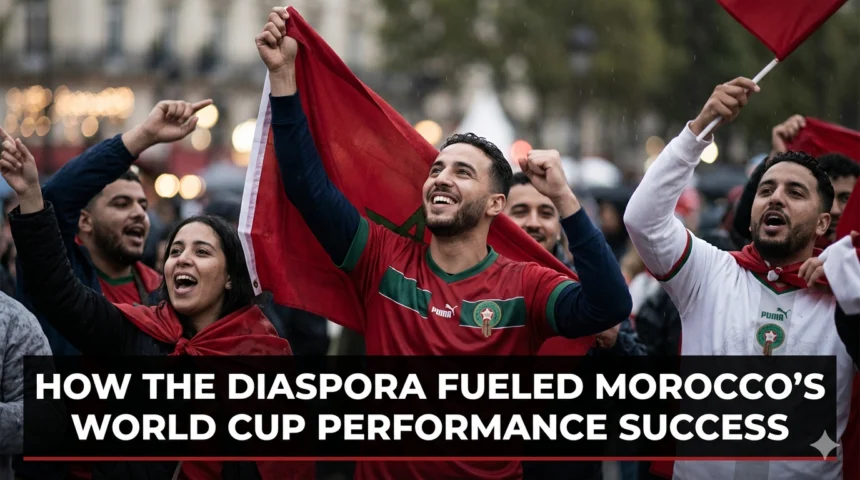
Their success resonated with Moroccan communities across Europe, who celebrated each win as their own.
After each victory, scenes of players celebrating with families in the stands highlighted this deep connection. It wasn’t just a tournament; it was a shared moment for a global community.
Post‑2022: a model for the future
The 2022 run validated Morocco’s diaspora strategy as a long‑term model, not a one‑off.
Inspiring the next generation
Young Moroccans in Europe now see a clear pathway:
Excel in local academies → get noticed by FRMF → play for Morocco.
The success of players like Hakimi, Ziyech, and Amrabat sends a message:
You don’t have to choose between identities; you can embrace both and represent Morocco at the highest level.
FRMF’s continued investment
The federation is likely to:
Strengthen scouting networks in key countries.
Expand youth camps for diaspora players.
Improve integration (language, culture, media training).
This ensures a steady pipeline of diaspora talent for future World Cups and AFCON tournaments.
Challenges and balance with domestic talent
While the diaspora model is a strength, it also raises questions:
How to balance diaspora players with homegrown talent from the Botola?
How to ensure domestic players still see a clear pathway to the national team?
Morocco’s ideal model is a hybrid:
Diaspora players bringing European top‑level experience.
Botola‑developed players providing depth, competition, and local identity.
Managing this balance will be key to sustaining success.
FAQ: Morocco’s Diaspora and the 2022 World Cup
What is the “Moroccan diaspora” in football terms?
It refers to players of Moroccan origin who were born or raised outside Morocco, mainly in Europe (France, Netherlands, Spain, Belgium), and who choose to represent the Morocco national team instead of their country of birth.
How did the diaspora help Morocco in the 2022 World Cup?
The diaspora expanded Morocco’s talent pool, bringing players trained in top European academies and leagues. They added technical quality, tactical flexibility, and big‑match experience. Around 73% of the 2022 squad were born outside Morocco, and many key players (Hakimi, Ziyech, Amrabat, Saïss) were diaspora products.
Who were the main diaspora players in the 2022 squad?
Key examples include Achraf Hakimi (Spain), Hakim Ziyech (Netherlands), Sofyan Amrabat (Netherlands), Noussair Mazraoui (Netherlands), Romain Saïss (France), Sofiane Boufal (France), Azzedine Ounahi (France), and Brahim Díaz (Spain).
How did the FRMF engage diaspora players?
The FRMF built scouting networks across Europe, organized youth camps and tournaments, and integrated promising players into Moroccan youth teams early. They also worked to create an inclusive environment where diaspora players felt valued and connected to the national team.
Is Morocco’s diaspora model a blueprint for other countries?
Yes. Morocco’s 2022 success shows how a country with a large diaspora can turn that into a competitive advantage by actively scouting, integrating, and embracing dual‑identity players. Other nations with big expatriate communities are already studying this approach.