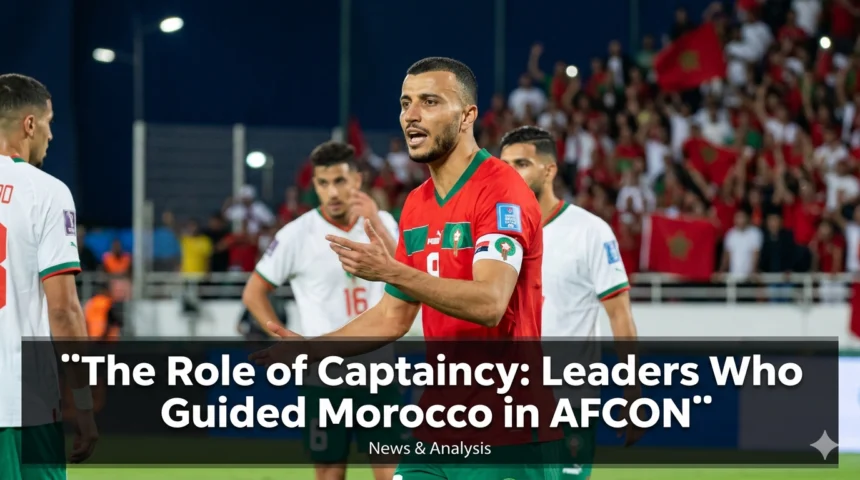
The captain’s armband in Moroccan football represents more than authority. It carries the expectations of an entire nation and the responsibility of leading a team through one of Africa’s most demanding tournaments. This article covers every major era of Morocco’s AFCON captaincy, the leaders who shaped each chapter, and what made their leadership count.
Why Captaincy Matters at AFCON
At the Africa Cup of Nations, a captain’s role extends well beyond the coin toss. They are the tactical voice on the pitch, the link between players and coaching staff, and the emotional anchor when matches get tight. For Morocco’s captains, that responsibility has always been amplified by a football-obsessed nation watching closely.
A good captain motivates, organises, and leads by example. They are often the first to absorb pressure and the first to respond when the team needs a lift. Outside the ninety minutes, they represent the team publicly, deal with the media, and maintain professionalism that sets the tone across the squad.
The First Leaders: 1970s
Ahmed Faras and the 1976 AFCON Title
The 1970s produced Morocco’s greatest AFCON achievement. Ahmed Faras captained the Atlas Lions to their only continental title in 1976, leading with both goals and character. He was a prolific striker but also a commanding presence who channelled the team’s energy toward a common goal.
The 1976 tournament used a final group stage format rather than knockout rounds, making consistent leadership across multiple matches essential. Faras delivered throughout, scoring crucial goals and maintaining the team’s focus against strong opposition. His captaincy in this period is explored in depth in The Golden Generation: Morocco’s 1976 AFCON Triumph Explained.
The 1980s: Commanding from the Back
After 1976, Morocco remained competitive in African football through the following decade. Badou Zaki emerged as one of this era’s defining leaders. Best known as a goalkeeper, Zaki regularly wore the armband and led through his presence, communication, and authority at the back of the defensive structure.
His leadership was most visible during Morocco’s run to fourth place at the 1986 AFCON. Zaki’s ability to organise defenders and keep the team composed in difficult moments was a consistent feature of his captaincy. The 1980s captains maintained Morocco’s relevance on the continent and built on the legacy of the 1976 generation.
The 1990s: Holding the Line
Morocco’s AFCON results in the 1990s were inconsistent. The team went through a transitional period, and captains during this era faced the harder task of keeping morale and identity intact through difficult campaigns. Noureddine Naybet began to establish himself as a leader in this period, laying the foundation for what followed in the 2000s.

These captains kept the squad together through setbacks and ensured the qualities that define Moroccan football were never entirely lost, even when results did not reflect the team’s ability.
The 2000s: Naybet and the 2004 Final
The early 2000s brought renewed optimism. Noureddine Naybet captained Morocco to the 2004 AFCON final, where they faced Tunisia as hosts. Naybet was a towering centre-back whose physical presence and organisational ability gave the team defensive stability throughout the tournament.
His ability to command the backline and inspire defenders around him was the foundation of Morocco’s run to the final. His leadership in this period stands as one of the clearest examples of how defensive captaincy shapes a team’s tournament performance. Mustapha Hadji also took the armband during this era, adding creative leadership to the mix.
For more on this period, see Morocco’s Top AFCON Performances Beyond the 1976 Win.
The 2010s: Building Toward the Next Generation
The 2010s were a rebuilding period for Moroccan football. Mehdi Benatia emerged as the defining captain of this decade, bringing professionalism, tactical awareness, and the respect of both senior players and younger squad members. His European club experience gave him an edge in understanding the demands of top-level football and translating that into national team leadership.
Benatia’s captaincy focused on creating a cohesive group and managing the transition between generations. The groundwork he laid contributed directly to the performances that followed in the 2020s.
More Read

Current Leaders: Saïss and the Modern Era
Romain Saïss has been the primary captain for Morocco in recent AFCON tournaments and beyond. His defensive composure, tactical understanding, and consistency under pressure make him the natural leader of this generation. Saïss was a key figure during Morocco’s 2022 World Cup run, a campaign that demonstrated exactly the kind of leadership qualities that define a great captain at tournament level.
Hakim Ziyech has also worn the armband, bringing a different kind of leadership through creative ability and big-match experience. The current generation carries forward the standard set by those who came before them, as highlighted in Key Players: The Legends Who Shaped Morocco’s AFCON Journey.
What Makes a Great Morocco AFCON Captain
Tactical Leadership on the Pitch
Every great Morocco captain has shaped the game from their position. Faras directed attacks with intelligent movement. Naybet organised the defence with authority. Saïss maintains shape and composure under sustained pressure. Tactical awareness and the ability to read situations quickly are consistent across all eras.
Mentorship and Squad Unity
Long tournaments like AFCON require captains to manage relationships across the squad for weeks at a time. The best Morocco captains have connected generations of players, helping younger talents adapt while keeping experienced players focused. Benatia was particularly respected for this quality.
Resilience in Pressure Moments
AFCON is an emotional tournament. Captains who deliver in the hardest moments leave the deepest impressions. Zaki’s performances in goal provided inspiration during critical matches in the 1980s. Saïss’s composure during penalty shootouts in 2022 showed the same quality in a different form.
The Legacy of Morocco’s AFCON Captains
Each captain has added a chapter to Morocco’s AFCON record. Their contributions extend beyond individual tournament results. They have shaped the identity, values, and standards of the Atlas Lions across decades.
The complete story of their impact sits within Morocco’s Complete AFCON Record: A Historical Overview. Their leadership has been the one constant through changing squads, coaches, and tournament formats. Understanding why Morocco have not won AFCON since 1976 requires acknowledging that even strong captaincy could not overcome every obstacle, as examined in Why Morocco Hasn’t Won AFCON Since 1976: A Deep Dive.
The responsibility these captains carried continues to motivate the current generation. The armband is a source of pride and a direct connection to those who wore it before.
FAQ
Who was Morocco’s captain when they won AFCON in 1976?
Ahmed Faras captained Morocco to their only Africa Cup of Nations title in 1976. A prolific striker and the defining leader of that generation.
Which Moroccan defender captained the team across several AFCON tournaments in the 2000s?
Noureddine Naybet captained Morocco in several AFCON tournaments throughout the 2000s, including their run to the 2004 final. He was a dominant defensive presence and highly respected leader.
What qualities are required of Morocco’s AFCON captains?
Strong tactical awareness, the ability to motivate teammates, resilience under pressure, and consistent professionalism on and off the pitch. They serve as the direct link between the coaching staff and the playing group during tournament conditions.
Has Morocco ever had a goalkeeper as AFCON captain?
Yes. Badou Zaki wore the armband for Morocco at AFCON tournaments in the 1980s. His presence, communication, and leadership from the back were central to the team’s competitive performances during that decade.
Which captains have led Morocco at recent AFCON tournaments?
Romain Saïss has been the most prominent captain in recent editions, with Mehdi Benatia and Hakim Ziyech also taking the armband at various points. Each brought different leadership qualities to the role.