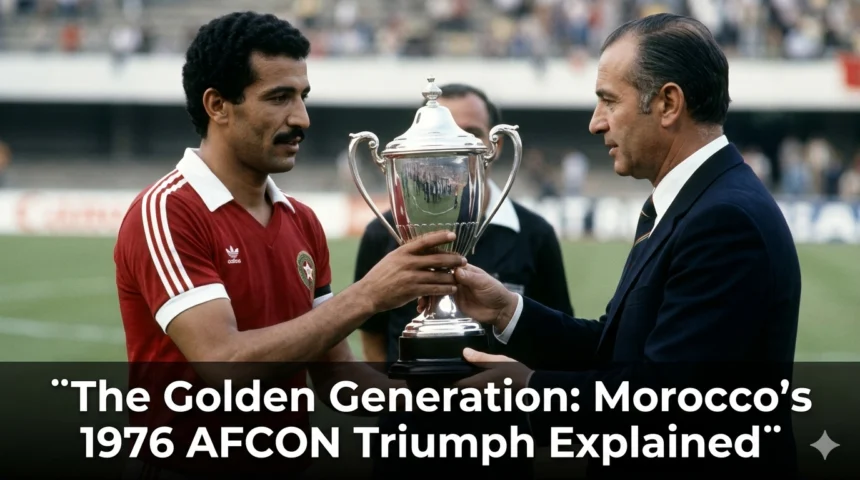
The year 1976 represents a pivotal moment in Moroccan football history, marking the nation’s only Africa Cup of Nations (AFCON) triumph. Frequently celebrated as the victory of the “Golden Generation,” this achievement extended beyond sport, establishing Morocco as a continental powerhouse. A comprehensive analysis of the 1976 AFCON victory reveals a narrative characterized by tactical brilliance, unwavering team cohesion, and individual excellence, culminating in an unforgettable triumph in Ethiopia. This article documents the Atlas Lions’ journey, examining the decisive factors behind their historic title and its enduring influence on Morocco’s Africa Cup of Nations (AFCON) record.
For generations, this achievement has served as both an inspiration and a benchmark for Moroccan football, demonstrating the outcomes of determination and strategic vision. Analyzing the nuances of this campaign provides essential insights into the foundations of Moroccan football identity.
The Pre-1976 Landscape: Morocco’s Emerging Presence
Prior to the 1976 campaign, Morocco had begun to establish itself on the international stage. The Atlas Lions participated in the 1970 FIFA World Cup, becoming the first African nation to qualify since Egypt in 1934. Although the World Cup campaign did not yield victories, the experience gained against elite competition proved invaluable.
Morocco’s AFCON journey commenced in 1972, concluding with a group stage exit. Although this initial attempt was unsuccessful, the experience provided essential groundwork for future ambitions. Over time, a talented core of players emerged, positioning the nation for significant growth and higher aspirations in continental football.
Building Blocks: A Foundation of Talent and Ambition
During the early 1970s, Morocco invested significantly in football development. Enhanced domestic leagues nurtured emerging talent, establishing the foundation for an exceptional squad. The experiences of the 1970 World Cup and 1972 AFCON, despite limited immediate success, provided valuable lessons and fostered a belief that proved transformative in subsequent years.

The Road to Ethiopia: Qualification and Preparation
Morocco’s path to the 1976 AFCON finals in Ethiopia was challenging, requiring it to navigate multiple qualifying rounds that tested the team’s resilience and tactical understanding against formidable African opposition. These challenges ultimately demonstrated Morocco’s growing stature in continental football.
Navigating the Qualifiers: A Test of Mettle
The qualification process consisted of a series of demanding knockout matches. Morocco’s victories in these preliminary rounds were crucial for building confidence and momentum within the squad, demonstrating their readiness for continental competition.
Guided by Romanian coach Gheorghe Mărdărescu, the team developed a distinctive tactical identity. His methodical approach, combined with exceptional Moroccan talent, created a formidable unit whose preparation was instrumental to their eventual success, as detailed in The Coaches Behind the Atlas Lions: Morocco’s AFCON Managerial History.

The 1976 AFCON Tournament Format Explained
The 1976 Africa Cup of Nations employed a distinctive format markedly different from contemporary tournaments. Rather than advancing to traditional knockout stages, the competition culminated in a final round-robin group of four teams.
Group Stage and Final Group Stage
Eight teams competed in two groups of four during the initial phase. The top two teams from each group progressed to a final group stage, where they faced each other once. The champion was determined by points accumulated across matches—a system that demands consistency and sustained performance over multiple encounters rather than relying on a single knockout match.
This structure introduced additional complexity and pressure, requiring teams to maintain form throughout an extended series of crucial fixtures. For a comprehensive overview, see Morocco’s Complete AFCON Record: A Historical Overview, which contextualises this format within its era.
Morocco’s Campaign: A Match-by-Match Breakdown
The Atlas Lions approached their 1976 objective with focused determination. Their performances throughout the tournament reflected tactical discipline, individual brilliance, and exceptional team spirit. A comprehensive understanding of their path to victory requires examination of each phase of the campaign.
Group Stage: Dominance and Progression
Morocco was grouped with Nigeria, Sudan, and Zaire (now DR Congo), the defending champions. The team’s performances immediately signaled championship ambitions.
Morocco vs Sudan (Match 1)
Morocco began the tournament with a 2-1 victory over Sudan. Goals from Abdelali Zahraoui and Ahmed Faras secured a crucial opening win, establishing the team’s intent and providing early momentum.
More Read

Morocco vs Zaire (Match 2)
In a significant upset, Morocco defeated defending champions Zaire 1-0 with a goal from Abdelali Zahraoui. This result demonstrated Morocco’s capacity to overcome established continental powers and underscored their championship credentials.
Morocco vs Nigeria (Match 3)
After securing advancement to the final group, Morocco faced Nigeria in the closing group match. Despite a 3-1 defeat, with Ahmed Faras scoring the team’s only goal, Morocco finished at the top of Group B and advanced with confidence, having already demonstrated resilience against strong opposition.
Final Group Stage: The Road to the Title
The decisive phase matched Morocco against Guinea, Egypt, and Nigeria, the strongest teams from the initial groups. This stage determined the African champion.
Morocco vs Egypt (Match 1)
Morocco began the final phase with a 2-1 victory over Egypt. Goals from Ahmed Faras and Abdelmajid Dolmy established the team’s superiority and secured maximum points in this crucial stage.
Morocco vs Nigeria (Match 2)
Morocco achieved a decisive 2-1 victory over Nigeria, with goals from Ahmed Faras and Redouane Guezzar. This result positioned the team at the top of the final group, requiring only one more match to secure the championship.
Morocco vs Guinea (Match 3 – The Decisive Encounter)
The tournament’s final match featured Morocco and Guinea in a direct contest for the title. Morocco required only a draw to secure the championship, while Guinea needed a victory. The intensity and stakes of the match were exceptionally high.
Key Players and Tactical Masterclass
The 1976 triumph resulted from exceptional talent and astute tactical guidance rather than mere fortune. Analyzing this achievement necessitates recognition of the individuals and strategies that defined the era.
The Visionary Coach: Gheorghe Mărdărescu
Romanian coach Gheorghe Mărdărescu played a fundamental role in shaping the 1976 squad by instilling discipline, tactical awareness, and a championship mentality. His strategic vision enabled Morocco to adapt effectively to various opponents and situations, a hallmark of their successful campaign. His contributions are further detailed in The Coaches Behind the Atlas Lions: Morocco’s AFCON Managerial History.
The Golden Generation: Legends on the Field
The 1976 squad comprised an exceptional group of talented players whose collective strength formed the foundation. Key contributors included:
- Ahmed Faras: The undisputed captain and team heartbeat, Faras exemplified leadership through both goal-scoring prowess and playmaking brilliance. His tournament-leading four goals earned him recognition as African Player of the Year in 1975. He remains among Morocco’s All-Time Leading Goalscorers in AFCON History.
- Abdelmajid Dolmy: A midfield virtuoso renowned for elegant play, exceptional vision, and game control, Dolmy’s composure under pressure proved invaluable throughout the tournament.
- Larbi Benbarek: Though a veteran by 1976, Benbarek’s experience and presence provided continuity with Moroccan footballing excellence.
- Mohamed Hazzaz: The reliable goalkeeper delivered crucial saves throughout, anchoring the defence.
- Abdelali Zahraoui & Redouane Guezzar: Both forwards contributed vital goals and attacking thrust, providing multiple offensive threats beyond Faras.
Together with Chérif El Ouazzani and Mustapha Fetoui, these players formed a cohesive unit characterized by intuitive understanding and mutual awareness. Their collective contributions are central to Key Players: The Legends Who Shaped Morocco’s AFCON Journey.
Tactical Prowess: Adaptability and Resilience
Morocco implemented a strategy that balanced strong defensive organisation with incisive counter-attacking. The team excelled at absorbing pressure and exploiting spaces through rapid, skilful forward play. Demonstrated resilience, including the ability to recover from deficits and maintain composure in closely contested matches, proved crucial for navigating the round-robin final stage,, where every point was significant.
The Decisive Match: Morocco vs Guinea
On March 14, 1976, in Addis Ababa, Ethiopia, Morocco and Guinea contested the championship-deciding encounter. Morocco needed only a draw to claim the title, while Guinea required a victory.
A Battle of Nerves and Skill
The match was intensely contested. Guinea attacked aggressively, while Morocco maintained defensive solidity, recognizing that a draw would secure the championship.
Guinea broke through in the 33rd minute via Papa Camara’s goal, creating significant pressure on Morocco. However, the Atlas Lions displayed exceptional character and resolve.
The Equaliser and the Triumph
In the 86th minute, with four minutes remaining, Ahmed Makrouh—known as ‘Baba’—delivered a dramatic equaliser that sent the Moroccan contingent into raptures. The 1-1 result clinched the title.
The final whistle confirmed Morocco as African champions. The ensuing jubilation reflected years of dedication, determination, and collective belief. This moment transcended football and became a defining national achievement.
The Impact and Legacy of the 1976 Victory
The 1976 AFCON triumph extended beyond sporting accomplishment, becoming a profound source of national pride and inspiration. Its influence reshaped the trajectory of Moroccan football for decades.
A Beacon of National Pride
For an emerging nation, the victory symbolised international excellence and capability. It united the country and fostered collective pride. The players of the “Golden Generation” became national heroes, their names permanently etched in Moroccan consciousness. This triumph remains a defining moment in Morocco’s Africa Cup of Nations (AFCON) record.
Inspiring Future Generations
The 1976 success inspired numerous young Moroccans to pursue football, accelerating the sport’s growth at all levels nationwide. It demonstrated that African teams could achieve continental supremacy, fostering ambition and belief among subsequent generations of players and coaches.
Setting a High Bar
The victory established an exceptionally high standard. Although the Atlas Lions achieved other notable successes, including World Cup knockout stage appearances and strong AFCON performances, the 1976 title remains their only continental championship. This enduring status continues to motivate the pursuit of excellence, as documented in Morocco’s Top 5 AFCON Performances Beyond Their 1976 Victory.
Why This Triumph Stands Alone: A Deep Dive into Challenges
Despite assembling several strong squads and mounting promising campaigns, Morocco has not replicated the 1976 AFCON achievement. This singular status warrants a deeper examination of the obstacles that have prevented subsequent generations from claiming the continental trophy.
The Evolving Landscape of African Football
Since 1976, African football has become significantly more competitive. An increasing number of nations have developed sophisticated football structures, resulting in a much larger pool of championship contenders. Cameroon, Egypt, Ghana, and other West African nations have emerged as consistent powerhouses, substantially intensifying competition.
Consistency and Tournament Nerves
Although Morocco has frequently displayed moments of brilliance in various AFCON campaigns, maintaining consistency throughout the competition’s demanding schedule has been challenging. The modern knockout format, which replaced the 1976 round-robin system, has further tested subsequent Moroccan teams, as explored in Why Morocco Hasn’t Won AFCON Since 1976: A Deep Dive into Challenges.
The “Golden Generation” Effect
The 1976 squad represented an exceptional convergence of talent, leadership, and collective synergy, reaching its peak when circumstances aligned. Identifying another generation with comparable depth and unified vision has proven elusive. While subsequent teams have featured individual stars, assembling groups with similar cohesion and mental fortitude has remained rare.
The “Golden Generation” Defined
In football, the term “Golden Generation” refers to exceptionally talented players who achieve unprecedented national success. For Morocco, this designation is inextricably linked to the 1976 AFCON-winning squad.
More Than Just a Team
This generation surpassed football excellence through strong camaraderie, resilience, and profound national pride. The team’s passion deeply resonated with Moroccan supporters. Their triumph exemplified collective effort arising from a shared vision and commitment to excellence.
The legacy of the 1976 “Golden Generation” continues to inspire. Their achievement serves as a a permanent reminder of what talent, dedication, and unity can accomplish, providing a benchmark against which subsequent Moroccan teams are measured and an enduring source of national pride.
Conclusion: A Legacy Etched in History
The analysis of Morocco’s 1976 AFCON victory reveals more than a football achievement; it represents a defining historical moment. This triumph resulted from tactical sophistication, individual brilliance exemplified by Ahmed Faras, and exceptional team spirit. The distinctive tournament format, combined with consistent performances across group and final stages, distinguished Morocco.
The “Golden Generation” secured Morocco’s only Africa Cup of Nations title, establishing a legacy that resonates through subsequent decades. This achievement exemplifies overcoming adversity, inspiring nations, and setting benchmarks for future Atlas Lions generations. The 1976 victory represents the pinnacle of Morocco’s Africa Cup of Nations (AFCON) record, serving as a testament to an exceptional team and an unforgettable achievement.
FAQ Section
Q1: Who was the coach of Morocco during their 1976 AFCON win?
A1: Morocco was coached by Romanian Gheorghe Mărdărescu during their triumphant 1976 Africa Cup of Nations campaign. His tactical guidance and leadership proved crucial to the team’s success.
Q2: Who was the top scorer for Morocco in the 1976 AFCON?
A2: Ahmed Faras, the legendary team captain, topped Morocco’s scoring with four tournament goals. He was also named African Player of the Year in 1975.
Q3: What was unique about the format of the 1976 AFCON?
A3: The 1976 AFCON featured a distinctive format where the top two teams from each initial group advanced to a final round-robin group of four. The champion was determined by accumulated points rather than through traditional semi-finals and a final match.
Q4: How many times has Morocco won the AFCON?
A4: Morocco has won the Africa Cup of Nations once, in 1976. This sole continental triumph remains highly cherished in their football history.
Q5: Which team did Morocco play in the decisive match to win the 1976 AFCON?
A5: Morocco faced Guinea in the final group stage match of the 1976 AFCON. The 1-1 draw was sufficient for Morocco to secure the championship, given their superior point total in the round-robin group.