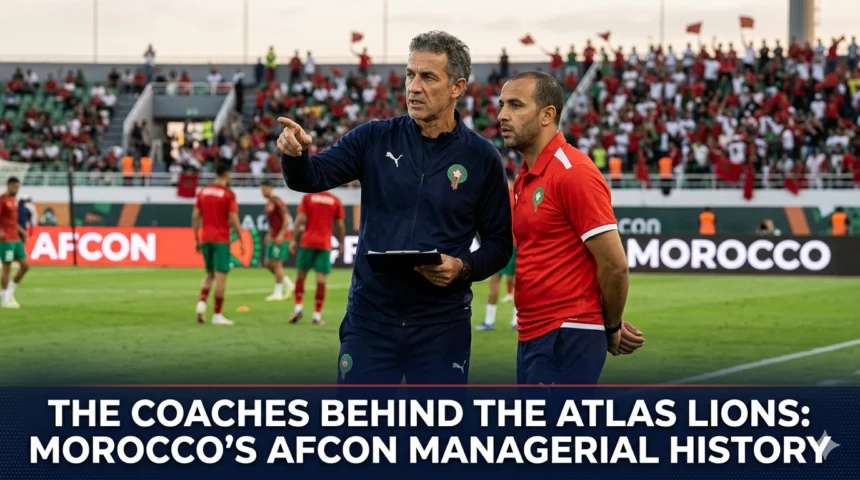
The Atlas Lions’ participation in the Africa Cup of Nations represents a narrative defined by passion, talent, and a persistent quest for continental success. Although players often receive the most attention, the strategic leadership provided by coaches is equally significant. Examining Morocco’s coaching legacy in AFCON provides valuable insight into the nation’s football history, highlighting eras of triumph, near successes, and important lessons accumulated over the decades.
Morocco’s tournament history, from its initial emergence on the continental stage to its recent resurgence, is closely connected to the diverse managers who have led the team. Both domestic and international coaches have significantly influenced the team’s identity and ambitions. This article examines the managerial history of the Atlas Lions, analyzing how these individuals shaped Morocco’s performances in the Africa Cup of Nations and contributed to the broader record of Moroccan football in the competition.
Early Forays and Building the Foundation: Initial Years
Morocco’s initial participations in the Africa Cup of Nations demonstrated a nation in search of experience and a distinct footballing identity. Coaches in these formative years laid the foundation for future achievements by progressively building a squad capable of competing with Africa’s leading teams.
The Inaugural Appearances: Laying the Groundwork
Morocco qualified for the Africa Cup of Nations for the first time in 1972 under Romanian coach Gheorghe Mărdărescu. Although the team was eliminated in the group stage, this debut was a pivotal moment in their continental development. Mărdărescu’s short tenure introduced structured tactical approaches that became important in later campaigns. Participation in these early tournaments enabled Morocco to better understand the demands and intensity of continental competition, contributing to the nation’s evolving historical record.
In subsequent tournaments, Morocco experienced frequent coaching changes, with each manager working to refine the squad and improve performance. Early coaches encountered the challenge of integrating domestic talent and enhancing tactical understanding, thereby preparing the team for future accomplishments.

The Golden Generation and the 1976 Triumph: A Defining Moment
The year 1976 is a landmark in Moroccan football history, marking the Atlas Lions’ victory in the Africa Cup of Nations. This significant accomplishment was achieved under the guidance of a coach who effectively utilised the squad’s combination of skill and resilience.
Gheorghe Mărdărescu: The Architect of Glory
Gheorghe Mărdărescu returned to coach Morocco during their only championship-winning campaign in 1976, marking a highly successful second tenure. He implemented a tactical system that enabled key players, such as Ahmed Faras, to excel. His ability to balance discipline with creative freedom was instrumental in the team’s success. The tournament, hosted in Ethiopia, required Morocco to overcome a demanding format to secure victory. This era is widely regarded as the peak of Morocco’s managerial achievements.
Mărdărescu’s achievements demonstrated the significant influence a visionary coach can exert on a national team. His legacy includes establishing a distinctive playing style and fostering a winning mentality that persisted for years beyond the championship.

Navigating the 1980s and 1990s: A Period of Evolution
After the 1976 victory, Morocco entered a period focused on replicating that success. In the following decades, a series of coaches introduced their own tactical philosophies as the team sought greater consistency and additional continental achievements.
Coaches of the Late 1970s and Early 1980s
Following the 1976 championship, Abdallah El Amrani and subsequently Brazilian coach Jaime Valente led the team. Under Valente, Morocco reached the semi-finals in 1980 and secured third place, reflecting sustained competitive performance despite not winning another title. Subsequent coaches continued to pursue this objective, which became a central theme in their managerial strategies.
Coaches of the Late 1980s and 1990s: Building Consistency
In the late 1980s, Brazilian coach José Faria took charge, having previously led Morocco in the 1986 World Cup and to the 1988 Africa Cup of Nations semi-finals on home soil. Faria’s approach, which combined discipline with tactical flexibility, had a lasting impact on the team. Reaching the semi-finals at home was a notable achievement, and during this period, Morocco consistently competed among Africa’s top teams, frequently facing North African rivals.
During the 1990s, French coach Henri Michel led Morocco to the 1998 World Cup and the 2000 Africa Cup of Nations. Although his tenure did not result in a championship, his teams were recognized for their technical skill and attacking style. Coaches in this era balanced the demands of maintaining high expectations with the development of new generations of players to sustain competitive performance.
The New Millennium: Seeking Resurgence
The beginning of the new century brought both new opportunities and challenges for Moroccan football. A succession of foreign and domestic coaches sought to restore the Atlas Lions to the top of African football, with one manager achieving notable progress toward this goal.
The Turn of the Century: New Perspectives
At the start of the 2000s, coaches such as Humberto Coelho and later Badou Zaki led the national team. Zaki, a renowned former goalkeeper, brought significant national pride and expertise to the role. His appointment was met with high expectations due to his prominent status in Moroccan football.
More Read

Badou Zaki and the 2004 Final Run
Badou Zaki‘s tenure culminated in a notable appearance in the 2004 final in Tunisia. Under his guidance, Morocco demonstrated a balance of defensive strength and effective attacking play. The team defeated strong opponents such as Algeria and Nigeria before narrowly losing to the host nation, Tunisia. This performance is considered one of Morocco’s most significant achievements since the 1976 victory and demonstrated that domestic coaching talent could lead the team to continental success.
Although the team did not win the final, Zaki’s 2004 campaign is regarded as a highlight in Moroccan football, illustrating the team’s potential under skilled and tactically proficient leadership. This period renewed optimism among supporters.
A Decade of Transition and Rebuilding
The years following the 2004 final represented a transitional period for Morocco, characterized by difficulties in maintaining consistent performance. This era saw frequent coaching changes as the federation sought an effective managerial approach.
Various Coaches and Their Impact (2006-2014)
Between 2006 and 2014, Morocco appointed several coaches, including Mohamed Fakhir, Henri Michel, Roger Lemerre, Eric Gerets, and Rachid Taoussi. Each introduced unique approaches and objectives, but the team frequently struggled to advance beyond the the group stages. These recurring difficulties prompted concerns regarding consistency and player development.
Although certain managers, such as Gerets, implemented greater tactical discipline, the overall results during this period were disappointing. This era highlighted the challenges of international football and the persistent pressure to achieve success.
The Rise of Hervé Renard and Walid Regragui: Modern Leadership
The mid-2010s represented a turning point, as new coaches introduced renewed energy, tactical proficiency, and strategic direction for the Atlas Lions, resulting in a notable international resurgence.
Hervé Renard: Professionalism and Structure
The appointment of French coach Hervé Renard in 2016 was a pivotal development. Renard, recognized for his previous AFCON successes with Zambia and Ivory Coast, implemented professional standards and a defined tactical approach. Under his leadership, Morocco qualified for the 2017 and 2019 tournaments, reaching the quarter-finals in 2017, their best result since 2004. Notably, he also led the team to qualify for the 2018 World Cup, ending a 20-year absence. His tenure contributed to renewed confidence and an enhanced international reputation.
During Renard’s tenure, several key players emerged who would become central to Morocco’s future successes, reflecting his skill in talent identification. The introduction of modern training techniques and a strong team ethic significantly improved the team’s prospects.
Walid Regragui: The Homegrown Hero and World Cup Legacy
Following Vahid Halilhodžić‘s successful qualification of Morocco for the 2022 competitions, Walid Regragui, a domestic coach, assumed leadership shortly before the World Cup. Under his guidance, Morocco reached the semi-finals, becoming the first African and Arab nation to achieve this milestone. This accomplishment significantly enhanced the the global perception of Moroccan football and considerably elevated the team’s its international standing.
Regragui’s leadership integrated tactical adaptability with a strong understanding of player mentality and cultural context. Although Morocco’s 2023 tournament ended earlier than anticipated, the foundation established during his tenure, particularly the World Cup performance, marks the beginning of a new era of ambition. His leadership has set new standards for future generations.
Analysing the Managerial Record: Diverse Styles and Philosophies
Morocco’s coaching history encompasses a wide range of managerial philosophies. The nation has benefited from disciplined Eastern European frameworks, such as those introduced by Mărdărescu, dynamic South American influences, and pragmatic French professionalism exemplified by Renard. Domestic coaches, including Zaki and Regragui, have demonstrated a strong understanding of local football culture and have established meaningful connections with both players and supporters.
Analysis of performance data indicates that coaching stability often correlates with improved results, whereas frequent managerial changes tend to result in inconsistency. The ability to address unique challenges and perform effectively under tournament pressure have consistently influenced Morocco’s success.
The history of the Atlas Lions reflects both the influence of individual coaches andtheion of Moroccan foo of Moroccan footballtball. Each manager has played a significant role in shaping the team and mentoring players who have defined the nation’s achievements in continental competition.
Conclusion
Morocco’s managerial history demonstrates a sustained commitment to excellence. From the pioneering efforts of early coaches, through Gheorghe Mărdărescu’s 1976 success, Badou Zaki’s near-triumph in 2004, and the recent resurgence under Hervé Renard and Walid Regragui, each coach has played a crucial role. Their contributions have shaped the team’s tournament performances and significantly influenced the development of football within Morocco.
As Morocco continues to pursue further championships, the lessons learned from these varied coaching tenures will inform future strategies. The coaches who have led the Atlas Lions remain integral to the nation’s distinguished football history.
Frequently Asked Questions (FAQs)
Who was the coach when Morocco won their only AFCON title in 1976?
Morocco won their sole Africa Cup of Nations title in 1976 under Romanian coach Gheorghe Mărdărescu. His tactical brilliance and ability to inspire the squad proved crucial to their historic victory.
Which Moroccan coach led the team to the 2004 AFCON final?
Legendary goalkeeper Badou Zaki coached the Atlas Lions to the 2004 final. They narrowly lost to hosts Tunisia in the championship match.
Who are some of the most successful foreign coaches in Morocco’s AFCON history?
Beyond Gheorghe Mărdărescu, other notable foreign coaches include José Faria, who reached the 1988 semi-finals, and Hervé Renard, who guided Morocco to the 2017 quarter-finals and World Cup qualification.
Has Walid Regragui coached Morocco in an AFCON tournament?
Yes, Walid Regragui managed Morocco at the 2023 Africa Cup of Nations (played in early 2024). His tenure famously includes leading the team to the 2022 FIFA World Cup semi-finals.
How many different coaches have led Morocco in the Africa Cup of Nations finals?
Numerous coaches across their tournament appearances have led Morocco. While exact numbers vary based on how brief stints are counted, more than a dozen distinct individuals have managed the Atlas Lions throughout the decades.