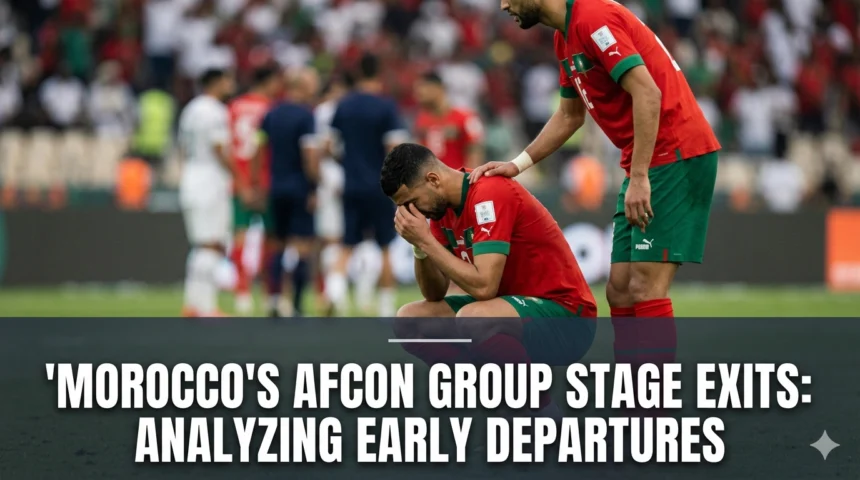
The Africa Cup of Nations (AFCON) is the pinnacle of continental football, a stage where nations fight for glory and showcase their talent. Morocco is a country with a proud footballing tradition and fervent fans, and they have had a real rollercoaster of a tournament. The Atlas Lions have had their successes, famously winning the trophy in 1976, but their AFCON history is littered with disappointments, especially early exits. In this article, we take a look at Morocco’s Africa Cup of Nations (AFCON) record and zero in on the cases of Morocco’s AFCON group-stage exits, the reasons behind them, and the lessons learned from these early exits.
Morocco AFCON Group Stage Exits: A Historical Perspective
Morocco and the AFCON have a complicated relationship. Although the squads are full of world-class talent, consistency has sometimes been a problem. If we take a look at Morocco’s Full AFCON Record: A Historical Overview, we see that they have performed well in qualification but have found the going tough in the main tournament. Here, we focus on the tournaments in which the Atlas Lions have failed to get past the first round, a recurring problem that has baffled fans and analysts alike.
These early exits are more than mere statistical footnotes; they are significant moments for Moroccan football and raise questions about strategy, preparation, and mental resilience. They show the elements that in the past prevented Morocco from progressing in Africa’s premier football competition.
The Early Years: Morocco’s AFCON Group Stage Exits in the 1970s
AFCON 1972 (Cameroon): A First Appearance, Hesitant
Morocco’s first appearance at the AFCON in 1972 was not the smoothest. The Atlas Lions, still newcomers at the continental level, struggled to find their rhythm in Group B with Congo and Sudan. The tournament was a baptism by fire for the Moroccan squad.
Their campaign began with a glimmer of hope, a 1-1 draw against Sudan. But this was followed by a heavy 4-0 loss to eventual winners Congo. This devastating defeat was among the first in Morocco’s AFCON group-stage exits, underscoring the difficulties of facing established African powers. It was a disappointing experience for the fledgling national team, but a valuable one.
AFCON 1978 (Ghana): The Reigning Champions Stumble
After their historic triumph in The Golden Generation: Morocco’s 1976 AFCON Triumph Explained, expectations were sky-high for the 1978 tournament. Morocco entered as defending champions and was expected to dominate. But football often has its surprises, and this was a hard lesson in this edition.

Morocco, which was drawn in Group B with Tunisia, Congo, and Uganda, started with a 1-1 draw against their North African rivals. They then secured a vital 1-0 win over Congo, putting them in good standing. They finished third, behind Uganda and Tunisia, after a shocking 3-0 defeat to Uganda in their final group game. It was a stunning group-stage exit for the defending champions, underscoring a stark decline from the glory days of 1976.
Challenges of the 1990s and Early 2000s: Repeated Early Departures
AFCON 1992 (Senegal): A Revisited Early Exit
After a spell of relative success in the late 1980s, when they finished fourth in 1986 and 1988, Morocco suffered another frustrating first-round exit. The Senegal tournament put the Atlas Lions in a tough Group B with continental giants Cameroon and a strong Zaire (now DR Congo) side.
They started their campaign with a 1-0 loss to eventual finalists Cameroon, in which Morocco wasted chances. Then they drew 1-1 with Zaire, not enough to keep their hopes alive. Morocco ended bottom of their group with only one point. This tournament was a disappointing return to early exits, a reminder of a time when they had talented players but couldn’t put it together consistently.
AFCON 2000 (Ghana/Nigeria): A Lost Opportunity
The beginning of the new millennium saw hope return to Moroccan football with a squad full of promising talents. However, the co-hosted AFCON 2000 in Ghana and Nigeria produced another disappointing campaign. Morocco was drawn into Group D with tough opponents, Nigeria, Tunisia, and Congo, so the setup called for the best from the Moroccan side.

Morocco clung on to a battling 1-0 victory over Congo that initially raised their hopes. Further costly were decisive losses to Nigeria (2-0) and Tunisia (1-0). They finished third with three points and once again did not qualify for the knockout stages. This exit reflected a consistent pattern of inconsistency and difficulty in collecting valuable points against major opponents, as outlined in Morocco’s AFCON Record Against North African Rivals.
AFCON 2002 (Mali): West Africa’s woes
Two years later, Morocco would meet a similar fate in Mali. In Group B, they had South Africa, Ghana and Burkina Faso. A tough group, but manageable. The team was a huge disappointment despite having promising talent.
There was no cutting edge to their campaign, and they drew goalless against both Ghana and South Africa. This failure to convert opportunities into goals proved costly. However, a shock 2-1 loss to Burkina Faso sealed their fate, and they finished bottom of the group with two points. The inability to convert promising positions into wins, combined with a shock defeat, summed up the problems that led to another frustrating last-16 exit.
The mid-2000s to early 2010s: A frustrating period
AFCON 2006 (Egypt): End on a Sour Note After Finals
Expectations were rightly high for Morocco in 2006 after their final appearance in 2004, when they narrowly lost to Tunisia. However, the Egypt tournament was a far cry from their previous performance. It was a particularly difficult draw in Group A, with hosts Egypt, the Ivory Coast, and Libya.
Morocco proved defensively resilient, holding Egypt and Libya to goalless draws. But a crucial 1-0 defeat to the Ivory Coast proved fatal. The Atlas Lions came third with two points and failed to progress again. Given their impressive run, it was especially disappointing, and it raised the question of how to maintain momentum.
AFCON 2008 (Ghana): Another Early Exit
The 2008 AFCON in Ghana continued the unfortunate trend of early exits. They were drawn in Group A with hosts Ghana, Guinea, and Namibia, a group many considered winnable and one that presented a clear path to the knockout rounds.
More Read

Morocco had a flying start with a 5-1 thrashing of Namibia but was brought back to earth with a 3-2 loss to Guinea. It was followed by a vital 2-0 loss to Ghana in their final game. Those back-to-back defeats left them in third position and another early exit from the group stages. They showed a lack of consistency by failing to build on a good start and by picking up points against better teams.
AFCON 2012 (Gabon/Equatorial Guinea): A Difficult Group
Morocco was in what many called the ‘Group of Death’ at AFCON 2012, along with co-hosts Gabon and Niger and Tunisia. This section proved to be a monumental task for the team.
Unfortunately, the Atlas Lions were in dire straits, losing all three group matches—2-1 to Tunisia, 3-2 to Gabon, and a shock 1-0 loss to Niger. They finished bottom of the group with no points in one of their worst group stage failures. It highlighted the cutthroat nature of the tournament and the absolute need to be on your game against any opponent.
AFCON 2013 (South Africa): Bottom Half of Group
But Morocco went out again at the group stage a year later, continuing a frustrating trend. The Atlas Lions were tipped to progress from Group A, along with hosts South Africa, Cape Verde, and Angola, based on their squad.
However, their campaign was not distinguished by any conclusive victories, with three draws: 0-0 against Angola, 1-1 against Cape Verde, and 2-2 against South Africa. They trailed in last place by three points. They couldn’t turn draws into crucial wins, something that has plagued them in several tournaments, and that was the end of them, another early exit.
Common reasons for group stage eliminations
With all these early exits, some common threads have plagued Morocco’s AFCON campaigns in the past. Understanding these factors is key to understanding the challenges the Atlas Lions face.
Expectation & Pressure
Morocco is a football-mad nation with a strong domestic league and a history of developing gifted players, and it always brings high hopes to the AFCON. That pressure from passionate fans and demanding media can cause players to underperform at crucial times. This is one of the reasons identified in Why Morocco Hasn’t Won AFCON Since 1976: A Deep Dive into Challenges.
Inconsistency and Clinical Finishes
One common thread in many group-stage exits is the inability to maintain consistent performance across all matches. There are some brilliant individual moments, but these are often undone by tactical mistakes, defensive frailties and most importantly, poor finishing in front of goal. This ongoing struggle is highlighted by the many draws in 2002, 2006 and 2013, chances made but not taken.
Managerial instability and tactical issues
Tactical uncertainties or coaching changes have marked some of the early-exit tournaments. Tactical identity, managerial stability, and game plan are key to tournament success. The Coaches Behind the Atlas Lions: Morocco’s AFCON Managerial History. All the while, a series of varying approaches was sometimes stifling long-term team development.
Challenging and Underestimating Opponents
“Morocco has had genuine ‘groups of death’ at times, but also moments of failure against less-fancied teams. The AFCON is unpredictable, and the smaller nations often pull off surprises thanks to determination and home advantage. In fact, underestimating any team can be fatal (see the 2002 loss to Burkina Faso or the 2012 defeat to Niger).
Squad depth and the fitness of the players
Injuries or lack of depth in key positions can play a major role in performance over a gruelling tournament schedule. Morocco has had star players, but there have been times when they have struggled to develop a cohesive, deep squad that can adapt to different challenges and deal with fatigue, especially in key third group games with key players: The Legends Who Shaped Morocco’s AFCON Journey.
Moroccan Soccer and the Early Exit Impact
Consistent group-stage eliminations have had grave long-term consequences for Moroccan football from both fan sentiment and strategic planning perspectives.
Criticism and Disappointment of Fans
The early exits are a huge disappointment to the passionate Moroccan fanbase that spends a lot of money supporting their national team. This usually leads to heavy criticism of players, coaches, and federation officials, calling for accountability and major changes.
Unstable Management
Usually, early exits are followed by coaching changes, creating a cycle of instability that makes it hard to plan long-term and build a team. This constant turnover makes it hard to build a consistent philosophy and build cohesion across tournament cycles.
Effect on Player Morale And Growth
Continental showcase failures can take a toll on player confidence, especially for younger rising stars. It is an honour to represent the nation, but continually coming up short can undermine the squad’s prestige and its ability to attract the best players.
Learn and Grow—Don’t Let the Past Get You Down
Moroccan football has had its struggles in the past with group-stage exits, but it has shown resilience and a desire to improve. We have seen a positive change in AFCON tournaments of late, and Morocco has always qualified from the group stages.
The team’s performances in 2017, 2019, 2021 and 2023, reaching the knockout rounds, show improved consistency and tactical discipline in navigating the initial stages. This is due to better preparation, more settled coaching and a greater mental resilience in the squad. The trophy remains the ultimate goal, but getting out of the group stage every time is a big step forward, as illustrated in Morocco’s Top 5 AFCON Performances Beyond Their 1976 Victory.
Conclusion: What’s next for Morocco in AFCON?
Looking back at group-stage exits offers interesting lessons in the intricacies of Africa’s biggest football tournament. The early upsets have been woven into Morocco’s continental story, from their tentative 1972 debut to the frustrating draws of the 2010s. They cite ongoing problems such as immense pressure, inconsistent performance, and tactical issues that must be resolved.
But consistent qualification from the group stage in recent times suggests a positive trajectory and growing maturity in the national team. If Morocco can overcome the historical factors that have contributed to these exits, it can build on its strengths and pursue sustainable success and yet another AFCON trophy. The journey goes on, and the lessons of the past are vital to creating a stronger future. Read more on Morocco’s full AFCON history here: Morocco’s Africa Cup of Nations (AFCON) History.
Morocco AFCON Group Stage Exits: Frequently Asked Questions
Q1: How many times has Morocco been eliminated at the group stage of the AFCON?
Morocco has been eliminated from the group stage of the Africa Cup of Nations nine times (1972, 1978, 1992, 2000, 2002, 2006, 2008, 2012, 2013).
Q2: What was Morocco’s worst record in the group stage?
If there were ever a tournament that Morocco would like to forget, it would be the 2012 AFCON, where they finished bottom of the group with no points, losing all three matches to Tunisia, Gabon, and Niger.
Q3. As defending champions, did Morocco ever get eliminated in the AFCON group stage?
Yes, Morocco exited in the group stage in 1978, only two years after winning their first and only title in 1976. This is still one of their more shocking group stage exits in their history.
Q4: Why does Morocco often exit in the group stage?
Some of the reasons for this include immense fan pressure and expectations, inconsistency between matches, tactical shortcomings, managerial instability, difficult group draws, and sometimes underestimating opponents in the unpredictable AFCON environment.
Q5: Has Morocco’s group stage form dipped recently?
Morocco has improved significantly in recent years, reaching the knockout rounds in 2017, 2019, 2021, and 2023. This is an improvement in consistency, tactical approach, and mental resilience.