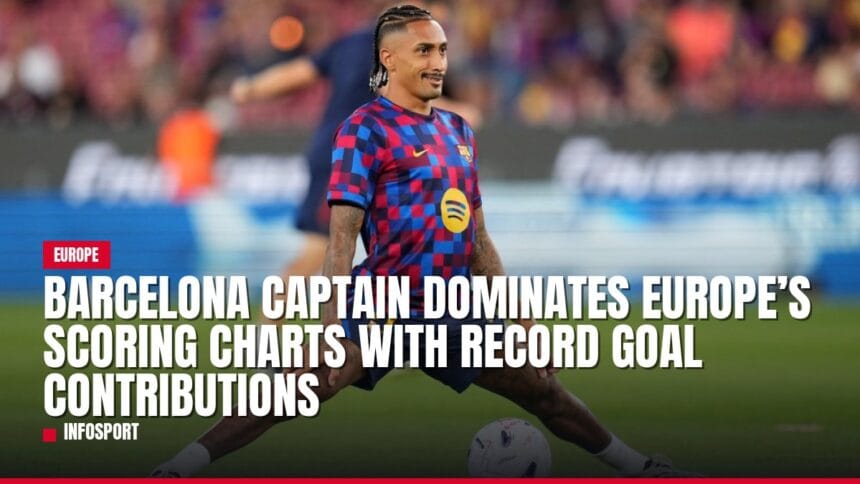
Barcelona’s unbeaten start to the 2026/27 season has been built on the prolific form of captain Raphinha, who continues to lead Europe’s major leagues in direct goal contributions. The 29-year-old Brazilian has been deployed as a centre-forward by manager Hansi Flick and has delivered consistently, though he narrowly missed a piece of club history on Sunday.
Raphinha failed to break the net in Barcelona’s 4-2 victory over Levante, denying himself the chance to join Cesar Rodriguez (1950/51) and Zlatan Ibrahimovic (2009/10) as the only Barcelona players to score in their opening five league matches. His two assists in that fixture—setting up Xavi Espart in the fifth minute and finding Lamine Yamal shortly after—ensured his impact remained decisive nonetheless.
Nine contributions in five games sets Barcelona apart
Raphinha’s output across La Liga has no peer in Europe’s elite divisions. After five league matches, he has accumulated six goals and three assists, directly influencing nine of Barcelona’s 21 total league goals. His combined tally across all competitions stands at eight goals and three assists, a total unmatched by any rival frontman.
The disparity between Raphinha’s numbers and those of Europe’s other leading marksmen underscores the scale of his dominance:
Premier League: Erling Haaland has netted four times for Manchester City with no assists. Serie A: Donyell Malen of Roma leads with five goals but zero assists. Ligue 1: Amine Gouiri (Marseille) and Kamory Doumbia (Brest) have four goals apiece without assists; Paris FC’s Lassine Sinayoko has also scored four times. Bundesliga: Igor Matanović (Freiburg) and Patrik Schick (Bayer Leverkusen) have three goals and one assist each.
More Read

Creating beyond the final ball
Against Levante, Raphinha’s contribution extended well beyond his goal involvements. He created three chances—more than any teammate—and completed three successful dribbles, a figure matched only by Lamine Yamal among Barcelona’s attacking players. He registered two shots, one of which found the target, yet his true value lay in his orchestration of play across the final third.
This expanded influence reflects Flick’s tactical deployment of the Brazilian. Rather than functioning solely as a predatory finisher, Raphinha has become a playmaker-forward hybrid, pressing opposition defenders, driving possession forward, and involving teammates in attacking sequences. His ability to combine goal contributions with chance creation has become the defining characteristic of his campaign.
Why Barcelona’s six-from-six success rests on Raphinha’s versatility
Barcelona’s perfect record across all competitions owes substantially to having a captain capable of both finishing and creating at elite level. Raphinha’s dual threat—scoring prolifically while simultaneously unlocking teammates—removes the predictability that often haunts teams built around a single focal point. Flick has positioned him centrally to exploit this, allowing him to receive the ball in dangerous areas and distribute rather than simply shoot. With competing sides relying on specialists who excel in isolation, Barcelona’s model of a forward who contributes across multiple attacking phases provides structural advantage. The missed opportunity to join Rodriguez and Ibrahimovic in Barcelona’s scoring-streak record is thus secondary to the broader reality: Raphinha is reshaping how the position functions under his captain’s armband.
More Read