The crowning achievement of Morocco’s rise as a global football power was its incredible 2022 FIFA World Cup run.
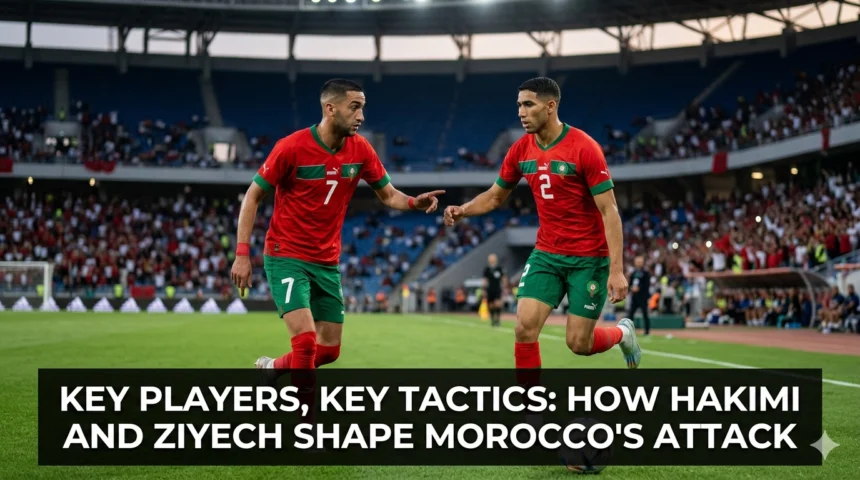
Achraf Hakimi and Hakim Ziyech are two great talents who are the heart of their attacking success. Morocco’s attacking game is built on individual brilliance and the extraordinary understanding between players on the pitch. To understand the tactics and playing style of the Morocco national team, we need to look at how these players work and how their diverse skills fit into the overall tactical system. It examines the functions they play, their synergetic relationship, and the tactical nuances that make Morocco’s attack so potent.
Hakimi and Ziyech are not your typical star players but tactical anchors with explosive runs down the right flank, precise passing, and set-piece expertise. Morocco has become a real challenger, able to take on anyone thanks to their consistently high-pressure displays. Their capacity to switch positions and create numerical advantages speaks to their understanding and Walid Regragui’s smart tactics.
Hakimi in Flux: the Attacking Full-back Engine
Achraf Hakimi is one of the best offensive full-backs in the world. Much more than a defender, he is a primary offensive weapon for Morocco. His pace, stamina, and technical ability are such that he can dominate the whole right-hand side and make a major contribution both attacking and defending.”
Overlapping Runs Creating Width
Hakimi’s trademark is the explosive overlapping run. He also starts from defensive positions, but then surges forward, often beyond Morocco’s right winger, to provide width and an extra attacking outlet. These raids stretch opposition defences, forcing opposing fullbacks into tough tactical decisions: mark Hakimi and give the winger interior space, or stay deep and let him receive the ball in dangerous areas.

This constant, overlapping threat is vital in creating central space and unlocking half-space opportunities. This means Morocco’s attack is not predictable; there are options for cross-field switches and quick transitions that destabilise opponents.
Ability to Pinpoint Crossing
Hakimi’s crossing skills come to light once in advanced positions. He is a constant threat in front of the goal, whether that’s driving low balls across the six-yard box or lofting them towards the back post. He has a knack for finding teammates in crowded areas, often picking out strikers or late-arriving midfielders with pinpoint accuracy.
His delivery from deep or down the byline gives Morocco’s attack some variety in the dimension, providing service for aerial threats and runners in the box alike. This strength is especially useful against tight defences, providing Morocco a way to get through the crowded middle.

Interactions and Combinations
Hakimi is a smart footballer who participates in intricate link-up play, as well as sprinting and dribbling. He forms important triangles with the right winger, often Ziyech, and the central midfielder nearby. Morocco’s quick exchanges enable them to split defensive lines, keep the ball in tight spaces, and move up the field quickly.
His ability to play one-twos in tight areas ensures attacking moves are always fluid and unpredictable. This dynamic is a key element of how he and Ziyech combine forces to break down defences.
Ziyech: The Creative Genius of the Right-Winger Playmaker
Hakim Ziyech is the creative brain behind Morocco’s attack. On the right flank, he avoids the usual tactic of sticking to the touchline. Instead, he is brilliant at drifting into the centre, controlling the play, and dictating the attack. He can pick locks on defences with one-off passes or spectacular strikes; his left foot runs like clockwork.
Drifting Inward and Visionary Passing
Ziyech often comes inside from the right wing on his natural left foot. This inward drift creates a multitude of opportunities, shots on goal, through balls to forwards, or switches of play to the other flank. “He has great vision; he sees runs and spaces that other people might not see.
His incisive passing, often curled around defenders, has been a key weapon. Perfectly weighted balls can tear organised defences apart, creating real chances to score. The inward movement also enables Hakimi to overlap, creating dynamic interchange on the right.
The Specialist From Set-Pieces
Ziyech is just as good with his left foot from set-pieces. He is Morocco’s primary taker of corners and free kicks, and he delivers them with pace, curl, and accuracy.
More Read

He is a consistent threat from set pieces, helping Morocco become a dangerous set-piece threat.
Whether it’s inswinging corners aimed at towering defenders or direct free kicks dipping towards the top corner, Ziyech’s expertise adds significant attacking dimensions. Often, these are the moments that win tight matches.
Threat of Scoring from Outside
When Ziyech cuts inside, he often finds himself in positions that allow for unconventional shooting.
His long-range shots are powerful and accurate, and can catch goalkeepers out. Speculative shots do more than threaten a goal; they force defenders to close down quickly, potentially creating space for teammates.
His ability to score crucial goals from the most unlikely of positions makes him a constant threat to be respected and handled with care.
Hakimi and Ziyech: Synergy and Collaboration
It’s in their synergy that their real sophistication lies. They can read each other’s moves, and they operate with the sort of coordination you’d expect from a single unit down the right flank. This partnership is a strong example of tactical collaboration within Morocco’s global system.
Dominate the Right Flank
Hakimi and Ziyech combine well to create a dangerous overload in attack on the right side. Ziyech cuts inside; Hakimi goes on the outside. The defenders have to decide who to pick up. Either option allows for the other. This constant positional interchange makes defensive organisation very difficult.
They often swap with the right-sided central midfielder to create a dynamic triangle, which allows for quick retention of possession and progressive play through the thirds.
Rotation and Bluff
They have a tactical relationship that is fueled by smart rotational movement. Ziyech might start wide and come inside, with Hakimi starting deeper, and then they interchange. Such constant fluidity does not allow defenders to return to predictable schemes.
This positional interchangeability provides numerical advantages in certain pitch areas, particularly the right side, overwhelming individual markers and creating passing opportunities.
Strength on the Counter
Both players possess phenomenal speed and vision, which makes them deadly in transition. When Morocco has the ball deep, the speed of Hakimi, combined with the passing range or cutting runs of Ziyech, means they can quickly progress the ball and are clinical in transition. Ziyech will get the ball, drag defenders away from their positions and send Hakimi through into acres of space, which is cruel when you’re committed up the other end.
The duo is especially good at quick transitions.
How to break down low blocks
When the opponents are deep, it’s all about individual quality. Hakimi’s crosses cut through congested central zones, and Ziyech’s deft passes and long-range shots find avenues through defensive lines. Individually and collectively, they are constant threats that force difficult decisions on defenders and create exploitable space.
In their ability to provide quality service from large areas or through central penetration, they are of great value against well-organised defences.
Regragui’s Masterplan: Getting Hakimi and Ziyech to Work Together
“Walid Regragui has integrated both players seamlessly into his tactical setup. Walid Regragui’s coaching philosophy, outlined in”t Walid Regragui’s Coaching Philosophy, is one of defensive stability with creative expression for his star talents.
Freedom of Structure
Regragui knows that unlocking the full potential of these players requires creative freedom. He is rigid in his defensive structure, especially in midfield and on the back line. Still, his attacking wide players are given freedom to roam, interchange, and make decisions in the final third.
This balance of structure and freedom is important. Midfielders like Sofyan Amrabat have defensive discipline that allows Hakimi to go forward aggressively without leaving the defence exposed, knowing there is cover behind him.
What They Do in a 4-3-3 System
This Morocco 4-3-3 formation is mostly used and suits both players perfectly. Hakimi is a right-back, but when he attacks, he often plays like a wing-back or even an auxiliary winger. Ziyech is a right-sided player who often drifts inside into the number-10 channel.
Once in possession, though, the system changes dynamically with Hakimi pushing forward and Ziyech drifting into central attacking areas to create fluid shapes that are hard for opponents to pick up on. Regragui’s approach is a testament to this flexibility, as can be seen in his World Cup strategy.
Changing Tactics and Dealing with Opponents
Regragui’s tactical flexibility is evident in how he adjusts instructions depending on the opponent. They are still central to their roles, but there are other directives. Hakimi may curb his forward runs against attacking opponents to cover defensively better. The midfield and left-back compensate for the defensive shortfall, and both enjoy more attacking freedom against defensive blocks.
This sophisticated approach enables them to adapt their tactics to the specific demands of each game.
Impact on Morocco’s attack overall
Together,r they are more than the sum of their parts, and they take the whole of the Moroccan attack to another level, one that is dynamic, unpredictable, and fearsome.
Contribution to goals
Both players contribute directly to scoring, either with goals or assists. Hakimi’s crosses and cut-backs result in tap-ins or headers, while Ziyech’s through balls, set-piece delivery, and shots directly create goals. Their presence means Morocco has several ways to score.”
Even when the team is not playing well, they can turn the game around through their individual excellence and brilliance.
Making Room for Others
They draw multiple defenders to open up space for teammates.
Ziyech’s inward drift draws centre-backs out of position, creating space for the striker to run into. Hakimi’s overlaps push opposing wingers back, preventing them from pressing Morocco’s central midfielders.
They attract defenders’ attention, giving players like Sofiane Boufal and Youssef En-Nesyri greater freedom to operate.
Psychological Advantage
Having them on the team sheet is a psychological advantage. They are respected for what they can do, and their opponents work hard to make them ineffective. Sometimes this respect is expressed as defensive caution, and Morocco takes advantage of it. The big-match experience and pressure-performance record breed confidence among teammates that game-changing talent is in the squad.
Obstacles and Transformations
They are very effective, but their use in practice does have some challenges that need to be handled carefully.
Dependence on Key Players
Over-reliance on two-star players comes with risk. Missing through injury or suspension could have a massive impact on attacking output. “Regragui will have to find workarounds and plan B tactically to offset this weakness.”
We continue to develop depth at these key attacking positions as an organisational priority to ensure performance stability regardless of availability.
Defensive Weaknesses
Hakimi’s attacking importance lies in his aggressive forays, while his defensive importance lies in his aggressive forays; Morocco’s defensive gaps in the midfield and centre-back cover mean well-organised opponents with quick wingers could exploit the space behind them.
“It’s always a key point to balance his attacking freedom with defensive responsibility, especially against teams who counterattack well.
Opponent Strategy Change
Morocco’s success makes it harder for opponents to adapt. Teams can use double-marking, fixed man-marking, and changes in formation to limit supply lines or available space. Morocco must continue to evolve its approach, finding new ways of integration and defensive exploitations.
This is part of the overall tactical evolution that comes with sustained competitive success.
Final Verdict
Achraf Hakimi and Hakim Ziyech are not just players with individual talent. They are the reflection of Morocco’s tactical identity and attacking philosophy.” Their speed, tech skill, vision, and synchronicity combine to make a formidable threat on the right side that is difficult for opponents to contain. They’ve been expertly woven into Walid Regragui’s system, directly contributing to goals and creating space and opportunities for teammates.
As Morocco continues their international progress, this partnership will undoubtedly remain central to its attacking approach. They can create moments of magic, and they can also contribute on a tactical level. That means that the Atlas Lions will give the elite of football headaches for years to come.
FAQs
Q1: How do Hakimi and Ziyech combine in Morocco’s attack?
A1: The two link up with overlapping runs and complex one-twos down the right side. Ziyech also drifts inwards often, drawing defenders away and opening up space for Hakimi to make his explosive runs. They create overloads by using quick passing combinations and rotation moves to confuse the opposing defences.
Q2: What exactly is Achraf Hakimi’s tactical role for Morocco on attack?
A2: Right-back Hakimi is a very attacking player and often plays as a wing-back. He can provide width with his overlapping runs, put in accurate crosses, and is also good at quick passing sequences to get the ball up the field. He acts as a primary offensive outlet down the right side.
Q3. How does Hakim Ziyech help Morocco’s attack from the right wing?
A3: Ziyech is a creative playmaker coming from the right wing. He likes to cut inside on his left foot to take a shot, play a through ball, or switch play. He is also Morocco’s go-to set-piece specialist, with deadly corners and free kicks, and he still has a powerful long-range strike.
Q4: How do Hakimi and Ziyech’s attacking styles fit with Walid Regragui’s coaching philosophy?
A4: Regragui has defensive discipline with attacking flair. The 4-3-3 gives Hakimi and Ziyech the freedom to move around, swap positions, and make decisive attacking plays, while the midfield and defence provide the cover needed to remain solid at the back.
Q5: What are the biggest problems with Morocco’s attack through Hakimi and Ziyech?
A5: The major concern is the dependence on two key players who could see a drop in attacking output when they are not available. Hakimi’s forward positioning can be a defensive vulnerability. Regragui also needs to keep adjusting tactically as opponents study and devise ways to neutralise them more and more.