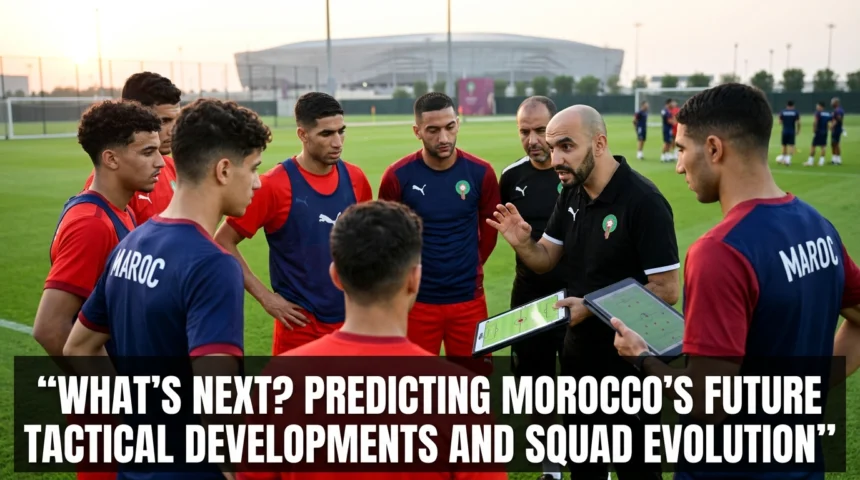
Morocco’s fairy-tale run at the 2022 FIFA World Cup captured the imagination of the world with a blend of tactical discipline, individual brilliance, and collective spirit. Under the wise guidance of Walid Regragui, the Atlas Lions built a strong identity and took the team to new heights for an African nation. As the footballing world looks ahead, one key question looms large: What tactical shifts are in store for Morocco, and how will the squad evolve to sustain and build on this success? To forecast the next stage, we need to consider our strengths today, our growth potential, and our emerging competitors.
Regragui’s foundation has set the bar high, but stagnation is not an option in modern football. This article looks at possible tactical evolutions and squad development that could dictate Morocco’s path, keeping them a powerful force on the international stage.
The Bedrock: Building on Regragui’s Legacy
Walid Regragui’s era has been characterised by pragmatism and efficiency. His blueprint for the 2022 World Cup was stark: defensive solidity, midfield control, and blistering counter-attacks. This style, often with a 4-3-3 formation that could easily become 4-1-4-1 or 4-5-1 when out of possession, was very hard to overcome even for the best teams in the world.
The triumph in Qatar came from a careful plan and a good understanding of the squad’s capabilities. The team were highly adaptable, tailoring their approach to the opposition but sticking to the fundamentals.
Playing to your strengths
Any discussion of Morocco’s future must start by acknowledging and strengthening the qualities that drove its success. Their hallmark was perhaps their defensive fortress, built on a compact backline and intelligent pressing. Nayef Aguerd and Romain Saïss were a formidable central defensive partnership. Achraf Hakimi and Noussair Mazraoui provided both defensive solidity and offensive thrust from the flanks. This defensive base will surely stay a priority.

The midfield was the vital link between defence and attack, with Sofyan Amrabat’s tireless ball-winning and Azzedine Ounahi’s flashes of creativity powering it. It was important they could break up opposition play and get quick transitions going. Their speed and precision in counter-attacking up front, often with Hakim Ziyech and Sofiane Boufal, did well to exploit spaces left by opponents pushing forward.
Why the Need for Tactical Evolution?
These are undeniable strengths, but relying on them alone risks predictability. Rivals will be looking to Morocco’s World Cup blueprint to find ways to nullify their favoured approach. So the next step must be evolution, building new dimensions onto their game while keeping the established base. This will be key for long-term success and preparedness against different opponents in different tournament situations.
Looking Ahead to Future Tactical Developments
To stay ahead, Morocco will probably add more flexibility and a wider range of approaches in the different phases of play. This evolution is not a renunciation of their defensive resolve but an augmentation of it through improved offensive capabilities and subtler transitions.

The Evolution of Offensive Play: More Possession, Changing Attacking Patterns
One development they foresee is a slow move towards more controlled possession, especially against teams they should boss. Counter-attacking will always be a powerful weapon, but the ability to break down well-organised defences through sustained pressure and intricate passing will be vital.
Counter-Attack to Control
Morocco’s World Cup success was built on absorbing pressure and hitting opponents on the break. It is effective, but this style can be gruelling and not always suitable when they are favourites. The coaching staff are likely to focus on improving the build-up from the back, encouraging defenders and midfielders to be more comfortable on the ball under pressure. This is more complex passing in the middle third, and more emphasis on positional play to create passing lanes.
That evolution would give them more chances to control the tempo of the game, saving energy while annoying opponents who like to sit deep. It’s a game that requires players with good spatial awareness, technical skill, and composure under pressure.
Width and Rotations Work
A lot of their width is coming from the attacking full-backs, and especially Hakimi at the moment. Another dimension would be effectively diversifying wide play. It could be wingers who are good in one-on-one situations, cutting inside or driving to the byline and putting in crosses. The interchange among wide players, attacking midfielders, and full-backs can confuse the opposition’s defence and create new attacking opportunities.
And it would need strikers capable of linking play, dropping deep or making intelligent runs into space rather than just being target men. The idea is to make attacking patterns less predictable, thereby making them harder to defend against.
Defensive Changes: High Pressure and Flexibility in Positioning
Their low block and compact defence were exemplary, but future approaches may see a more aggressive, higher press in some situations. This would allow them to regain possession closer to the opponent’s goal, leading to immediate attacking opportunities.
Elevating the Press
A more aggressive, more collective press might be useful against teams that play from the back. This means forwards and attacking midfielders have to press smartly, closing down passing lanes and forcing turnovers. It requires a high level of fitness and tactical understanding to perform it effectively without leaving dangerous space. It’s not just about winning the ball but winning it in dangerous areas, quickly leading to transitions and shots on goal.
More Read

Flexible defensive formations
Regragui’s World Cup strategy often saw a switch between a 4-3-3 and a 4-5-1. Future versions might be a bit more flexible in their positioning, perhaps trying a three at the back in some situations or more fluid defensive formations to suit the opposition’s shape and movements. That would mean defenders who are comfortable playing in multiple roles and systems.
Midfield Mechanics: Creativity and Flexibility
The middle of the field has been the heart of their team. If we are to succeed in the long term, we need to focus more on developing versatility and creativity in this important area.
How Advanced Playmakers Make a Difference
Morocco could do with developing or incorporating more traditional advanced playmakers, even though Ounahi provided creative sparks at the World Cup. Through balls, incisive passes, and intelligent movement between the lines could help players consistently unlock defences and add another attacking dimension. This could mean a change to the midfield triangle, perhaps moving from a purely defensive pivot to a more balanced midfield consisting of one defensive midfielder and two box-to-box or attacking-minded players.
Box-to-Box Energy and Distribution
In the modern game, midfielders have to move around, win tackles, and distribute the ball. In the future, we will continue to look for box-to-box midfielders who can contribute both offensively and defensively. The emphasis will be on players who, beyond winning the ball, can launch attacks with precise long passes and smart combinations, integrating smoothly into the attacking unit.
Creative with set-pieces
Morocco had moments of brilliance from set-pieces at the World Cup, often using them to relieve pressure or create opportunities. “Expect more sophisticated routines offensively and defensively moving forward. This includes a variety of delivery methods, decoy runs, and creative blocking schemes to maximise these vital opportunities.
Squad Evolution: Adding New Talent and Keeping Depth
Tactical evolution has to go hand in hand with squad development. As key players get older or leave, bringing in new talent is important to stay competitive. The national team has a deep diaspora and an expanding domestic league to draw from in producing potential stars.
Goalkeeping: Locking down the next generation
Yassine Bounou has proved his quality as a world-class goalkeeper, but replacing him remains a key long-term task. The emphasis will be on young keepers with decent shot-stopping skills, a strong presence in their area, and increasingly decent distribution skills to complement possession-based philosophies. The Moroccan league and its youth academies will be vital for scouting purposes.
Defensive Additions: Pace, Ball-Playing, and Versatility
We have a good defence. But the way we play in the future requires more qualities. Defenders who can play a high line with pace and start attacks with their ball-playing ability will be in demand, and they must also be strong and good in the air. Wing-backs who can seamlessly switch between defensive duties and provide width in the future will be crucial. Having more versatile defenders who can play all across the backline will greatly increase our tactical flexibility.
Midfield Masters: Growing Creativity and Control
It’s a huge challenge to replace the energy and creativity of players like Amrabat and Ounahi. The priority will be to develop midfielders with a combination of defensive diligence, flair, vision, and pinpoint passing. It will be important to encourage young players to dictate the tempo, break lines with passes, and score goals. European clubs and the Moroccan league will be out searching for such talent.
Offensive Strength: Forwards and Wingers
One area that needs improvement is goal-scoring from open play. The evolution of the squad will be about finding and developing clinical strikers who can lead the line, hold up play, and put chances away. At the same time, the wingers, with their exceptional dribbling skills, speed, and goal-scoring prowess, will be key in providing width and breaking down opposition defences. “There will be organised team play, with moments of individual brilliance to go with it.
Role in Diaspora and Domestic League
Morocco has long reaped the benefits of a big diaspora, with many of its key players having emerged from European academies. This trend is likely to continue, providing access to players exposed to top-level football at the youth level. At the same time, it’s important to work on the Botola Pro (Moroccan domestic league) and its academies. Building the local talent pool is a sustainable way to find players who understand Moroccan football culture and fit seamlessly into the national team setup. This talent pool is constantly intermingled with the evolution of their tactical approach.
Possible Challenges and Opportunities
The future looks promising, but several challenges and opportunities will shape tactical and squad developments.
Consistency and Performance Standards
The biggest challenge after a breakthrough performance is consistency. Opponents will now have more respect for and better tactical preparation against Morocco. The Atlas Lions should not be complacent and must continue to evolve to stay ahead. This requires strong leadership on and off the pitch and a constant desire to improve.”
Dealing With Opponent Strategy
As Morocco becomes better known, opponents will surely change their approach accordingly. Teams can sit deep to deny space for counter-attacks or push higher up the pitch to disrupt buildup. The ability to be tactically adaptable and to come up with multiple game plans will be huge. This is where tactical adaptability, which is a hallmark of recent success, needs to be further sharpened.
Injuries and Player Burnout
“The demands of modern football are great. Player fitness, injury prevention, and burnout mitigation will be critical. Long qualification campaigns and big tournaments will need a deep squad with quality backups in all positions. “This shows we need to keep developing the squad and scouting for talent.
Conclusion: A bright future for the Atlas Lions
There’s no doubt that the future is bright for Moroccan football. The Atlas Lions, following their brilliant performance at the 2022 World Cup, are set to build on that. They should get more versatile on offence, more methodical with the ball, and more advanced with their press, but still be good defensively.
The squad is going to evolve with a constant flow of talent from the diaspora and a strengthening domestic league; players who have the technical prowess, physical attributes, and tactical intelligence required for modern football are coming in. There are challenges ahead, but the foundation is good, the ambition is clear, and the potential for the Atlas Lions to secure their place among the elite of football remains huge. It’s going to be a fascinating journey.
FAQ Part
What are Morocco’s potential tactical evolutions going forward?
It is anticipated that future methods will evolve into a more balanced style, incorporating controlled possession and a higher, more aggressive press while retaining defensive solidity and a counter-attacking threat. They will probably want greater versatility in offensive patterns and more creativity in midfield.
How will the Moroccan team evolve in the next few years?
The squad will change with new blood from the Moroccan diaspora and the local league coming in. This includes the identification and development of goalkeepers, pacey, ball-playing defenders, creative and versatile midfielders, and clinical goal scorers, and wingers to ensure depth and quality across all positions, he added.
Will Walid Regragui change his coaching approach for future challenges? As a child, I loved all the stories from the Bible.
Walid Regragui’s core coaching philosophy of pragmatism and team spirit will probably stay the same, but his tactical approach will need to change. Strategy needs to evolve beyond the current approach to incorporate a wider range of attacking options and defensive shifts to counter opponents who have had time to analyse Morocco’s World Cup success.
How will the 4-3-3 system be incorporated into future Morocco tactics?
The 4-3-3 system, or its variations, is likely to remain a fixture due to its flexibility. But expect more dynamic interpretations, with fluid transitions into other shapes—such as a 4-2-3-1 or even three at the back—depending on the opponent and the game situation, with tactical flexibility as the emphasis.
What obstacles could Morocco face in implementing these future tactics?
Key challenges will be consistency after their World Cup success, adapting to opponents who will now see them in a different light, and managing player injuries and burnout after a gruelling football calendar. Maintaining team cohesion while successfully integrating new talent will also be crucial.