
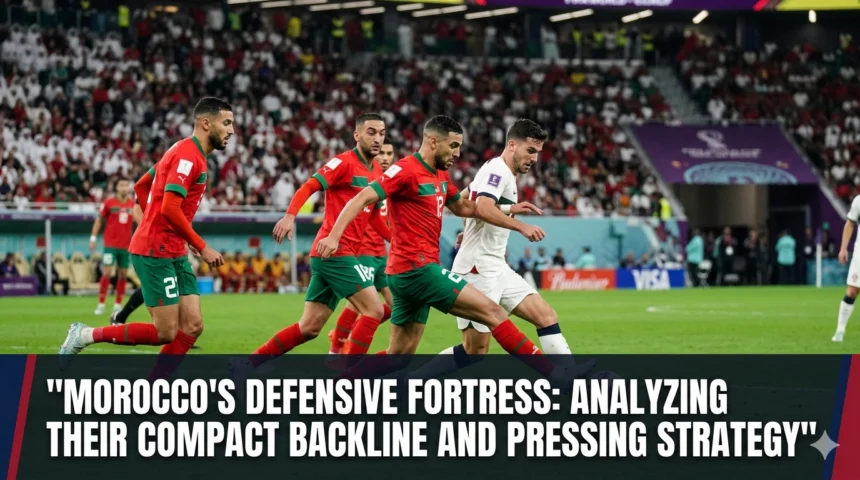
The Moroccan football team has been winning hearts around the world with its mix of passion, skill, and tactical discipline. The foundation of their sensational success, most notably their historic run at the 2022 FIFA World Cup, is a rock-solid and well-drilled defensive system. In this article, we take a look at the intricacies of Morocco’s defending, their compact backline, smart pressing game, and the collective effort that makes them an impenetrable fortress. Fully understanding the factors important to appreciating the broader tactics and playing style of the Morocco national team.
The Basis of Morocco’s Defensive Success
The strength of the Atlas Lions’ defence is no accident; it is based on a clear philosophy, strict coaching, and the players’ unwavering commitment. They focus on taking away space, making it hard for the opposition, and turning defensive actions into opportunities to attack.
Walid Regragui’s Defensive Philosophy: A Pragmatic Approach
Morocco has also adopted a pragmatic but very effective defensive philosophy under coach Walid Regragui. Regragui, whose coaching philosophy focuses on collective effort and defensive solidity, believes that a strong defence is the foundation of any successful team. He gives everyone, from the goalkeeper to the most advanced player, a sense of responsibility so that everyone knows their defensive roles. His approach is not about sitting deep but intelligent organisation, anticipation, and quick transitions to make the team’s system both resilient and dangerous.
Compact Formation Backline: A Solid Wall of Four or Five
One of the defining characteristics of Morocco’s setup is its incredibly compact back line. Though they typically begin in a 4-3-3 system, this formation generally drops back defensively into a 4-5-1 or even a 5-4-1, forming a tight, unbreachable block. Having little space between the defensive line and midfield is key, not giving opponents pockets to exploit. That tightness forces the opposing teams out wide, allowing Morocco to apply pressure with their numerical superiority. The compact nature of this structure makes it very hard to get through the middle and forces opponents into predictable wide play or shots from distance.
Dissecting Morocco’s Compact Backline
The efficiency of this defensive block depends largely on individual quality and collective understanding.

Central Defensive Partnership: The Backbone of the Defence
Morocco has a strong central partnership at the heart of the defence, with the likes of Nayef Aguerd and Romain Saiss. These defenders are physically imposing but with great positional awareness, aerial ability, and crucial communication skills. They are aware of danger, make good interceptions, and are rarely out of position. Their reading of the game and covering for one another creates a reliable barrier that is incredibly hard to break down, providing the security that allows teammates to go about their roles with confidence.
Discipline in Full-Backs and the Awareness to Overlap
Morocco’s full-backs, especially Achraf Hakimi and Noussair Mazraoui, are renowned for their offensive contribution. But their defensive discipline is just as important to the team’s system. They are urged to overlap and provide width in attack, but are drilled in recovery runs and in marking the opposition wingers. This balance is exemplified by Hakimi, who displays amazing stamina and dedication to sprinting back to negate threats down his flank, as discussed in Key Players, Key Tactics: How Hakimi and Ziyech Shape Morocco’s Attack. Their ability to mix attacking flair with defensive responsibility is key to keeping the team in shape.
Midfield Shield – Defending the Defending
The midfield, especially the defensive midfielder, is a crucial barrier in front of the defence. This is the role that Sofyan Amrabat plays, a man defined by his relentless energy, ball-winning ability, and tactical intelligence. He defends, breaks up play, wins second balls and closes down passing lanes, preventing opponents from getting through to the central defenders. He makes defenders comfortable doing their jobs because they know they have good protection in front of them. His role is critical and is described in detail in The Midfield Engine: Key Roles and Tactical Contributions of Morocco’s Midfielders.

Pressing in Morocco: Intelligent and Cohesive
They defend not just with a compact low block but also with intelligent, coordinated pressing, trying to break up the opponent’s build-up and win the ball high up the pitch.
High Press or Mid-Block: When To Use It
The Moroccan pressing is not one-size-fits-all. They are good at playing a mid-block and, in some situations, a high press. Against better possession-dominant teams, they often sit in a well-organised mid-block, allowing opponents to retain possession in their own half while denying central attacking space. It saves energy and draws opponents forward. This opens space for counterattacks. But against sides they feel they can bully, or when the opposition shows frailty in their build-up, Morocco can unleash a ferocious high press. Their adaptability to situations is a sign of their advanced tactical thinking.
Coordinated pressings and traps
The Moroccan press is strong because it is coordinated. All the players know the exact triggers for the start of the press: a bad pass, a heavy touch, a defender with his back to goal, or a pass into a wide area. Once a trigger is found, the whole team moves as one, often setting traps by letting opponents move into open spaces before swarming the ball carrier from several angles. When groups of players move like this, they force the opposition into mistakes in dangerous areas and turn defensive pressure into instant attacking opportunities. Wingers are crucial in marking opposition wide players, while central midfielders cut off passing lanes, creating a suffocating environment.
The role of the attackers in defensive pressure
Morocco’s forwards, like Youssef En-Nesyri, and wingers, such as Sofiane Boufal and Hakim Ziyech, are more than just goal scorers; they are the first line of defence. The way they apply pressure from the front is a key part of the team’s overall system. They chase down opposition defenders and goalkeepers, forcing rushed clearances or wayward passes. They intelligently cut off passing lanes and channel play into pressing traps that take the opposition into bad places. Ziyech is a player you can trust to lend a hand in defence, and his dedication to tracking back and pressing is admirable. He can help bring the team together defensively, as discussed in Key Players, Key Tactics: How Hakimi and Ziyech Shape Morocco’s Attack.
Defensive Solidity Important Points
But Morocco’s defensive record isn’t just about formations and pressing schemes.
The Excellence of Goalkeeping: The Impact of Yassine Bounou
A good goalkeeper is always the basis of a good defence, and Yassine Bounou (Bono) is a great example of this for Morocco. “His shot-stopping ability, his command of his area, and his composure under pressure are all top class.” “Bono’s dependability gives his defenders confidence in the knowledge that they have a world-class keeper behind them. His distribution also permits quick counterattacks, making him vital in defensive and offensive transitions.

Tactical Flexibility and Changes During the Game
Tactical nous from Walid Regragui and the adaptability of his players are the keys to success. Morocco is not rigid; they adapt their game plan depending on the opponent, the scoreline, and the flow of the match. “Their tactical adaptability guarantees their system’s effectiveness across different scenarios, whether it’s switching from a 4-3-3 to a 5-4-1 to protect a lead or increasing the press to chase a goal. They are flexible, and this gives them an unpredictable defensive posture.
Team Spirit and Work Ethic
Maybe the most underrated but most fundamental aspect of Morocco’s success is the incredible team unity and non-stop work rate. Everyone is prepared to run, track back, and cover for one another. You can feel it in the air. There is a sense of unity and purpose. Individual egos are sacrificed for the good of the group. This attitude is evident in many moments of desperate blocks, last-ditch tackles, and tireless tracking back, making them a really difficult team to break down.
Morocco’s Defensive Strategies: Case Studies in Practice
On the biggest stage, Morocco’s system was tested to the ultimate and delivered historic results.
2022 World Cup performance – Defensive masterclass
Defensive excellence largely paved Morocco’s path to the semi-finals of the 2022 FIFA World Cup. Before the semi-finals, they had conceded just one goal, an own goal, and kept clean sheets against formidable opponents in the shape of Croatia, Belgium, Spain and Portugal. Especially in the matches against Spain and Portugal, we saw the perfect definition of their defensive organisation and pressing plan. In these matches, Morocco soaked up huge pressure, remained disciplined and executed their counterattacking game plan with devastating effect. This historic run is a testament to Walid Regragui’s Masterplan and the players’ belief in the system.
Overcoming Elite Resistance
A major factor in Morocco’s quality has been its ability to frustrate elite attacking sides. They are capable of denying space, forcing turnovers, limiting clear-cut chances, and shutting down even the most potent attacking units. Their shape is so compact that creative players struggle to find pockets of space, and the quick transitions punish any lapse in concentration by the opposition. They have earned worldwide respect and admiration for their ability to shut down world-class attackers consistently.
The Balance: Defence as an Offensive Platform
While they are rightly praised for their defensive strength, it is important to understand that Morocco’s system is not one of containment. That’s part of their offence.
Fast Breaks and Counterattacking Danger
One of the most exciting aspects of Morocco’s play is its ability to transition quickly from defence to attack. Quick counters can be expected after recovering possession, especially in midfield. Players such as Hakimi, Ounahi, and Ziyech have the speed, vision, and technical ability to move the ball quickly forward, taking advantage of the space left by opponents committed to attack. This instant transition from defensive solidity to offensive thrust is their hallmark and a key reason for their success. Their counterattacking ability is directly proportional to their defensive efficiency.
Using Space Created by Opponents
Morocco’s system lends itself to being exploited in the space behind their defence by inviting opponents to push further up the pitch and commit players to attacking positions. Once they win possession back, the ball is moved quickly to wide areas or in through the channels to target the pace of their wingers and the intelligent runs of their striker. This is a classic example of their overall sophisticated approach: they use defensive solidity as a platform to create attacking opportunities.
Morocco’s defensive effort is a lesson in modern football, with discipline, organisation, relentless work, and intelligent pressing. They have a good back four, protected by a hardworking midfield and well supported by committed front men, and that is a tough wall to break down.” That solidity has been the bedrock of their success under Walid Regragui, frustrating opponents while launching devastating counterattacks. The Atlas Lions have shown that a well-drilled defence and collective spirit can indeed win on the world stage. Their approach continues to be an interesting study in Moroccan national team tactics and playing style.
FAQ Part
What are the key tenets of Morocco’s defensive strategy?
The Moroccan way is based on compactness, not providing space centrally, and clever press triggers and work rate together. Their whole game is built on defensive solidity. But they focus on closing down space between lines and forcing opponents into wide, predictable areas.
What is Morocco’s standard defensive formation?
Morocco normally lines up in a 4-3-3, but when they are defending, they often fall back into a more compact 4-5-1 or even 5-4-1. That allows them to build a tight block, clog the midfield, and cover the central areas, making it hard for opponents to play through them.
Morocco’s main defensive players are
The main defensive players are the central defensive pair (for example, Nayef Aguerd and Romain Saiss), the defensive midfielder Sofyan Amrabat, and well-organised full-backs such as Achraf Hakimi and Noussair Mazraoui. Goalkeeper Yassine Bounou is also key for his shot-stopping and authority in the area.
The Moroccan pressing system:
Morocco uses a coordinated, situational pressing strategy. They can use a mid-block to save energy and to tempt opponents, or a high press when triggers such as a heavy touch or a misplaced pass occur. The entire team plays as one to deny space, cut passing lanes, and create turnovers, often in specific “traps” designed to get the ball back.
What does Morocco’s defence bring to the table on offence?
Morocco’s system is crucial to their attack, creating opportunities for rapid transitions and counterattacks. They recover the ball quickly and efficiently, usually in midfield, and immediately launch swift counterattacks into areas vacated by committed opponents. This allows them to exploit the pace and skill of their wingers and midfielders.