
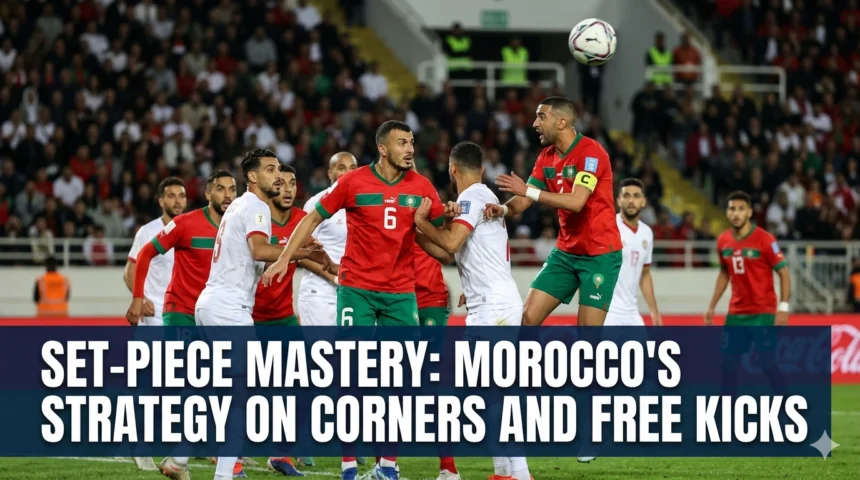
Modern football is a game of fine margins, where every detail can be the difference. Set-pieces have become a key part of the tactical make-up of the Morocco national team under the shrewd guidance of Walid Regragui. Morocco’s set-piece tactics are not an afterthought but a planned, rehearsed routine that turns corners and free kicks into genuine scoring chances and solid foundations to defend from. This detailed approach to dead-ball situations reflects the Morocco national team’s strategic depth, an important aspect of its tactics and playing style.
Aside from their defensive and counter-attacking strengths, the Atlas Lions’ incredible run, especially at the 2022 FIFA World Cup, demonstrated their prowess in set-pieces at both ends. In this piece, we examine the specific tactics Morocco uses, looking at how they exploit weaknesses of offset pieces and how they shut down the opposition.
Morocco’s Set-Piece Tactics Will Be Key
Dead-ball situations can be overlooked in a game where open-play goals are often the main thing. But statistics always show that a large percentage of goals are scored from these moments. Their mastery is in Morocco’s favour on several points:
The following is the text:
- Goal scoring opportunities: Scoring goals from corners and free kicks adds another dimension to their attack, especially when up against teams that are hard to break down in open play.
- Relief and pressure release: Offensive set-pieces provide sustained pressure on the opponent’s goal, providing a brief respite for the Moroccan defence.
- Defensive solidity: Just as important to stop opposition goals from set-pieces.
- A well-drilled defensive unit reduces risk and keeps clean sheets.
- Psychological edge: Scoring from set-pieces boosts team morale and deflates opponents, while defending them well breeds confidence.
2.
Walid Regragui’s philosophy, explored in greater detail in Walid Regragui’s Coaching Philosophy: The Architect Behind Morocco’s Success, is all about pragmatism and efficiency. This leads to dead-ball situations where every routine is crafted with a specific purpose and executed with precision.
Offensive Set-Piece Mastery: Generating Scoring Chances from Corners and Free Kicks
Morocco combines tactical variety, intelligent movement, and quality delivery from their key players in their approach to offensive set pieces. They try to create confusion, exploit mismatches, and ultimately get the ball into dangerous areas.

Corner Kick Routines: A Collection of Weapons
The Atlas Lions don’t have one corner routine. Instead, they have a varied bag of tricks, often customised to the particular opponent or game situation. This is how they play: tactical flexibility, as covered in Tactical Adaptability: How Morocco Adjusts Their Game Plan In-Match.
Inswingers and Outswingers: How to Curve the Ball on Purpose
The most common are inswing and outswing deliveries. Hakim Ziyech is well known for his excellent crossing ability and is often the first choice. He is a deadly weapon, able to bend the ball with pace and precision. These deliveries are typically directed to:
- Near post runs: Nayef Aguerd or Romain Saïss, for example, will often make sharp runs to the front post looking to flick the ball on or get a direct header.
- Far post targets: Taller or aerially gifted players, such as Youssef En-Nesyri, will be at the far post, looking for direct headers or knock-downs.
- Goalkeeper interference: The way Ziyech delivers the ball often leaves the opposition goalkeeper in difficult positions, making it harder for them to claim the ball cleanly.
Short Corners: The Key to Tight Defences
Morocco often uses short corner routines against teams that defend with a deep, compact block. This tactic is designed to:

- Pull defenders out: Pulling defenders out of the penalty area creates space for other attacking players.
- Creating crossing angles: A quick pass can give the attacking player more space and time to get the ball, maybe opening up a better crossing angle or even a shooting opportunity outside the box.
- Intricate plays: Sometimes the short corner is used to make a pass or two, quick exchanges, to get around the first line of defence and make a cut-back or low cross into a dangerous area.
Precision, Not Power: Targeting Specific Areas
Morocco’s corner routines often target specific areas rather than simply lumping the ball into the box:
- The ‘corridor of uncertainty’: The space between the goalkeeper and defenders, where a well-placed cross can cause maximum chaos.
- The penalty spot area: A traditional target for powerful headers, often used by players on late runs.
- Cut-backs to the edge of the box: When defenders are pulled deep, a quick cut-back to a composed midfielder or full-back, such as Achraf Hakimi, whose offensive contribution is important as discussed in Key Players, Key Tactics: How Hakimi and Ziyech Shape Morocco’s Attack, can create a goal-scoring chance from a less congested area.
Free Kick Tactics: Direct Threat and Creative Plays
Morocco’s free-kick routines are equally diverse, with direct goal shots, elaborate crossing schemes, and smart short passes all in the mix.
Free Kicks: Ziyech’s Precision, Hakimi’s Power
Hakim Ziyech is the first choice to take penalties when within shooting range. He has loads of curl and dip on his left foot, making him a threat from 20-30 yards. Achraf Hakimi has a venomous shot; he hits the ball with venom. Such direct threats force opponents to tread carefully and open up other possibilities.
Crossing free-kicks: Air raids
Free kicks are often used to send crosses into the penalty area from wider positions or from deeper central areas. The aim is to recreate the corners: exploit the aerial ability and create scoring chances. Key elements include
What if I wanted to use the same value for multiple properties?
- Attacking set pieces: En-Nesyri, Saïss, and Aguerd are all aerial threats. Most of the deliveries are aimed at their heads, with some aimed at freeing them up.
- Second ball situations: Moroccan players are trained to look for loose balls even if the first header doesn’t go in. They look for tap-ins or follow-up shots.
- Blocking runs: Attackers will often make runs to block or get in the way of defenders, therefore creating space for teammates to attack the ball.
Short Free Kicks: Tactical Deception
Like corners, Morocco likes to take short free kicks, especially in non-shooting positions. This may include:
- Quick exchanges: A quick one-two to get around an opponent’s pressing line and switch the point of attack.
- Making overloads: Moving the ball swiftly and drawing defenders to one side, then switching the ball to an open man on the other side.
- Set plays for certain shots: Sometimes a short free kick will be followed by a well-rehearsed shot from a particular player, aimed at catching the defence off guard.
Defensive Set-Piece Organisation: Morocco’s Fortress
Morocco’s Defensive Fortress: How Their Compact Backline and Pressing Strategy W. Offensive set-piece tactics are meant to create opportunities, but Morocco’s defensive organisation is key to their success. A big part of their World Cup success was their ability to neutralise opposition corners and free kicks, conceding very few goals from such situations.

Defending Corner Kicks: Zonal Marking with Man-Oriented Responsibilities
Morocco usually defends corners using a hybrid system that blends zonal marking with man-oriented roles. It covers critical areas while tracing dangerous attackers.
Six Yards Box Coverage (Zone)
The biggest and strongest players are put in a core group who are assigned specific zones in and around the six-yard box and the penalty spot. The main thing is for them to go up and try to win the ball when it comes into their area, and to stop the other team from getting free headers in the most dangerous areas.
Man-Oriented Responsibilities: Countering Major Threats
In addition to zonal marking, some players will be given the task of man-marking the opposition’s most dangerous aerial threats. This means that even if a zonal marker is beaten, there is still a man-marking defender on the primary target. These two systems need to communicate to avoid leaving gaps.
Clearing Lines: First and Second Ball Hope
Moroccan defenders can read the ball’s flight well and make decisive clearances. More importantly, they are disciplined in reading second balls. If the first header or clearance isn’t perfect, Moroccan players quickly close down the loose ball to clear the danger or win possession, which is key to their defensive solidity.
Keeper’s Job: The Command of Bono
Yassine Bounou (Bono) is vital in defensive set-pieces. Good vocal communication and defensive command are his presence in the air. He steps out of position to claim crosses when the situation calls for it, relieving defenders of pressure. He always makes a good decision in these moments.
Wall Organisation and Group Discipline on Free Kicks
Free kicks are a whole other matter and can require a different approach, especially regarding quick plays and stopping them.
Wall – Formation and Discipline
Morocco sets up a good wall for direct free kicks within shooting distance. The number of players depends on distance and angle, but it is typically 4-5 players. Key aspects are:
- Height and stature: Taller players are positioned on the wall to block shots.
- Discipline: Players are instructed to stay in line until the ball is played to prevent gaps from forming.
- Blockers: Occasionally, a smaller player might lie down behind the wall to block any low shots from going under it.
Defending the Goal and Reading Crosses
For free kicks taken from wider or deeper positions that are more likely to be crossed, Morocco’s defensive shape is similar to their corner defence, with the following adjustments:
- Deep line: The defence will often drop deep to cut out runs in behind.
- Zonal marking in the box: Just like corners, players occupy vital space in the penalty area.
- Aggressive Headers: Defenders encouraged to attack the ball aggressively and clear it out of danger.
- Stopping quick plays: Players are alert to short free kicks and quick switches of play, ensuring they’re not caught off guard.
How the Midfield Engine is Disrupting Delivery
Midfield Engine: Key Roles and Tactical Contributions of Morocco’s Midfielders, especially players such as Sofyan Amrabat, are instrumental in stopping the opposition from delivering from set pieces. They often get in the way of short passes or press the free-kick taker, reducing the quality of the cross or shot.
How Morocco Trained and Prepared for Set-Pieces: The Basis of Morocco’s Set-Piece Tactics
The hard work that goes into training for set pieces is the reason Moroccans have been so effective. Those are things Walid Regragui and his staff spend a lot of time on.
Practice Routines: From Practice to Match Day
All offensive and defensive set-piece routines are drilled in training, over and over. Players know their roles, their movements, their responsibilities. The repetition creates muscle memory and ensures a flawless execution under pressure.
Video Analysis: Watching Your Opponents and Yourself
“There’s a lot of video analysis done to look at the strengths and weaknesses of opposition set pieces. Morocco’s coaches study opponents’ patterns of attack and defence in dead-ball situations and build their tactics accordingly. It is also important to self-evaluate, review your performance, and identify where you can improve.
Playing to Your Strengths: Player Specialisation
Regragui knows how to play to individuals’ strengths. Ziyech is the designated set-piece taker due to his exceptional delivery, while aerial threats like En-Nesyri and Saïss are positioned to maximise their heading ability. The specialisation makes their set pieces very good.
Examples of Morocco’s set-piece tactics from the World Cup 2022
Morocco’s proficiency in set-pieces was evident in many instances during the 2022 FIFA World Cup. Their passage to the semi-finals was also aided by set-pieces, built on defensive solidity, as revealed in Walid Regragui’s Masterplan: Dissecting Morocco’s World Cup 2022 Tactics.
Goal: En-Nesyri Header Vs Portugal
Arguably, the most iconic example was Youssef En-Nesyri’s header against Portugal in the quarter finals. It wasn’t a corner that was directly earned, but there was a cross into the box in the build-up, showing Morocco’s aerial threat. This goal showed they could hit the ball hard in tight spaces.
Spain and Portugal’s defensive resilience
Morocco, especially in matches against possession-heavy sides like Spain and Portugal, had to contend with several opposition corners and free-kicks in the tournament. But Bono and their commanding centre-backs marshalled an organised defence that closed off such threats, and they kept their defensive record intact. Their ability to transition fluidly between their 4-3-3 system (How Morocco Utilises Information Under Regragui) and a more defensive formation has strengthened their defence and set-piece defence under Set-Piece Tactics in Morocco
Under Regragui, Morocco’s set-piece tactics have reached a new level of sophistication, but the framework for solid dead-ball play has been in the making. The Atlas Lions have always had athletically gifted players who can challenge in the air. Still, the current focus on complex routines and tactical variation is a big forward step, as part of the wider” The Evolution of Atlas Lions Tactics: A Historical Perspective“.
“In the future, Morocco will be looking to refine and adapt their set-piece strategies further. There will always have to be innovation because opponents will no doubt study their routines. The coaching staff will likely incorporate fresh variations, tap into developing talent, and adjust the strategy based on the strengths and weaknesses of upcoming opponents. This ongoing evolution is essential for keeping their competitive edge.
Conclusion: Morocco’s successes owe a debt of gratitude to these unsung heroes
The unsung hero of Morocco’s recent international success story has been the mastery of set-pieces, both offensively and defensively. The type of planning that goes into set-piece tactics turns potentially humdrum moments into key opportunities. From Hakim Ziyech’s pinpoint deliveries to the aerial dominance of Romain Saïss and Youssef En-Nesyri and their impenetrable defensive wall, every detail is perfected.
The dedication is a testament to Walid Regragui’s holistic approach to coaching and the team’s commitment to tactical excellence. With the Atlas Lions still taking on the best in the world, their efficiency in dead-ball situations will surely remain a vital weapon alongside their solid defence and potent counter-attacking brilliance: speed and precision in Morocco’s offensive transitions. This means they remain a formidable force on the international stage, with every part of their game demonstrating their position as a tactically astute and disciplined national team.
Frequently Asked Questions about Morocco’s Set-Piece Strategy
Here are some common questions about Morocco’s corner and free-kick routines:
Why is Morocco’s offensive set-piece play so effective?
Morocco’s offensive set-piece tactics work for a variety of reasons: accurate delivery from players like Hakim Ziyech, different routines (inswingers, outswingers, short corners, and cut-backs), intelligent movement from players to create space and target specific zones, and the aerial threat from players such as Youssef En-Nesyri and Romain Saïss. They want to sow confusion and exploit defensive weaknesses.
Who are the key players in Morocco’s set-piece routines?
Morocco’s set-piece routines revolve around the excellent delivery of Hakim Ziyech from corners and free kicks, the powerful shots and attacking runs of Achraf Hakimi, and the aerial threats of Youssef En-Nesyri, Romain Saïss, and Nayef Aguerd. Goalkeeper Yassine Bounou is also involved in the positioning of defensive set pieces.
How does Morocco defend against the opposition’s set pieces (corners or free kicks)?
Morocco’s opposition corners and free kicks are defended in a hybrid system of zonal marking with man-oriented responsibilities. They are zonal markers in the vital areas of the six-yard box and the penalty spot, and they allocate players to track dangerous aerial threats. Their defence is marked by strong aerial duels, aggressive clearances, anticipation of second balls, and the commanding presence of their goalkeeper, Bono.
How does Walid Regragui contribute to Morocco’s set-piece strategies?
The following are some of the functions our program can handle: In addition to the functions listed above, it can also handle other tasks.
Walid Regragui is heavily involved in the creation of Morocco’s set-piece plans. His coaching philosophy revolves around meticulous planning, pragmatism, and utilising individuals’ strengths. Set pieces are practised religiously and incorporated into the team’s tactical plan rather than left up to chance. His attention to detail and analytical mind are key to their success in dead-ball situations.
Have Morocco’s set-piece strategies changed over time? Here’s some help on how to do it:
Yes, Morocco’s set-piece plays have improved, particularly under Walid Regragui. Yes, the Atlas Lions have always had athletic players capable of challenging in the air. Still, Regragui has taken their routines to a new level of sophistication, variety, and detailed planning. This development is indicative of a broader trend of tactical sophistication and flexibility in the national squad, aiming to maximise all aspects of their play to perform at the top level.