The Moroccan national football team has won over fans around the world with its historic tournament performances and unique style of play. They succeed in their masterful execution of the counter-attack. The Morocco National Team’s tactics and playing style are based on defensive solidity, which provides a springboard for devastating offensive transitions. In this article, we will see how the Atlas Lions turn defence into attack with breathtaking speed and clinical precision, making their counter-attacking game a formidable weapon against any opponent.
The Base: A Launchpad for Offensive Transitions from Defensive Solidity. Morocco’s good defensive organisation is part of their ability to launch potent counterattacks. But first, they have to win the ball back, and they do so with great discipline and teamwork. This defensive ability is the platform that they need to start these offensive transitions.
Compact Shape and Ball Winning
Morocco generally adopts a compact 4-3-3 or 4-1-4-1 shape when out of possession under Walid Regragui, designed to deny space in central areas and force opponents wide. This deep block is not passive; it’s an intelligent system designed to trap opponents. Players stay close together, and it’s hard for opposing midfielders to pass the ball through the lines. For more on how they defend, check out Morocco’s Defensive Fortress: Analysing Their Compact Backline and Pressing Strategy.
The collective pressing triggers are finely tuned. The Atlas Lions will pounce if an opponent receives the ball in a vulnerable position or makes a loose pass. Midfielders and defenders close down quickly, often in packs, to win the ball back. This aggressive and controlled approach is the first step to begin fast transitions.
Embarking on the Transition
The moment of winning possession is crucial. The Moroccan players are immediately on the hunt for opportunities to push forward. While teams may seek to hold the ball and establish possession, Morocco’s instinct is often to go straight to the point. The first pass is often forward once a team has the ball back, trying to get past the opposition lines and find players further up the pitch who can run into space.
Such a quick change from defence to offence can surprise many teams. Opponents are often open to a sudden change of possession with players committed forward in their own attack. Morocco exploits this disorganisation with admirable consistency, turning defensive stops into immediate attacking threats.

Offensive Transitions: The Traits of Speed and Directness
As soon as the ball is back in their possession, the speed and directness of Morocco’s play are immediately in evidence. There is minimal hesitation; the objective is to get the ball into dangerous areas as quickly as possible, exploiting the space left by the retreating opposition.
Getting The Ball Out Fast
This approach is characterised by its verticality. The idea is to get the ball forward with the fewest touches, so one or two-touch passing sequences are encouraged. It stops the opposition from reorganising and getting into their defensive shape. Long passes are often used to bypass the midfield battle and get the ball out to the wingers or strikers in space. They are often used from central midfield or defenders.
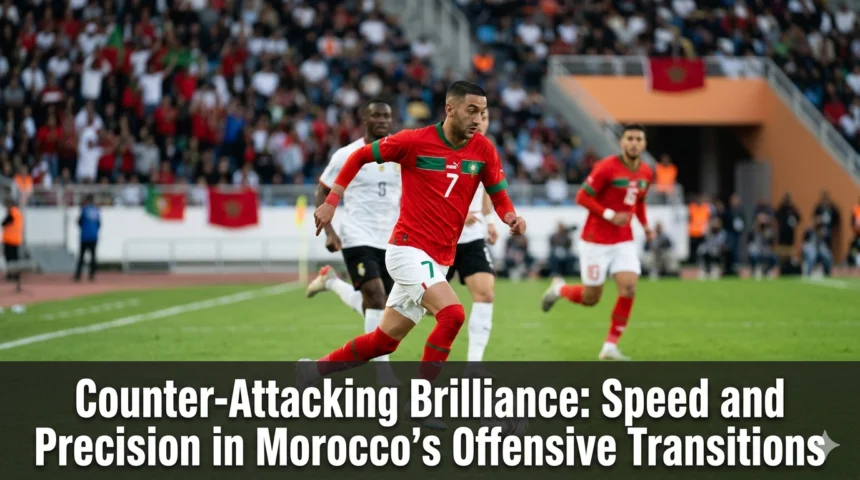
AchrHakimi’s and SofiaBoufal’s speed is key here. They are not just fast; they are fast with the ball at their feet, and they have the decision-making ability to utilise bursts of speed. This rapid progress intends to create numerical superiority or isolation situations in the final third before the opposition can recover.

Use the space behind the defence.
Intelligent use of space is a major factor. When the opposition pushes up high on the pitch, they always leave gaps behind their defensive line. Youssef En-Nesyri and Moroccan attackers in general are good at intelligent runs into those channels. The passes don’t always need to be perfectly weighted; sometimes, a good through ball into space can allow the attacker to run onto it and beat the last defender with pace.
Wingers like Hakim Ziyech and Sofiane Boufal are important in this regard. They usually begin wide, pulling full-backs out, then cut inside or run diagonally, creating dilemmas for central defenders. Directness means there is always a real threat in every transition, so opponents always have to be aware of Morocco’s quick changes in play.
Important Steps of an Effective Counter-Attack
A good offensive transition may look spontaneous, but it’s more often a complex series of steps that have been practised and that demand various skills and roles performed by various players.
Initial Turnover and First Pass
The time of reckoning has come. When the ball is won (interception, tackle, or blocked shot), the player winning possession must think about options immediately. The initial pass is often the most important as it establishes the tempo and direction of the transition. It must be accurate and break at least one line of enemy pressure. This pass is often to a midfielder who can turn quickly and drive forward or to an outfield player who is already looking to run into space.
In this phase, the speed of thought and execution is paramount. Any pause allows the enemy valuable seconds to regroup and lessens effectiveness. “Moroccan players are trained to make quick decisions under pressure, which indicates their tactical discipline.
Distribution and transition in midfield
Midfield engine in motion after the first pass. Players like Sofyan Amrabat, Azzedine Ounahi, and Selim Amallah are key to linking defence to attack. They’re not just fields. They’re part of quick ball Amrabat ‘sion. Amrabat’s incredible work rate and ability to win the ball often start a transition with a strong tackle and pinpoint pass. Ounahi is good at carrying the ball forward at pace, dribbling past opponents, creating space, and drawing defenders. Read more on their roles in The Midfield Engine: Key Roles and Tactical ConMorocco’s Midfielders.
More Read

It is key that they can get the ball out quickly to the wide men or centre. It’s the creative spark and the driving force to keep the momentum of the first turnover going. They can pick out the runs of wide players or the striker with perfectly weighted through balls that cut through several opposition players.
Attacking the Third Penetration and Finishing
Accuracy is the paramount thing in the last third of “he play. “Players need to make smart runs, create overloads, and put in good crosses or shots. Players such as Ziyech and Boufal are good dribblers and can beat defenders before either cutting in to shoot or putting in dangerous shots. Hakimi’s overlapping runs provide another attacking option, resulting in overloads on the flanks.
Youssef En-Nesyri, the central striker, is the focal point of these attacks. His aerial ability and predatory instinct in the box make him a dangerous target for crosses and through balls. Often, the difference in these high-pressure situations is the finishing, and Moroccan players have shown incredible composure and clinical precision when it matters most.
Success Architects: Who They Are and What They Do
Success is not just a matter of tactical systems; a lot of it comes down to the individual brilliance and collective understanding of key players, who are quick, precise, and tactically intelligent. For insight into how some players influence their attack, see Key Players, Key Tactics: How Hakimi and ZiMorocco’s Morocco’s Attack.
Achraf Hakimi: le train de la vitesse sur le côté
Achraf Hakimi is arguably one of the most dynamic full-backs in world football, and hMorocco’sn Morocco’s transitions are vital. He has blistering pace, fantastic stamina, and excellent dribbling ability and can turn defence into attack in seconds. He picks up the ball deep in his own half and makes powerful runs down the right flank, beating several opponents. His ability to deliver accurate crosses or his link-up play with Ziyech make him a constant threat.
His link-up play with Ziyech on the right wing is especially threatening. This combo can become an almost unstoppable force in offensive transitions, often creating numbers and dangerous situations for the opposition. Hakimi’s desire to get forward adds width and depth to the attack and stretches the opposition defence.
Hakim Ziyech—Vision and Delivery
Hakim Ziyech is the brains behind Morocco’s transitions. He is basically a right-winger with great vision, a wonderful range of passing, and a deadly left foot. Often Ziyech receives the ball after a defensive turnover, and with a quick turn, he can either dribble past his marker or hit a pinpoint through ball to a teammate making a run forward.
His long diagonal passes to switch play are key, often finding Boufal on the other flank or Hakimi bombing forward. The threat of legendary crosses and set-piece deliveries from Ziyech adds a further dimension to plays that get into the final. He’s the main conductor, able to slow the play down to think his options through or speed it up with a decisive pass.
Sofiane Boufal and Youssef En-Nesyri: A Direct Threat and Clinical Edge
Sofiane Boufal, normally a left winger, has flair, close control, and the ability to beat defenders one-on-one. His direct running and dribbling skills are invaluable to disorganise retreating defences during transitions. He can cut in to shoot or drive into the byeline for a cross, which adds an element of unpredictability to Morocco’s play.
The clinical touch to these attacking moves comes from the main striker, Youssef En-Nesyri. His intelligent off-the-ball movement, particularly his runs into space behind defenders, makes him a constant threat. He has great aerial ability and an eye for being in the right place at the right time to take chances. His main instinct is to get into goal-scoring positions quickly, but he has the pace and strength to hold up the ball if needed and bring others into play.
Midfield Anchors: The Contribution of Amrabat and Ounahi
Sofyan Amrabat and Azzedine Ounahi are often praised for their defensive work. Still, they are just as important in starting attacks. Amrabat’s ability to win the ball back and then immediately release it accurately, often with a long, piercing pass, is a cornerstone of Morocco’s play. It’s the physicality and the quickness of thought that give the first Ounahis.
Ounahi’s dynamism and his dribbling are also key. “He can run the ball a long way, create space for his mates, and bring players in. His vision and passing range can help him find wide players or the striker with incisive through balls, transforming defensive solidity into offensive opportunities in an instant.
Tactical Nuances and Coaching Impact
This uniform execution of these transitions is no accident but a carefully planned game plan perfected by Walid Regragui. His coaching philosophy has given the squad a clear sense of identity and purpose, bringing out the best of their natural talents to devastating effect. For more on his impact, check Regragui’s Coaching Philosophy: The Architect of Morocco’s Success, Regragui’s Masterplan: DMorocco’s World Cup 2022, Regragui’s
Regragui’s Fixation with Verticality
Walid Regragui has praised a pragmatic but effective approach. He knows that with the players at his disposal, especially those with pace out wide, the best way of getting the ball into the box is often to play it vertically and directly. His system is all about getting the ball forward quickly, bypassing congested midfield areas and playing with the space behind opposition defences. That verticality is a defining feature of their offensive transitions, so every play really looks like it wants to score.
That means players have to be looking to run forward at every opportunity, even when they are defending “g deep. ” The idea is to go from defence to attack straight away, with players already looking at where space is going to open up. This proactive approach is a testament to Regragui’s tactical acumen and the players’ buy-in.
Exercise for RapiMorocco’s
Morocco’s play is seamless because they spend a lot of time in Regragui’s sessions, which probably include drills for rapid ball recovery, quick distribution under pressure, and synchronised attacking runs. The players are trained to make rapid decisions, often with few touches, and to anticipate teammates’ movements without having to look up all the time.
Small-sided games and tactical drills likely replicate in-game situations where turnovers occur, so players can work on transitioning quickly from defence to offence. This type of repetitive training builds muscle memory and tactical understanding, allowing the team to play through complex patterns almost instinctively in competitive matches.
Counter Adaptation: Flexible Formation
The 4-3-3 system is a staple under Regragui (explained in The 4-3-3 System: How Morocco Utilises Its Core Formation Under Regragui); however, the team has great tactical flexibility. The principles of good transitions remain the same, even if the formation changes slightly or the people in it do. This flexibility is important against opponents with different playing styles. For their in-match adjustments, see Tactical Adaptability: How Morocco Adjusts Their Game Plan In-Match.
Morocco can change their defensive block and their triggers for offensive play, whether they are playing against a possession-heavy team or a high-press team. The basic idea of winning the ball and exploding forward with speed and precision remains, but the avenues and initial passes may change depending on the opponent’s weaknesses. That versatility makes them a threat in any future situation in the game.
Historical BaMorocco’s Morocco’s Changing Approach
This emphasis on fast transitions isn’t exactly new either, as Moroccan football history has witnessed flashes of quick exchanges, especially against stronger possession teams from Europe or South America. But this has been refined and elevated to an art form under Walid Regragui, a primary weapon rather than an occasional tactic.
The Moroccan teams have always been based on individual brilliance and technical skill. Regragui has created a system with all of these qualities. He has identified the strengths of his players—pace, dribbling ability, and defensive discipline—and built a system that maximises these qualities. This journey is just one part of The Evolution of Atlas Lions Tactics: A Historical Perspective, in which the national team has consistently sought to blend traditional flair with modern-day tactical pragmatism.
This tactical evolution has resulted in the present-day Atlas Lions, where defensive solidity and devastating transitions are not just complementary but mutually reinforcing elements of a highly effective playing philosophy. Morocco’s
Morocco’s game is not just a reactive counter-attack; it is a precisely orchestrated, expertly executed offensive strategy that has propelled the Atlas Lions to unprecedented heights. It’s built on a bedrock of defensive resilience. It uses the blistering pace of players like Hakimi and Boufal, the visionary passing of Ziyech and Ounahi, and the clinical finishing of En-Nesyri. Regragui’s philosophy to bring the disc brings verticality and tactical nous to turn defensive turnovers into genuine scoring opportunities with breathtaking speed and precision.
But their attacking brilliance makes Morocco a formidable opponent and a thrilling spectacle for fans. It shows how a well-drilled unit, playing to its strengths and with a clear game plan, can beat teams with better resources or reputation. The Atlas Lions have put on a masterclass in how to be effective in offensive transitions, turning defence into a devastating attack.
Common Questions
Why is Morocco so good on the count? Morocco’s
Morocco’s approach works because of a mixture of factors: a strong defensive organisation that creates turnovers, the immediate verticality and speed of their ball progression, the tactical intelligence of players making runs into space, and the individual brilliance of key players like Hakimi and Ziyech, who have both pace and precision.
Morocco’s counterattack
The main players are Achraf Hakimi and Sofiane Boufal for their pace and dribbling on the wings, Hakim Ziyech for his vision and passing, Youssef En-Nesyri for his intelligent runs and finishing, and midfielders such as Sofyan Amrabat and Azzedine Ounahi, who win the ball and spark quick transition—Morocco’s counter-attacking style.
Walid Regragui has instilled a clear coaching philosophy based on defensive solidity and rapid vertical transitions. He stresses quick decisions, few touches, and playing into space behind the opposition. His coaching style is based on fast transitions from defence to attack, which is what gives Morocco its identity.
Is the Moroccan counterattack a reactive strategy?
It is not only reactive, although it started when possession was had. It’s a proactive approach, as players are always looking for attacking opportunities, even when they are defending. It’s a deliberate, well-organised attacking weapon. The team is drilled to look for passes in front of them and run into space the instant they win the ball. Morocco’s defensive system enables it to launch counterattacks.
Morocco’s transitions are based on its compact and disciplined defensive block. They deny space, force errors, and create opportunities to win the ball in advantageous positions. They trigger the offensive transition the moment they win the ball to exploit the opponents’ disorganisation caused by players committed forward.