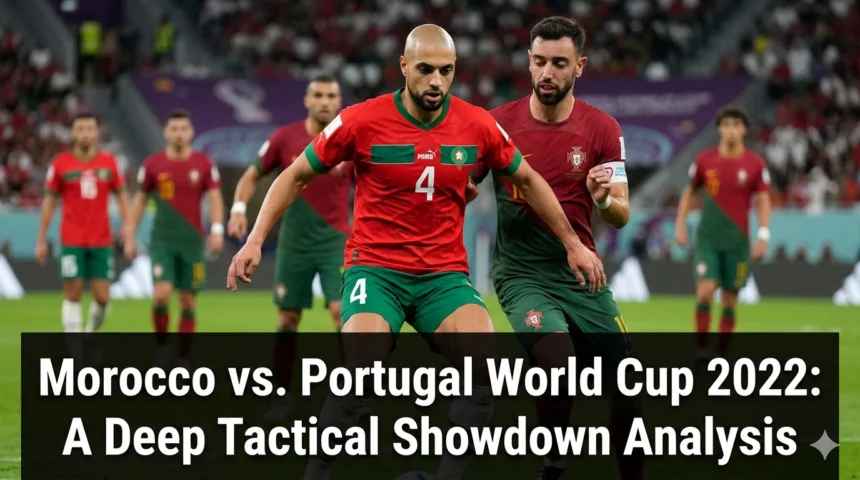
Morocco vs Portugal World Cup 2022: Tactical Showdown Breakdown
The FIFA World Cup 2022 quarter-final meeting of Morocco and Portugal was not just another football match; it was a highly tactical encounter that had the whole world engrossed. The game showcased masterful strategic execution, with Morocco ultimately victorious thanks to a meticulously crafted game plan. Understanding Morocco vs Portugal tactics provides valuable insight into one of the biggest upsets of the tournament and the nation’s historic journey to the semi-finals. This analysis breaks down the complex tactical decisions, player matchups, and in-game adjustments that defined this unforgettable contest.
Morocco’s Tactical Playbook: The Regragui Way
Morocco came to the World Cup with a clear tactical identity, and under the wise guidance of coach Walid Regragui, it was a good one. Their approach was based on defensive solidity, disciplined pressing, and lethal counter-attacking qualities. This philosophy, which is the backbone of Morocco’s tactics and playing style, proved to be their biggest advantage against a star-studded Portugal side.
The Compact Low Block: A Defensive Bulwark
The primary defensive structure was a tight low block, typically a 4-1-4-1 or 4-5-1 when not in possession. The idea was to block space in the middle and push the opposition out wide, where their fullbacks and wingers could press. The defensive line was so well disciplined that they rarely broke ranks and were therefore very difficult to penetrate. This commitment to defensive organisation was the basis of their success.
Sofyan Amrabat (the only holding midfielder) was the lynchpin of this system. His ability to screen the defence, break up plays, and get the ball back was key. Azzedine Ounahi and Selim Amallah were the central midfield duo who provided energy and covered acres of ground, helping out in both defensive and offensive phases.
Deadly counter-attacking: speed and accuracy
Morocco was anything but passive, even if it had a solid defence. Their counterattack was sharp, direct, and devastatingly effective. When possession was won, often deep in their own half, the team moved quickly, with the pace of Hakim Ziyech and Sofiane Boufal on the wings and the target-man capabilities of Youssef En-Nesyri. This rapid movement enabled them to cut through the Portuguese midfield and go straight at their defence.

Regragui’s hallmark was the transition from defence to attack. Players were drilled to be looking for forward passes the moment they won the ball and to exploit the gaps left by an attacking Portugal. This mix of resilience and opportunistic attack was crucial in their World Cup campaign.
Portugal’s Tactical Setup: Attacking Prowess and Positional Play
Under Fernando Santos, Portugal usually played an attacking style of football, focusing on possession, individual brilliance, and fluid movement in the final third. They had world-class talent on their team capable of breaking down most defences.
Attacking Options and Flexible Formations
Portugal often deployed in a 4-3-3 or 4-2-3-1 formation, aiming to create overloads in the wide areas and capitalise on half spaces. They had creativity at the heart of Bruno Fernandes, Bernardo Silva, and João Félix, who could combine intricate passing combinations and make incisive runs. Cristiano Ronaldo, whether starting or coming off the bench, was always a big aerial threat and a predatory instinct in the box.

Against Morocco, they were expected to put sustained pressure, use their fullbacks, and try to stretch the compact Moroccan defence. They went out to control the ball and use their technical qualities to break down the North African side.
Possible Vulnerabilities
Portugal’s attacking strengths had shown some vulnerability in defensive transitions, particularly when their fullbacks got forward. This could leave spaces behind them, which Morocco’s quick wingers and forwards would be eager to exploit. Portugal also occasionally struggled to break down well-organised, deep defences that limited their space in the centre and pushed them out to the flanks, leading to speculative long-range efforts or crosses.
The Tactical Battlefield: Key Battles and Tactics
The quarter-final was a fascinating chess match; both coaches made specific tactical decisions to try to gain the upper hand. Regragui’s master plan was most evident in how Morocco addressed key areas.
Portugal Attack vs Morocco Defence
This was likely the biggest matchup. Morocco planned to suffocate Portugal’s creative players by taking away the space and time. Amrabat was important in marking the runners like Bruno Fernandes and cutting off passes in the dangerous areas between the defence and midfield. Romain Saïss and Jawad El Yamiq (who replaced the injured Saïss early on) were immense, showing composure and dominance in the air and dealing with Portugal’s crosses and physicality.
Fullbacks Achraf Hakimi and Yahia Attiyat Allah also showed discipline by staying deep to deal with Portugal’s wide threats and to cut off any cutbacks. They could track back and cover, which helped with their defensive shape.
Engine vs Rhythm: Morocco’s Midfield Battle with Portugal
The middle-field battle was fierce. Ruben Neves and Otávio tried to control the game and move the ball around for Portugal, looking for spaces. But Morocco’s midfield trio of Amrabat, Ounahi, and Amallah were a constant thorn in the side of Portugal. They pressed hard in their own half, cutting off passing lanes, making it very difficult for Portugal to build any meaningful attacks.
More Read

Ounahi impressed with his endless energy and ball-carrying ability, turning defence into attack with surging runs. And it was this key link between defensive solidity and offensive transitions that gave Morocco its midfield advantage.
Morocco’s Counterattack vs Portugal’s High Line
Morocco looked to exploit Portugal’s tendency to push their fullbacks high and commit numbers forward. Morocco’s changes were rapid and aimed at the spaces left by Portugal’s defence. Ziyech and Boufal had to find ways into those pockets, while En-Nesyri was up top, looking for flick-ons or direct runs behind the defence.
This strategy was a testament in itself, as a goal was scored. EnEn-Nesyri capitalised on the misjudgment of goalkeeper Diogo Costa as he met a precise cross from Attiyat Allah. This showcased the effectiveness of Morocco’s wide-ranging delivery strategies and their ability to exploit defensive vulnerabilities.
Regragui’s masterclass: Tactical choices in detail
Walid Regragui’s game plan for the Portugal game was a tactical masterclass. His calls before and during the game were key to the historic win.
Choosing players and flexibility
Regragui stuck to his guns, keeping his tried-and-tested line-up and making a few changes. An early injury to captain Romain Saïss forced an unscripted change, with Jawad El Yamiq introduced. He fit well into the defensive scheme, a testament to the team’s collective understanding and tactical flexibility.
The decision to play Youssef En-Nesyri as a physically and aerially dominant striker was crucial. He was good in the air and provided a release for long balls, giving Morocco a way to hold the ball up and bring the wingers into play, and was perfectly suited to the 4-3-3 system that often morphed into a 4-1-4-1 at the back.
Changes within the game and defensive strengthening
Portugal increased the pressure in the second half, and Regragui was on the front foot with his substitutions, ensuring his team stayed compact at the back and adding fresh legs. Walid Cheddira replaced En-Nesyri, bringing the same physical presence but with fresh legs. Badr Benoun and Yahya Jabrane later came on to reinforce the midfield and defence, effectively creating an even more compact shape to withstand the Portuguese onslaught. Morocco held their defensive line despite being reduced to 10 men late in the game due to Cheddira’s red card, demonstrating the resilience built into Regragui’s coaching philosophy.
Portugal’s Response and Challenges
Portugal’s attempts to penetrate Morocco’s solid defence encountered serious difficulties. Fernando Santos made tactical changes, but it was not enough in the end.
Difficulty in Penetrating
Portugal struggled to create space in central areas and had to rely heavily on width and crosses. Morocco has some talented wingers and fullbacks, but their tight defensive block made it easy for their centre-backs and goalkeeper Yassine Bounou—who dominated—to deal with crosses. That summed up Morocco’s defensive prowess, with no clear-cut chances from open play.
Biography of Cristiano Ronaldo
The introduction of Cristiano Ronaldo early in the second half was an attempt to add a different dimension to the Portuguese attack, notably a greater aerial threat and proven goalscoring instinct in the box. Ronaldo had a couple of half-chances, but Morocco’s defence was well-organised and did a good job containing the Portuguese star, not giving him the space and service he thrives on.
Key Moments & Milestones
There were many pivotal moments in the tactical narrative that showed the success of Morocco’s game plan.
Tactical Story of En-Nesyri Goal
Morocco’s counter-attacking strategy bore fruit when Youssef En-Nesyri scored the opening goal in the 42nd minute. A quick breakdown of the left flank and a well-delivered cross caught the Portuguese defence and keeper off guard. This was a moment that encapsulated Morocco’s ability to punish a momentary lapse in concentration and take advantage of transitional play. It testified to their confidence, focus, exploitation, and directness.
Defensive Stands and Half-Time Fortitude
Morocco’s defence held up to Portugal’s second-half push. The players showed great stamina and discipline with vital blocks, interceptions, and clearances. Bounou’s confident handling of crosses and save from JFélix’six’s thunderous shot were crucial, demonstrating the team effort in defence that became a signature of the Atlas Lions. Their tactical discipline was also evident in their ability to defend with 10 men for the closing minutes.
Tactical consequences after the game
The Morocco vs Portugal tactics breakdown explains why Morocco won and what Portugal struggled with. It was not a flash in the pan. It was a well-executed strategy and a team that stuck together.
Why It Worked in Morocco
Morocco’s success was all about their game plan being executed perfectly. They were defensively solid;; they denied space to Portugal; their midfield never stopped working to break up play,; and their counterattacks were incisive. The belief in Regragui’s system and the collective effort of the players was tangible throughout. This match is a high point in the evolution of the Atlas Lions‘ tactics.
What Went Wrong for Portugal
Portugal, despite their talent, couldn’t adapt to Morocco’s defensive system. Morocco capitalised on their inability to create clear-cut chances from open play and reliance on crosses. They didn’t have the tactical or individual brilliance on the day to unlock a truly formidable defensive unit.
Synopsis
Morocco was a tactical masterclass in the quarter-final of the World Cup 2022 against Portugal, from Walid Regragui’s side. The Morocco vs Portugal tactics showed how a well-drilled, disciplined team can beat individual brilliance. Defensive solidity, midfield muscle, and a ruthless counter-attacking style were the winning ingredients as Morocco made history as the first African team to reach the last four of a World Cup. This game is a testament to the importance of strategy, planning, and execution in the beautiful game.
FAQs
What was Morocco’s main tactical plan against Portugal?
Morocco’s low-block was very disciplined and tight, often in a 4-1-4-1 or 4-5-1 shape without the ball. This was to deny Portugal space in the central areas, forcing them wide, while allowing for quick transitions into lethal counterattacks using the pace of their wingers and striker.
How did Sofyan Amrabat’s role facilitate Morocco’s tactical success?
The only defensive midfielder, Sofyan Amrabat, was the key to Morocco’s defence. His tireless work rate, reading of the game, breaking up plays, and regaining possession were vital in stifling Portugal’s creative midfielders and shielding the backline.
What were the main tactical challenges Portugal faced in breaking down Morocco’s defence?
Portugal struggled to get through Morocco’s compact central defence and had to rely on wide play and crosses, which Morocco’s strong central defenders and goalkeeper handled well. Morocco’s disciplined midfield meant there was little space and time, and few clear-cut chances were created from open play.
How did Walid Regragui’s tactical changes affect the match?
Regragui’s in-game adjustments, especially in the second half, were about ensuring defensive solidity and bringing on fresh legs. The introduction of Walid Cheddira for Youssef En-Nesyri, then Badr Benoun and Yahya Jabrane, helped shore up the midfield and defence, and Morocco was able to withstand Portugal’s increasing pressure, even when they were reduced to ten men.
Why was Youssef En-Nesyri’s goal tactically important?
Youssef En-Nesyri’s goal was the quintessential Moroccan counter-attack. It was the product of a quick counter down the flank and a clever cross to exploit a momentary lapse in Portugal’s defensive organisation and the keeper’s positioning. It was a testament to Morocco’s ability to make the best of a few opportunities.