
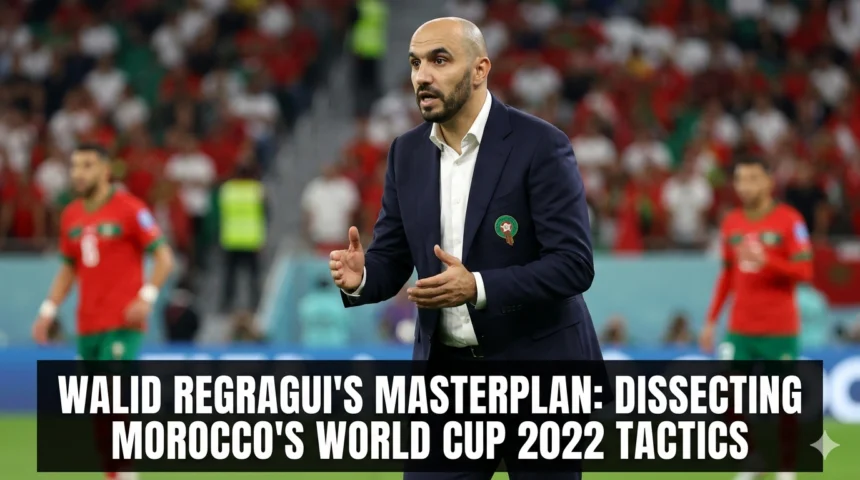
The Masterplan of Walid Regragui: Morocco’s Strategy at the World Cup 2022
Morocco’s amazing journey to the semi-finals of the FIFA World Cup 2022 was a historic achievement that fascinated millions and surpassed all expectations. This unprecedented success was a direct result of a master plan crafted with meticulous detail by head coach Walid Regragui. His new approach turned the Atlas Lions into an impenetrable defensive unit with a deadly counter-attacking threat, and their Morocco World Cup tactics became a subject of intense study and admiration.
Regragui’s Philosophy and Core Principles: The Birth of Success
Walid Regragui took over the Moroccan national team just three months before the World Cup, inheriting a talented group in need of direction and a unifying vision. His coaching philosophy of unity, discipline, and effort was soon instilled in the players. He instilled in them the belief that together they could conquer any hurdle and famously said, “We are a family.” This powerful team spirit became the basis for all future tactical decisions.
Regragui stressed that defensive solidity was a necessary groundwork for offensive ambition. Morocco’s best hope was to be incredibly difficult to break down against world-class opposition. The team’s identity throughout the tournament was a pragmatic approach with an emphasis on quick transitions. For a deeper insight into his overall vision, dive into Walid Regragui’s coaching philosophy in Walid Regragui’s Coaching Philosophy: The Architect Behind Morocco’s Success.
Why 4-3-3? Balance and Fluidity
Regragui’s Atlas Lions mostly lined up in a 4-3-3 formation, chosen for its balance and adaptability. The structure maintained a tight defensive shape but also allowed quick transition into attack. The three-person midfield was crucial in disrupting opposition play and initiating attacks, offering defensive solidity with creative flair.
The formation was fluid and often shifted into a 4-1-4-1 or 4-5-1 without the ball, creating a compact central block. This flexibility allowed Morocco to adapt to different opponents and situations while remaining true to itself. The key to understanding The 4-3-3 System: How Morocco Uses Its Core Formation Under Regragui is this basic layout.

Morocco’s Defensive Fortress: An Impenetrable Back Line
Morocco’s World Cup campaign was defined by its stout defensive record. They had not conceded a goal until the semifinals, when an own goal against Canada was evidence of the quality of their organisation and the players’ individual skill. That defensive solidity was not a fluke but a carefully rehearsed tactic.
Compact Block & Narrow Shape
Morocco defended deep and compact, often falling back into their own half and squeezing the pitch. This tactic was meant to deny opponents space in central areas, pushing them wide where threats could be more easily contained. The defensive line, usually featuring Romain Saïss and Nayef Aguerd (or Jawad El Yamiq), was well-positioned and rarely lost its shape.
The full-backs, Achraf Hakimi and Noussair Mazraoui, were key. When a midfielder dropped into the backline, they tracked back hard, a solid defensive unit of four or five despite their attacking prowess. Every player’s commitment was fundamental to their success.

Hard-Working But Disciplined Pressing
Morocco’s defence was frequently deep but active and aggressive. Disciplined pressing was used, especially in midfield and the final third, with clear triggers to look for when the opponent received possession with their back to the goal,l or a pass was played into congested areas. This allowed Morocco to win the ball back dangerously and set up immediate counterattacks.
Pressing has always been a group effort, with other players helping the pressing player by cutting passing lanes. Morocco’s lines were very hard for opponents to break through because of this coordinated approach. Learn more about their defensive system in Morocco’s Defensive Fortress: Analysing Their Compact Backline and Pressing Strategy.
The Engine Room: Management, Defence, and Transition
Morocco’s campaign was built on the back of their midfield trio of Sofyan Amrabat, Azzedine Ounahi, and Selim Amallah (or Bilal El Khannouss), who found the right balance of grit and creativity.
Amrabat: The Anchorman and the Destroyer
Sofyan Amrabat was one of the stars of the tournament, with his great defensive skills anchoring the midfield. His main role was to protect the back four, break up opposition attacks, and win the ball back. His relentless energy, tactical brain, and hard tackling created an almost unbreachable wall.
Crucially for the team, he was able to disrupt the opposition’s rhythm and often covered a huge amount of ground to snuff out threats. His reading of the game and intercepting of passes were key to the Moroccan central defence.
Ounahi and Amallah: Box-to-Box Firepower
Azzedine Ounahi and Selim Amallah joined Amrabat in offering important box-to-box energy. Ounahi’s elegant dribbling, his ability to carry the ball up the field, and his vision in connecting defence with attack stood out in particular. He was good at getting into tight spaces and driving play into the final third.

Amallah provided defensive support and industry, frequently falling back to support full-backs and add a presence in midfield. Together, the three ensured Morocco was always in the majority in central areas, allowing them to dictate the tempo and control the game. You can find out their contributions in detail in The Midfield Engine: Key Roles and Tactical Contributions of Morocco’s Midfielders.
Counter-attacking in style: speed and accuracy
Morocco was solid at the back but far from one-dimensional. Their counter-attacking ability was a constant threat, allowing them to move from defence to attack at blistering speed and with clinical precision.
Fast Transitions from Defence to Offence
Morocco tried to launch the counter-attack after winning the ball. The central midfielders, especially Ounahi, were good at running with the ball, and the wide players Hakim Ziyech and Sofiane Boufal would break into space. It was about exploiting space when the opposition committed men forward.
These transitions often started with a quick pass from Amrabat or a long pass from goalkeeper Yassine Bounou over the midfield to a winger in space. The pace of Hakimi and Boufal,, together with Ziyech’s vision,, made these counters very dangerous.
Space Optimisation and Clinical Finishing
Achraf Hakimi’s overlapping runs from right-back were a key component of the counter-attack. His pace and stamina were incredible, allowing him to get forward and join attacks, adding an extra dimension to the right flank. Hakim Ziyech, often drifting inside, would either whip in pinpoint crosses or unleash powerful distance shots.
Youssef En-Nesyri, the only striker, was important in holding the ball and making intelligent runs into the penalty area. He was particularly useful in the air in crossing situations. Morocco’s clinical counterattack showed its efficiency with few chances. Discover more about their offensive strategies with Counter-Attacking Brilliance: Speed and Precision in Morocco’s Offensive Transitions.
Key Players And Their Role In The Tactics
Morocco’s campaign was a system, but it was also about individuals. Many players shone and played important roles in the Morocco national team’s overall tactics and playing style.
Achraf Hakimi: The Full-Back With Two Faces
Achraf Hakimi was arguably the best right-back in the tournament. He was a good defender, using his speed to recover and make important tackles. Offensively, his lung-bursting runs, dribbling skills, and crossing ability offered a potent attacking dimension, particularly on the counter. Always dangerous with Ziyech on his right-wing partnership.
Hakim Ziyech: A Creative Spark with Defensive Workrate
Regragui has brought out the best in Ziyech again. As the inverted right winger, he provided the creative spark, cutting inside to shoot or deliver his trademark left-footed crosses. Significantly, Ziyech took on defensive duties and put in a shift to cover for Hakimi and defend the right flank. That was the key to a two-way commitment.
Sofyan Amrabat: The Unsung Defender
As mentioned above, Sofyan Amrabat was the key man in the midfield. His work rate, ability to win the ball, and tactical discipline provided the defensive security that allowed his teammates to focus on the attack. His performances were widely acclaimed.
Dribble Virtuoso: Azzedine Ounahi
Ounahi was brilliant in running at defenders with the ball. He was key in easing pressure, taking the ball out of danger and driving forward. His vision and passing range were also useful when starting counter-attacks.
Yassine Bounou: The Brave Keeper
Key heroics from Yassine Bounou between the sticks, particularly in the penalty shootout against Spain. His distribution also helped kick-start Morocco’s quick transitions, in addition to his shot-stopping. To learn more about how key players fit into Regragui’s system, see Key Players, Key Tactics: How Hakimi and Ziyech Shape Morocco’s Attack.
Tactical Flexibility: In-game adjustments and game management
Morocco’s tactical flexibility was one of the key components of Regragui’s master plan. The team didn’t stick to one formula but adjusted to opponents and game circumstances.
Flexibility of Formations
Morocco mostly used the 4-3-3 but was flexible enough to change formations when needed. Versus stronger attacking teams or when protecting a lead, they could go to a 5-4-1 or deeper 4-5-1 with added defensive protection in midfield and defence. That flexibility allowed them to absorb pressure better.
Regragui’s game management
Regragui was very good at managing the games, making the right substitutions at the right time, which always had a positive impact on the matches. His decisions to bring on fresh legs to maintain the defensive intensity or to bring on more attacking players to exploit tired defences paid off. This proactive approach reflected his understanding of the game and the squad’s capabilities. Read more about their dynamic adjustments in Tactical Adaptability: How Morocco Adjusts Their Game Plan In-Match.
Strategy from Set Pieces: A Hidden Weapon
Tactical intelligence was evident in Morocco, even in the less glamorous aspects of the game. Their set-piece play, in attack and defence, was a factor in their overall resilience.
Defensive organisation on set pieces
Morocco were brilliant defensively when it came to corners and free-kicks. They used mixed marking, zonal coverage in key areas, and man-marking of dangerous opponents. This was a disciplined approach that limited threats from limited-piece pieces, which are not a major source of goals at the highest level.
Offensive Routines and Variations
Morocco’s attack, not their primary source of offence, was based on well-rehearsed routines. Hakim Ziyech’s deliveries from corners and wide free-kicks were also spot-on, with the ball always aimed at the head of Romain Saïss or Youssef En-Nesyri. They also varied it, sometimes taking short corners or quick free-kicks to catch the opposition off guard. Set-Piece Mastery: Morocco’s Tactics on Corners and Free Kicks: Find out more about their approach to dead-ball situations.
Evolution of Atlas Lions Tactics: The Modern Way
Morocco’s 2022 World Cup tactics were a great development from previous eras. Moroccan sides have been praised for their individual brilliance in the past,t but sometimes criticised for their lack of tactical discipline and defensive solidity on football’s biggest stage.
Regragui mixed traditional Moroccan attacking flair with a modern, pragmatic, highly organised defensive structure. He proved that an African team can measure up to the best in the world, combining technical ability with tactical intelligence and a rock-solid collective spirit. This was a new bar for Moroccan football, a clear step away from past philosophies. For more historical context, check out The Evolution of Atlas Lions Tactics: A Historical Perspective.
Conclusion: Regragui’s Masterplan Legacy
Walid Regragui’s master plan for Morocco at the FIFA World Cup 2022 was a feat of tactical know-how, player belief, and grit. He created a defensively sound, compact, and well-organised team that could destroy opponents on the counter, and he unleashed his squad’s potential, taking them to an unprecedented semi-final.
Regragui’s Morocco showed that a team with a clear vision, strong leadership, and collective effort can take on established footballing powers. Their historic run will certainly inspire future generations and act as a blueprint for how underdogs can succeed on football’s biggest stage. It was a sign that they had a well-thought-out strategy and believed in a common cause.
Morocco World Cup Tactics by Walid Regragui: FAQ: What is
Walid Regragui’s core tactical philosophy for Morocco in the 2022 World Cup?
Walid Regragui’s core tactical philosophy for Morocco in the 2022 World Cup?
Walid Regragui’s main tactical philosophy was based on defensive solidity, collective effort, and quick transitions. His priority was to make Morocco very difficult to break down and to exploit the opponent’s weaknesses with quick counterattacks.
What was Morocco’s most used formation under Regragui at the World Cup?
Under Regragui, Morocco mostly played with a 4-3-3 formation. It gave the team a solid base with three players in midfield and allowed the wide men and full-backs to provide good support in attack transitions.
How did Sofyan Amrabat help Morocco’s World Cup plan?
Sofyan Amrabat was the midfield anchor, protecting the backline, disrupting opposition attacks and winning possession with relentless energy. His job was to release the ball to start counter-attacks quickly, and he was the cornerstone of Morocco’s defence.
Why did Morocco’s counter-attacking game work so well?
Morocco’s counter-attacking game worked because they transitioned quickly from defence to attack, with fast distribution from the back and the blistering pace of the likes of Achraf Hakimi, Sofiane Boufal, and Hakim Ziyech. They used the space well and finished off clinically.
What tactics did Regragui use to beat Spain and Portugal for Morocco?
Regragui’s tactics frustrated the attacking efforts of top teams by deploying a structured and compact defence that left no space in dangerous areas. Morocco took advantage of a few opportunities with swift, sharp counter-attacks, demonstrating defensive solidity and attacking efficiency against superior individual skills.