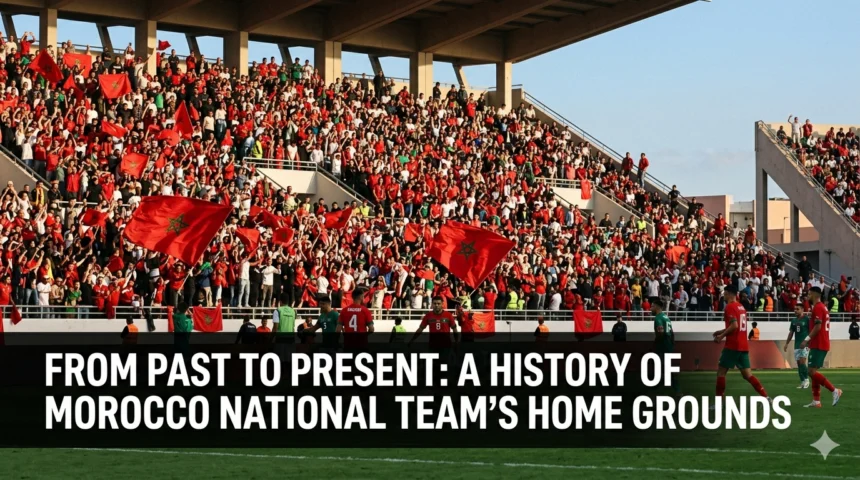
The roar of the crowd, the vibrant colours, and the electric atmosphere of a football stadium all form part of the national team experience. The Moroccan national football team, known as the Atlas Lions, has come to see their home grounds as more than just pitches. They have been arenas of passion, grounds of victory, and witnesses to the nation’s sporting journey. The history of Morocco’s national team stadiums is an interesting story of how they evolved from humble beginnings to the impressive modern facilities of today. This article delves into the evolution of these legendary arenas, analysing their growth and significance over the years and showcasing each venue’s contribution to the Moroccan football scene.
From independence to their historic semi-final run at the recent World Cup, the Atlas Lions have left their mark on pitches across the country. Understanding this rich heritage provides insight into the enduring connection between the team, its fans, and the ground they play on. Join us on a journey through time to discover the architectural wonders and cherished venues of the Moroccan national heroes.
The Early Football Grounds of Morocco: Where It All Started
In the early years following Morocco’s independence in 1956, the national team began to form its identity. Football rapidly became a unifying factor, and the need for suitable venues grew. Matches were initially held in multi-purpose sports arenas or grounds with minimal infrastructure, reflecting the nascent stage of the nation’s sporting landscape.
These early venues were vital, even if they weren’t all purpose-built football stadiums as we know them today. They hosted the Atlas Lions’ efforts to compete, build a team, and inspire a fledgling fan base. They were proving grounds where legends like Larbi Benbarek and later players began carving out their careers and laying the groundwork for future generations.

The Mohammed V Stadium: An Enduring Legacy in Casablanca
The true patriarch of Moroccan football stadiums is the Mohammed V Stadium in Casablanca. It opened in 1955, even before full independence, and soon became the spiritual home of Moroccan football. Originally called the Stade Marcel Cerdan, it was renamed the Stade d’Honneur after independence and, in 1979, took its present name in honour of King Mohammed V.
This venue has hosted countless pivotal moments in the history of Morocco’s national team stadiums. Situated in the heart of bustling Casablanca, it became the obvious choice for most of the national team’s major matches, thanks to its massive capacity. For decades, it served as the main stage where the Atlas Lions faced African giants and international opponents.
Early life and signature moments
Mohammed V Stadium has witnessed many of Morocco’s early successes, with its two-tiered stands and a passionate atmosphere unmatched elsewhere. It hosted important World Cup qualifiers, Africa Cup of Nations games, and friendlies that helped develop the squad. The roar of the Casablanca crowd, often said to be a force of its own, became synonymous with home advantage for the national side.

Renovations over the years have kept it relevant, a temple of football revered across Africa. Its history is inextricably linked to the very fabric of Moroccan football, where generations of fans have united to cheer on their beloved Atlas Lions. It stands as a testament to the enduring power of football in the country.
New Arenas: Growth in the Mid-20th Century
With the popularisation of Moroccan football in the 1960s and 70s, demand for larger, more modern stadiums in cities beyond Casablanca increased. During this period, the country built or improved several major venues, reflecting both the decentralisation of football enthusiasm and the nation’s improving infrastructure. These new grounds allowed the national team to reach fans in different regions, bringing the excitement of international football across the country.
Stade Prince Moulay Abdellah: The Royal Venue of Rabat
Another cornerstone of the history of Morocco’s national team stadiums is the Prince Moulay Abdellah Stadium in Rabat. This multi-purpose venue opened in 1983 and soon became the second most important ground for the Atlas Lions, usually sharing hosting duties with Stade Mohammed V. Its location in the capital city gave it special prestige, often hosting matches attended by members of the royal family.
The stadium’s design, featuring a distinctive arched roof and large capacity, marked a step forward in Moroccan stadium architecture. It provided a modern, comfortable environment for fans and enhanced the match-day experience. Several major renovations over the years to meet international standards have cemented its status as a premier venue.
National and Continental Competitions Centre
Prince Moulay Abdellah Stadium has been a regular host for major continental competitions, including the Africa Cup of Nations (AFCON) and the African Nations Championship (CHAN). Its state-of-the-art facilities have made it a reliable choice for high-stakes international fixtures, allowing Morocco to demonstrate its organisational capabilities on the world stage. This hallowed ground has witnessed many memorable triumphs and hard-fought battles of the Atlas Lions.
Other Notable Venues in the Emerging Age
While Casablanca and Rabat had the largest and most frequently used stadiums, other cities also developed venues that occasionally hosted the national team or played a key role in domestic football development, indirectly feeding talent to the national squad. These grounds, though perhaps smaller, were significant for regional football and formed part of the broader sporting infrastructure.

Stade El Abdi (El Jadida) and Stade Hassan II (Fès)
Important to local clubs, smaller stadiums like Stade El Abdi in El Jadida and the old Stade Hassan II (now Stade de Fez) in Fez sometimes hosted non-competitive national team games or training camps. Though not always in the spotlight, these venues were integral to the wider fabric of Moroccan football infrastructure, ensuring the game thrived beyond the major metropolitan areas. Their presence testified to the country’s commitment to football development.
Modern Era: Gearing Up for Global Ambitions
With the turn of the 21st century, a new wave of stadium development swept through Morocco. The country pursued ambitions to stage major international tournaments, including the FIFA World Cup, and embarked on a journey to build modern, purpose-built football facilities to the highest world standards. This era marked a major upgrade in the history of Morocco’s national team stadiums and a shift towards multi-purpose, technologically advanced arenas.
Stade de Marrakech: A Modern Wonder in the Red City
Opened in 2011, Stade de Marrakech represents a new generation of Moroccan stadiums. Nestled in the picturesque “Red City” of Marrakech, this arena is known for its distinctive architecture and modern facilities. Its impressive capacity and amenities made it a popular venue for national team matches, especially those with high tourist appeal.
The stadium’s construction aligned with Morocco’s wider strategy to modernise its sporting infrastructure and meet FIFA and CAF requirements. It has hosted several international matches and served as a major venue for club competitions, demonstrating Morocco’s capability to organise world-class football events. Its arrival enhanced the variety of home grounds available to the national team and gave fans in the south access to international football.
Stade Adrar (Agadir): The Seaside Fortress
Stade Adrar in Agadir, opened in 2013, is another jewel in Morocco’s modern stadium crown. The venue features dramatic design and boasts one of the largest seating capacities in the country and on the Atlantic coast. Located in a major tourist city, it provides an ideal setting for international matches and attracts both local and international spectators.
Stade Adrar has quickly become a reliable ground for the Atlas Lions, hosting important qualifiers and friendly matches. Top-notch facilities, including excellent pitch conditions and fan amenities, provide an enhanced match-day experience. This reflects the nation’s commitment to bringing quality football infrastructure to all its diverse regions.
Stade Ibn Batouta (Tangier): The Gateway to Europe
The Stade Ibn Batouta in Tangier, which opened in 2011, serves as Morocco’s northern gateway to European football. Its strategic position, a stone’s throw from Spain, makes it an ideal stage for matches against European teams and for showcasing Moroccan football to an international audience. The stadium’s sleek design and large capacity reflect the ambitions of a city on the cusp of major growth.
The venue has hosted high-profile events such as the Trophée des Champions (French Super Cup), the Spanish Supercopa, and international matches. These events demonstrate the capacity to organise major international football spectacles, consolidating Morocco’s image as a competent host nation. It is an important addition to the history of the Moroccan national team’s stadiums.
Holding Major Tournaments and World Cup Bids
Morocco’s ambition to host major international football tournaments has significantly influenced the evolution and modernisation of its stadiums. Constant investment in infrastructure has ensured the country’s venues meet the stringent requirements of FIFA and CAF, with aspirations to stage the world’s biggest football events.
Impact of AFCON and CHAN Tournaments
Morocco is proud to have hosted the Africa Cup of Nations (AFCON) in 1988 and the African Nations Championship (CHAN) in 2018. These tournaments necessitated major upgrades and the construction of new stadiums to ensure they met the highest standards for international competition. The successful organisation of these events demonstrated Morocco’s organisational capacity and the quality of its football infrastructure.
Hosting continental tournaments provided invaluable experience and facilities for even larger global events. These tournaments also left a lasting legacy, with improved stadiums that continue to benefit both the national team and domestic club football. Fans seeking information on attending such events can find useful details on how to get tickets for Morocco national team matches.
Morocco’s World Cup Bids Spur Stadium Upgrades
Morocco has made several high-profile bids to host the FIFA World Cup (1994, 1998, 2006, 2010, and 2026), and each bid served as a springboard for proposed and actual stadium development. While the solo bids ultimately proved unsuccessful, the planning and proposals generated considerable discussion and infrastructure investment. Each bid came with plans for new state-of-the-art stadiums and upgrades to existing ones, pushing the boundaries of Moroccan football infrastructure.
A new chapter has opened with the successful joint bid with Spain and Portugal for the 2030 FIFA World Cup. Explore Morocco’s World Cup Bid: revealing future stadiums and upgrades. This historic achievement is sure to drive substantial investments and the construction of truly world-class venues, setting new standards in the history of Morocco’s national team stadiums.
The Future: Grand Stade de Casablanca and Beyond
Morocco’s national team stadiums are undergoing yet another revolutionary transformation. The successful 2030 World Cup bid is ushering in a new era of stadium construction and renovation as the country commits to raising its football infrastructure to elite global standards. This future vision is embodied in ambitious projects such as the Grand Stade de Casablanca.
The Grand Stade de Casablanca: A Glimpse into the Future
The proposed Grand Stade de Casablanca is arguably the most ambitious project in the history of Morocco’s national team stadiums. Designed as the flagship venue for the 2030 World Cup, this cutting-edge arena will feature more than 90,000 seats and rank among the world’s largest and most technologically advanced stadiums. The project is central to Morocco’s preparations for hosting the World Cup in 2030, with plans to stage major matches, potentially including the final.
Its construction will not only provide the Atlas Lions with a magnificent new home but also serve as a symbol of Morocco’s ambition and capabilities on the world stage. The Grand Stade de Casablanca will be an architectural landmark, providing world-class fan experiences and top-class facilities for players and media. This stadium will establish new standards for football infrastructure across Africa.
Investment and Regional Development Continue
Beyond the Grand Stade de Casablanca, the 2030 World Cup bid requires major upgrades to existing stadiums in numerous cities. Venues including Prince Moulay Abdellah Stadium, Stade de Marrakech, Stade Adrar, and Stade Ibn Batouta will undergo comprehensive renovations to meet FIFA’s stringent World Cup standards. Improvements will encompass seating, hospitality spaces, media facilities, and surrounding infrastructure to ensure a seamless experience for fans and participants.
This detailed development plan reflects a commitment to delivering a successful World Cup whilst leaving a lasting legacy of world-class sporting facilities for future generations of Moroccan footballers and fans. The focus extends to improving your visit: hospitality and fan zones at Morocco national team stadiums to create vibrant match-day environments. The future of Morocco’s national team stadiums is bright, promising even more spectacular venues for the Atlas Lions to call home.
The history of Morocco’s national team reflects the country’s deep-rooted love for football and its relentless pursuit of greatness, from the humble beginnings of the post-independence period to the ambitious aspirations of the 2030 World Cup. These venues are not merely concrete and steel; they are living monuments to the Atlas Lions’ journey, resonating with the cheers of millions and prepared to host the next chapters of Moroccan football glory.
FAQs
What is the oldest stadium used by the Moroccan national team?
The Mohammed V Stadium in Casablanca is the oldest and most historic stadium regularly used by the Moroccan national team, having opened in 1955 as the Stade Marcel Cerdan. Since Morocco’s independence, it has served as a key venue for the Atlas Lions.
Where do the Atlas Lions play their home games?
While the Moroccan national team uses several modern stadiums throughout the country, the Prince Moulay Abdellah Stadium in Rabat and the Mohammed V Stadium in Casablanca typically serve as primary home grounds for major qualifiers and international friendlies due to their capacity and facilities. Other important matches are played at newer venues such as Stade de Marrakech and Stade Adrar.
How many stadiums will Morocco use in the 2030 FIFA World Cup?
Morocco is expected to use several stadiums as part of the joint bid with Spain and Portugal to host the 2030 FIFA World Cup. Current plans include venues in cities such as Casablanca (the new Grand Stade de Casablanca), Rabat, Marrakech, Agadir, and Tangier, all of which will require substantial upgrades and, in some cases, new construction to meet FIFA standards.
What is the largest stadium under construction in Morocco?
The Grand Stade de Casablanca is the largest stadium in Morocco’s development plans, with a capacity exceeding 90,000 spectators. It is being constructed as a major venue for the 2030 FIFA World Cup and is designed to become one of the world’s largest and most modern stadiums.
Have Morocco’s stadiums ever hosted international tournaments?
Yes, Morocco has hosted significant international tournaments previously. The country hosted the Africa Cup of Nations (AFCON) in 1988 and the African Nations Championship (CHAN) in 2018. These events were held across various stadiums throughout the country and contributed to their development and modernisation.