The performance of the Atlas Lions at the 2022 FIFA World Cup marked a pivotal moment in the history of the Morocco national team. Their unprecedented semi-final run has prompted widespread debate regarding whether this squad constitutes the nation’s “Golden Generation,” potentially surpassing the achievements of previous legendary teams. This article systematically compares the current Atlas Lions to their predecessors, evaluating their strengths, accomplishments, and unique characteristics within the context of Morocco’s extensive footballing heritage.
Tracing Morocco’s Football Legacy: A History of Excellence
Morocco’s participation in international football has been marked by periods of significant achievement and a sustained capacity to develop exceptional talent. From early African competitions to notable breakthroughs on the global stage, the national team has established itself as a formidable presence, contributing to a narrative of enduring excellence.
The 1970s: Pioneers of African Football
The 1970 squad holds a special place in African football history. Morocco became the first African nation to qualify for the FIFA World Cup since Egypt in 1934, breaking a long drought and paving the way for future generations. Led by iconic figures like Maouhoub Ghazouani, Houmane Jarir, and Driss Bamous, this team demonstrated impressive technical skill and tactical discipline.
Although the team exited in the group stage, it made history by becoming the first African team to score in a World Cup, a milestone that remains significant in the nation’s sporting legacy. Their performances against strong opponents such as West Germany and Peru demonstrated that African teams could compete at the highest level, providing inspiration across the continent.
The Mid-1980s: Mexico 1986 and Continental Breakthrough
The mid-1980s squad is widely regarded as the most celebrated era prior to the current generation. Under the leadership of Brazilian coach José Faria, the Atlas Lions accomplished what was previously considered unattainable at the 1986 FIFA World Cup in Mexico.

Featuring legendary goalkeeper Badou Zaki, midfield virtuoso Mohammed Timoumi, dynamic forward Aziz Bouderbala, and prolific striker Merry Krimau, this team topped a challenging group containing England, Poland, and Portugal. They became the first African and Arab nation to reach the knockout stages of a World Cup—a monumental achievement that reverberated globally and established a new benchmark for the continent.
The team’s fluid attacking style and strong cohesion garnered international recognition. Although they were narrowly defeated by eventual finalists West Germany in the Round of 16, their legacy as pioneers who redefined expectations for African football remains enduring.
The Late 1990s: Exceptional Talent and World Cup Heartbreak
The late 1990s produced another exceptionally talented generation, often called the “French Connection” because many players were based in French leagues. This squad featured stars like electrifying winger Mustapha Hadji (African Player of the Year in 1998), defensive stalwart Noureddine Naybet, creative midfielder Youssef Chippo, and prolific striker Salaheddine Bassir. They possessed remarkable individual quality and collective strength.

The team qualified for both the 1994 and 1998 World Cups. While the 1994 tournament yielded limited success, the 1998 campaign in France nearly matched the achievements of 1986. Despite a strong group stage performance, including a 3-0 victory over Scotland, the team was eliminated due to results in other matches. The technical proficiency and tactical sophistication of this squad contributed to another significant period in the nation’s football history.
The Current Squad: A New Era of Achievement
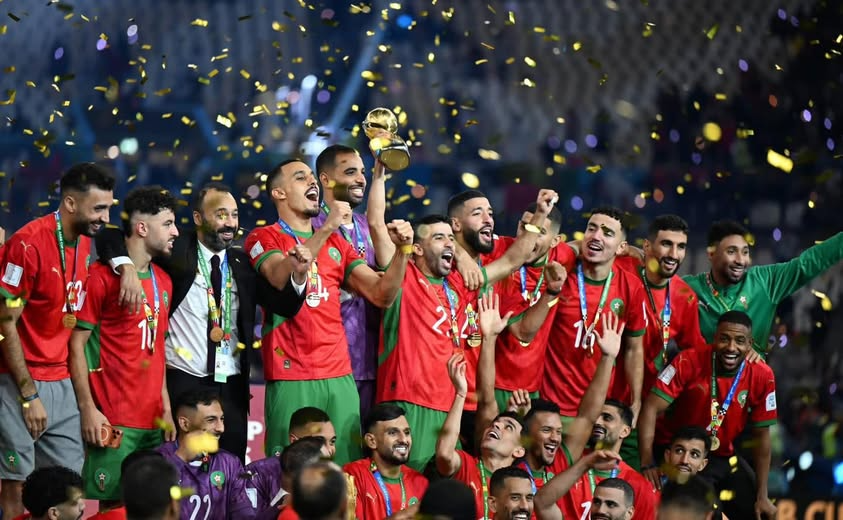
The current Morocco national team has arguably exceeded all previous accomplishments, establishing a new pinnacle in the nation’s football history. Their progression to the semi-finals of the 2022 FIFA World Cup in Qatar transcended national significance, earning continental and global recognition.
Under coach Walid Regragui’s leadership, this team defied expectations by defeating footballing titans including Belgium, Spain, and Portugal. They became the first African and Arab nation to reach the World Cup semi-finals, breaking long-standing barriers and inspiring millions worldwide.
Key Players of the Current Generation
The success of this squad is attributed to high-calibre talent, strong team cohesion, and effective tactical implementation. The majority of players are currently competing at the highest level in leading European leagues.
- Goalkeepers: Yassine Bounou (Bono) stands as the undisputed number one, whose crucial penalty saves and commanding presence were vital in Qatar. His experience and shot-stopping ability rank him among the world’s elite.
- Defenders: The defence is anchored by a formidable quartet. Achraf Hakimi is a world-class right-back renowned for blistering pace and attacking prowess. Central defenders Nayef Aguerd and veteran Romain Saïss form a robust partnership, delivering leadership and aerial dominance.
- Midfielders: The midfield is where the team truly excels. Sofyan Amrabat emerged as one of the tournament’s finest defensive midfielders, tirelessly breaking up play and controlling tempo. Azzedine Ounahi’s elegant dribbling and vision, combined with Selim Amallah’s industry, complete a dynamic and balanced trio.
- Forwards: The attack merges flair with clinical finishing. Hakim Ziyech provides creativity and a powerful left foot from the flank, while Sofiane Boufal’s dribbling can unlock any defence. Upfront, Youssef En-Nesyri poses an aerial threat and relentless pressure.
In addition to established players, the squad features emerging young talents who are expected to contribute to future campaigns. This combination of experience and youth supports a positive outlook for the team’s continued development, as outlined in the Morocco National Team Squad 2024: Full Player List and Analysis.
Coach Walid Regragui’s Impact and Philosophy
Coach Walid Regragui has played a pivotal role in the team’s recent achievements. Appointed only months before the World Cup, he fostered belief, unity, and tactical discipline within the squad. His philosophy, summarized by the phrase “Dima Maghrib” (Always Morocco), emphasizes collective effort, defensive organization, and rapid attacking transitions.

Regragui’s pragmatic approach, based on a solid defensive structure and effective counter-attacking, proved highly effective against higher-ranked opponents. His ability to foster unity among players from diverse backgrounds contributed to a cohesive team dynamic. Further insights into his vision are provided in Decoding the Morocco National Team’s Preferred Starting XI.
Squad Depth and Sustainability
Exceptional squad depth is a defining characteristic of elite teams, and the current Morocco side demonstrates this quality. Beyond the starting eleven, players such as Abdessamad Ezzalzouli, Zakaria Aboukhlal, and Abdelhamid Sabiri provide effective alternatives capable of impacting matches. This depth facilitates tactical flexibility and consistent performance throughout demanding tournaments.
The ongoing development of these players, combined with the emergence of new talents, indicates that the current era is likely to represent a sustained period of competitiveness. Strategic investment in youth development within Morocco further supports this perspective, helping to maintain the strength and depth of the national squad.
Comparing Eras: Distinguishing Strengths
Each “Golden Generation” has contributed uniquely to the nation’s football history, yet distinct differences set the current squad apart from its predecessors.
Tactical Evolution and Global Exposure
Football has transformed dramatically since the 1970s and 1980s. Modern play demands sophisticated tactical awareness, superior physical conditioning, and mental resilience. The current squad benefits from players developed almost exclusively in top European leagues, exposed to the sport’s highest standards from an early age.
This extensive global exposure has accustomed current players to high-pressure environments, advanced training methods, and a variety of tactical systems. Although previous generations included European-based players, the current squad benefits from a greater number and higher competitive level of leagues, resulting in a distinct developmental advantage and improved collective understanding.
Mental Resilience and Collective Spirit
The “Dima Maghrib” ethos promoted by Regragui was evident during the 2022 World Cup. The team’s strong belief, resilience under pressure, and unity were consistently demonstrated throughout the tournament. Their collective commitment to each other, the coach, and the nation was apparent in their performances.
While previous teams demonstrated patriotism and determination, the current squad’s consistent ability to overcome adversity, maintain composure against highly ranked opponents, and achieve unprecedented results at the highest level of competition reflects exceptional collective mental strength. Their campaign represents a significant milestone in the nation’s sporting heritage.
Achievements and Historic Milestones
The most significant distinction lies in the achievement itself. Reaching the World Cup semi-finals represents a landmark accomplishment that no other African or Arab nation has ever attained. This surpasses the 1986 Round of 16 finish and the 1998 near miss in both global impact and final placement.
Victories over Spain and Portugal, both former world champions and prominent European teams, were not isolated upsets but rather demonstrations of tactical proficiency and confidence. This sustained success against elite opposition distinguishes the current generation within the context of Moroccan football history.
The Definitive Golden Generation?
Taking into account historical context, player quality, tactical execution, and the unprecedented achievement of reaching the 2022 World Cup semi-finals, the current Morocco squad can be recognized as the nation’s definitive “Golden Generation.”
While the 1986 team broke new ground and inspired widespread admiration, and the 1998 squad demonstrated considerable talent, the current generation has advanced Moroccan football to unprecedented levels. They have not only competed with the world’s leading teams but have also achieved victories at a stage previously considered unattainable.
The team’s success is attributable not only to individual talent but also to a unified ethos, tactical proficiency, and strong national pride that has resonated internationally. The integration of experienced leaders such as Bono and Ziyech with emerging talents like Ounahi and Hakimi supports the prospect of continued competitiveness in the future.
The legacy of the 2022 squad is expected to inspire future generations of Moroccan footballers, contributing to the ongoing development of talent within the country. By achieving unprecedented success, this team has established itself as the most accomplished and influential generation in the history of the Morocco national team.
FAQ
What is considered the “Golden Generation” in Morocco’s national team history before the current squad?
The Morocco national team of the mid-1980s, particularly the squad that reached the Round of 16 at the 1986 FIFA World Cup, is widely considered the “Golden Generation” before the current era. They were the first African and Arab team to achieve this feat.
Who were some key players of the 1986 Morocco national team?
Key players from the 1986 squad included legendary goalkeeper Badou Zaki, creative midfielder Mohammed Timoumi, dynamic forward Aziz Bouderbala, and goal-scorer Merry Krimau. Their collective talent and team spirit were instrumental in their historic run.
What makes the current Morocco national team squad stand out in football history?
The current squad stands out by becoming the first African and Arab nation to reach the FIFA World Cup semi-finals in 2022. Their victories over top-ranked teams and their deep tournament run represent unprecedented achievements.
How does coach Walid Regragui’s philosophy contribute to the current team’s success?
Coach Walid Regragui’s philosophy emphasises collective unity, defensive solidity, and effective transitions. His ability to foster strong team spirit, instil belief, and implement a pragmatic yet effective tactical system has been crucial to the squad’s historic performances.
Which players are considered the pillars of the current Morocco national team?
The pillars include goalkeeper Yassine Bounou, defenders Achraf Hakimi and Romain Saïss, midfielders Sofyan Amrabat and Azzedine Ounahi, and attackers Hakim Ziyech and Youssef En-Nesyri. These players form the core of the squad’s success.